






+18 - Check if the casino you want to register with is eligible in your country.
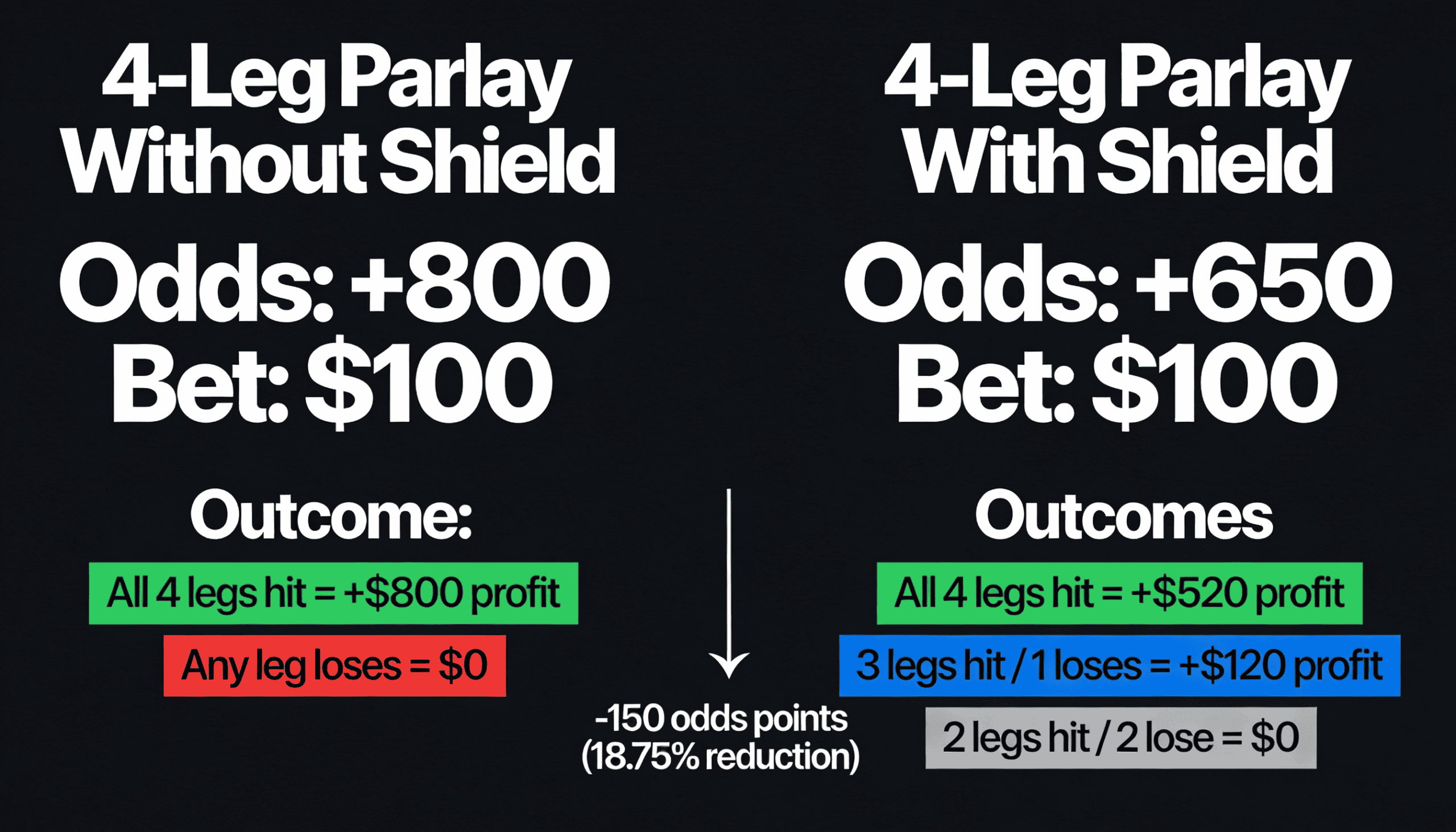
Stake Shield is a flexible payout structure on multi-leg bets that pays you partial winnings if some legs lose. The core cost: your odds reduce across all legs from the moment you activate it.
Here’s how it works in practice. You build a multi-leg parlay (also called an accumulator) with 3 or more selections. Without Shield, it's all-or-nothing: hit all legs and you win big, lose any leg and you get zero. With Shield activated, the sportsbook pre-calculates payouts for every partial-win scenario. Hit 4 out of 5 legs? You're not walking away empty-handed. You get a pre-determined payout, lower than if all 5 hit, but real money back.
The catch is real. To give you that partial protection, Stake reduces your odds on every single leg. You won’t see this as a flat fee. Instead, when you toggle Shield on in your betslip, your combined parlay odds drop visibly. A 5-leg parlay that would pay +2,200 without Shield might drop to +1,400 with Shield. That’s the cost of protection.
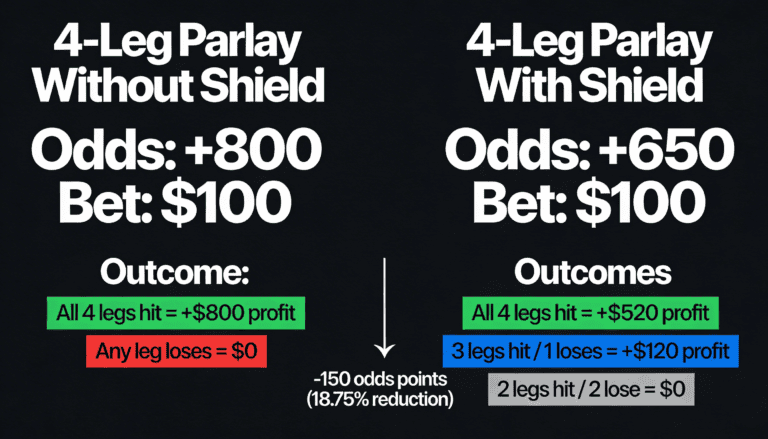
| Scenario | Without Shield | With Shield |
|---|---|---|
| Parlay Odds | +800 | +650 |
| Your Bet | $100 | $100 |
| All 4 Legs Hit | +$800 profit | +$520 profit |
| 3 Legs Hit, 1 Loses | $0 (total loss) | +$120 profit (partial payout) |
| 2 Legs Hit, 2 Lose | $0 (total loss) | $0 (no payout) |
The key difference: with Shield, you trade 150 odds points (the drop from +800 to +650) to get paid on partial wins. Without Shield, you’re betting for the full parlay. One leg dies, you lose everything. With Shield, you have a safety net, but you sacrifice winnings on the parlays you actually complete.
Shield doesn’t just reduce the final odds. It cuts odds on each individual leg proportionally. Here’s the truth: your odds get chopped across the board, not just at the end.
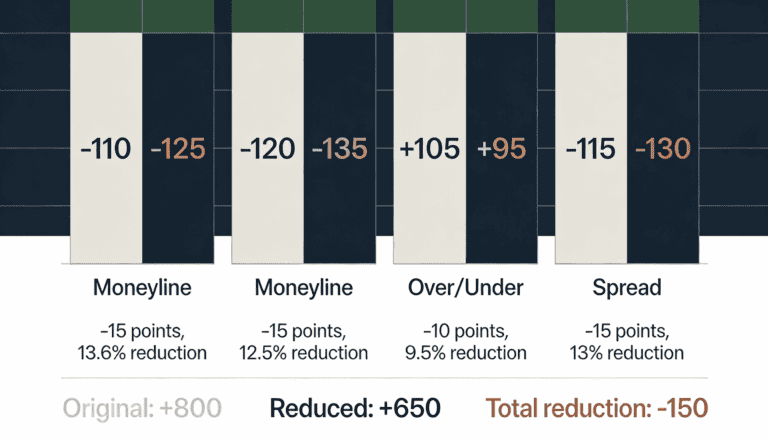
Example: you’re building a 4-leg parlay from these legs: -110 moneyline, -120 moneyline, +105 over/under, -115 spread. Without Shield, these combine into +800 odds. With Shield, Stake reduces each leg slightly so the combined odds drop to +650. The reduction is proportional across all four legs.
| Leg | Without Shield | With Shield | Reduction |
|---|---|---|---|
| Leg 1 (Moneyline) | -110 | -125 | -15 points |
| Leg 2 (Moneyline) | -120 | -135 | -15 points |
| Leg 3 (Over/Under) | +105 | +95 | -10 points |
| Leg 4 (Spread) | -115 | -130 | -15 points |
| Combined | +800 | +650 | -150 points |
This is why Shield feels like a hidden cost. You see the reduction at the end (your final odds drop), but the mechanism is spread across all your legs. You’re not losing 150 odds points at once. You’re losing small amounts on each selection, which adds up.
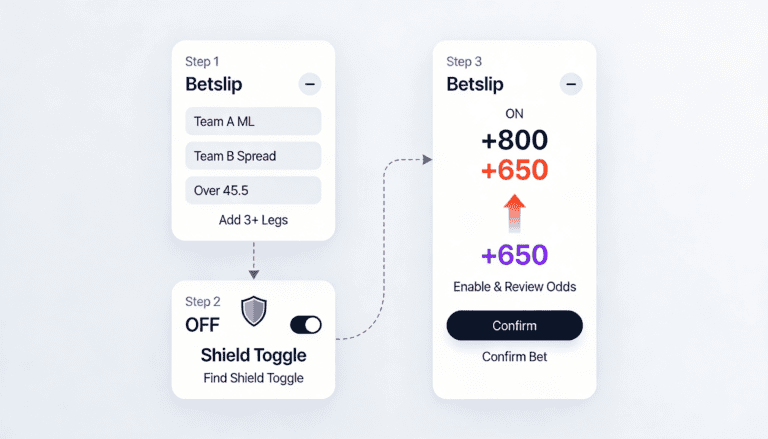
Activating Stake Shield takes about 2 seconds: add 3 or more legs to your betslip, toggle the Shield button on before confirming the bet. Done. But you need to know the eligibility rules first because Shield doesn’t show on every bet type.
Add at least 3 selections to your betslip. Shield doesn’t work on single bets or system bets, only on accumulators (parlays). If you have 2 legs, Shield won’t show. If you have 3 or more, you’re eligible. Don’t sleep on this detail: many players look for Shield and can’t find it because they only have 2 legs selected.
After you add your third leg, a Shield toggle will appear below the odds display in your betslip. It looks like a shield icon next to an on/off switch. If you don’t see it, check: Do you have 3+ legs? Are you in a supported region? Is Shield enabled on your account?
Click the toggle to turn Shield on. Your odds will update immediately. They’ll drop. The betslip will show your new combined odds and the new payout if all legs hit. Don’t skip this step. Always check the reduced odds before confirming. Sometimes the odds reduction is steep enough that Shield doesn’t feel worth it for your bet amount.
Click Confirm Bet. Your bet is now protected. If you win all legs, you get the reduced odds payout. If you lose legs, you’ll see a partial payout (if eligible for that scenario).
Shield ROI depends entirely on your win rate. If you lose 1 leg on 5-leg parlays often, Shield’s partial payouts outperform all-or-nothing bets. If you nail 95% of your parlays, the odds reduction costs you more than you save. The reality is somewhere in the middle for most players.
Here’s what competitors won’t tell you: Shield is not always the right choice. It has losing scenarios. We’re going to show you all three.
This is the Shield sweet spot. Let’s say you build 5-leg parlays at -110 per leg and bet $100 on each. Without Shield, your combined odds are around +2,200. All 5 legs hit and you win $2,200. Any leg loses and you get zero.
But you’re a realistic bettor. On your last 10 five-leg parlays, you hit 4 legs and lost 1 on 7 of those bets. That means 7 losing sessions for you (7 times zero). With Shield activated on the same parlays, your odds drop to around +1,400. All 5 legs hit and you win $1,400 (that’s $800 less than without Shield). But here’s the flip side: when you hit 4 legs and lose 1, Shield pays you a pre-calculated partial payout of around $400.
Cost of Shield this session: $800 in lost winnings on the one parlay you completed. Savings from Shield: $400 times 7 losing parlays equals $2,800. Net gain: $2,000. Shield profited you.
If this is your typical bet pattern, Shield is a net win.
You’re a sharpshooter. You research hard. Your 5-leg parlay hit rate is 90%. Without Shield, you hit all 5 legs on 9 out of 10 bets and get +$2,200 profit per win. That’s $19,800 profit across 10 bets. One parlay loses completely, you lose $100 (your stake).
With Shield, you hit all 5 legs on 9 out of 10 bets and get +$1,400 profit per win (that’s $800 less). Nine wins times $1,400 equals $12,600. Your one losing parlay still loses $100. Total profit: $12,500 minus $100 equals $12,400. Shield cost you $7,400 in profit across 10 bets.
If you’re a sharpshooter with a 90%+ hit rate, Shield is a drag on ROI.
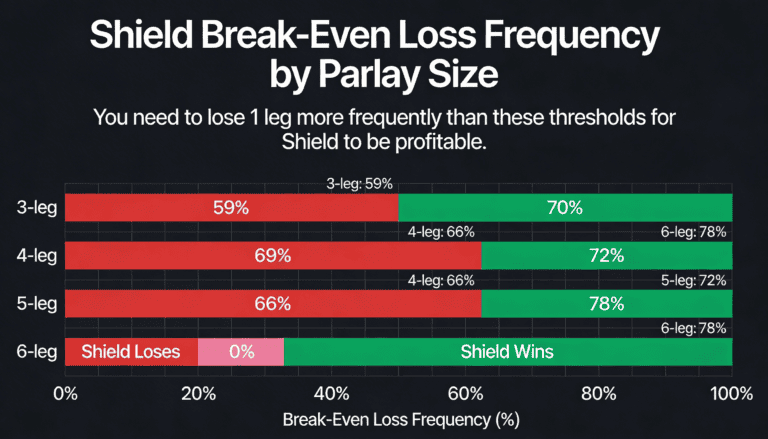
| Parlay Legs | Odds Reduction Cost | Partial Payout (1-Leg Loss) | Break-Even Loss Frequency |
|---|---|---|---|
| 3-Leg at -110 | $124 | $85 | Must lose 1 leg on 59%+ of bets |
| 4-Leg at -110 | $356 | $180 | Must lose 1 leg on 66%+ of bets |
| 5-Leg at -110 | $1,092 | $420 | Must lose 1 leg on 72%+ of bets |
| 6-Leg at -110 | $3,248 | $900 | Must lose 1 leg on 78%+ of bets |
To justify Shield, your break-even win rate is above these numbers. Calculate your actual loss rate on parlays over the last 30 days. Count how many times you lost exactly 1 leg on a multi-leg parlay. Divide that by your total parlay count. If your percentage is higher than the break-even number in the table, Shield is a win for you. If it’s lower, skip it.
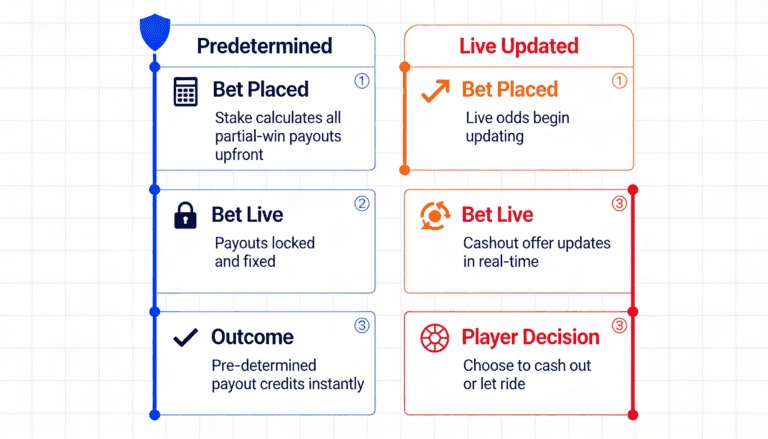
Shield is automatic partial protection based on a fixed payout structure. Cashout lets you exit a bet manually before results close and take whatever odds-based payout is live. Shield is passive. Cashout is active. Here’s the truth: they’re not the same.
When you activate Shield, Stake calculates all possible partial-win payouts upfront and locks them in. If 4 of your 5 legs hit, you get the pre-set payout for the “4-leg partial” scenario. You can’t negotiate. You can’t wait to see if odds move in your favor. It’s fixed from the moment you confirm your bet. Shield is set-it-and-forget-it protection.
Cashout lets you close your bet early and take the current odds-based payout. Your 5-leg parlay is live. Three legs hit, two are pending. You see a live cashout offer based on what the remaining two legs are priced at right now. You decide: take it or let it ride. No protection. Just an exit hatch. The payout is dynamic and changes as markets move.
| Feature | Shield | Cashout | Winner for Your Style |
|---|---|---|---|
| Protection Type | Automatic on all eligible partial-win scenarios | Manual exit, you initiate | Shield if you want passive protection. Cashout if you want control. |
| Payout Timing | Pre-calculated before bet is live | Dynamic, changes in real-time | Shield if you value certainty. Cashout if you want to react. |
| Flexibility | None. Fixed payout for each scenario. | Full. You choose when to cash out. | Cashout if you’re a decision-maker. Shield if you prefer no decisions. |
| Best For | Players who lose 1 leg frequently and want guaranteed payouts | Players who want to lock in profits or exit losers early | Use both. Shield for protection upfront. Cashout for live flexibility. |
Don’t confuse them. Shield is a payout structure you set when placing the bet. Cashout is a live exit option you use during the bet. They solve different problems.
Acca insurance refunds your stake if you lose by one leg. Shield pays you a reduced payout even if you lose multiple legs. They’re different animals.
Traditional acca insurance is simple. You bet $100 on a 5-leg accumulator. You lose 1 leg and lose the other 4. Traditional insurance refunds your $100 stake. You break even. That’s it. No payout on the 4 legs that hit. You’re back to square one.
Shield doesn’t refund your stake. Instead, it pays you a pre-calculated payout even though only 4 legs hit. Example: $100 bet on a 5-leg parlay with Shield. You lose 1 leg. Shield pays you $420. You made profit, not just broke even. But Shield cost you odds from the start. Traditional insurance typically costs a flat fee (like 5% of your bet) or a small odds reduction.
| Feature | Traditional Insurance | Stake Shield |
|---|---|---|
| What Triggers Payout | Lose exactly 1 leg (sometimes only on 4-5+ leg bets) | Lose any number of legs (but payout depends on how many hit) |
| Your Payout | Stake refund (break even). No profit on winning legs. | Partial win payout (actual profit). Amount depends on how many legs hit. |
| Cost | Flat fee (e.g., 5% of stake) or small odds reduction | Odds reduction on all legs (15-30% on multi-leg bets) |
| Best For | Players who want simple break-even protection. Rare situation. | Players who want actual profit even on partial wins and value bigger payouts than insurance stake refund. |
Shield is more generous if you lose because you’re getting profit, not just your money back. But it costs you more upfront in odds reduction. Traditional insurance is cheaper but only protects you if you lose exactly one leg. Choose based on whether you want passive profit (Shield) or stake protection (Insurance).
Stake Shield is a legitimate feature on Stake.com, a licensed platform under Curacao Gaming Authority. It’s not insurance fraud. It’s a payout structure. But players often debate if the odds reduction is worth the partial protection, and that debate is fair.
People worry it’s a scam. It’s not. The core mechanic is straightforward: you pay in odds reduction, you get partial payouts. That’s transparent. What some players argue is whether the trade is worth it, and that’s a strategy question, not a legitimacy question.
Stake.com is licensed under the Curacao Gaming Authority (CGA), which is a recognized gaming regulator for online betting platforms. Curacao licenses are not as strict as UK UKGC or Malta MGA licenses, but they’re legitimate. You can verify Stake’s license on the CGA registry. The company publishes its license information publicly on the Stake website.
On Reddit (r/sportsbook, r/Stake), players are split. Some love Shield for partial protection on big parlays. Others think the odds reduction is a hidden fee. One common complaint: “I’d rather lose everything or win everything, not split.” That feedback is fair. We’re not here to convince you Shield is ‘better’ than no Shield. We’re here to show you what it does and let you decide if it fits your strategy.
No hidden fees. Shield doesn’t charge a flat fee on top of your bet. The cost is the odds reduction, and you see it before you confirm. The betslip shows your original odds, the Shield toggle, and the new reduced odds. No surprise charges. No backend manipulation. Some players argue that “odds reduction equals hidden cost,” and they’re technically right (you lose potential winnings). But it’s disclosed upfront.
Yes. Verified by user reports across Trustpilot, Reddit, and Twitter. When players trigger partial-win scenarios (lose some legs, hit others), Stake credits the pre-calculated payout to their account. No disputes about this specific mechanic. The debate is purely whether the feature is worth the odds cost, not whether Stake cheats on payouts.
Shield doesn’t show on your betslip if you have fewer than 3 legs, your bet type is ineligible (system or single), or your region/account level isn’t supported. If your Shield toggle is missing or grayed out, here’s how to fix it.
Diagnosis: count your legs first. You need 3 or more. If you have 2 legs, add another selection. Second, check your bet type. System bets and single bets don’t support Shield. Only accumulators qualify. Third, some regions or account types might have Shield disabled.
If the toggle is grayed out, one of your legs might be ineligible. Some bet types (live bets, certain niche markets) aren’t supported by Shield. Solution: remove the live bet leg and replace it with a pre-game selection. Check that all legs are in major markets (moneyline, spread, over/under). Try toggling Shield again.
This isn’t a problem. It’s expected. When you activate Shield, odds drop noticeably, sometimes 15-20% on 5-leg parlays. This isn’t a bug. It’s the cost. If the new odds feel too low for your bankroll, toggle Shield off and go back to all-or-nothing odds. No penalty for changing your mind before confirming the bet.
Some regions, account levels, or account ages might not have Shield enabled yet. If you never see the toggle even with 3 or more legs, contact Stake support via live chat and ask: Is Shield available on my account? They’ll enable it or explain the restriction. Usually it’s a regional compliance reason.
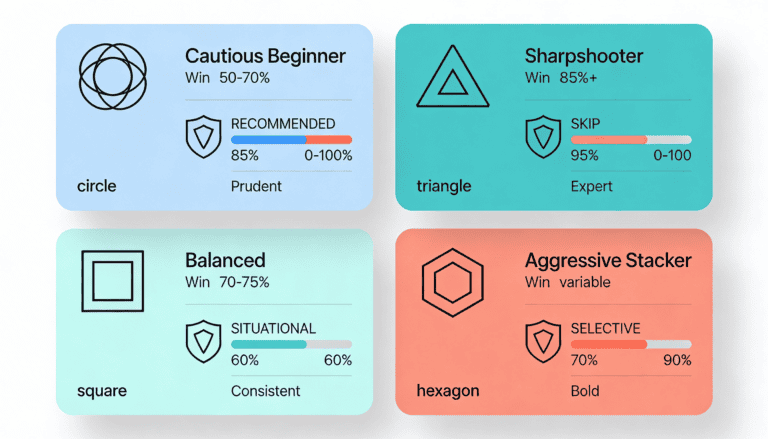
Use Shield if you lose legs frequently on multi-leg bets. Skip Shield if you win 85%+ of your parlays. Use Shield if you’re new to flexi betting and want insurance-like protection. Skip if you’re a sharpshooter who prefers all-or-nothing odds.
You’re new to multi-leg betting. You want some safety net but don’t want to feel like you wasted $50 if one leg dies. You’d rather get back $150 than $0. Shield is your friend. Use it on 4-5 leg parlays while you’re finding your edge. The odds reduction is worth the peace of mind as you learn.
Example: 4-leg parlay, $50 bet. Odds drop from +600 to +420. You lose 1 leg and get $80 back instead of $0. That’s real money that keeps your session alive.
You’ve been betting parlays for years. You win 85%+ of your 5-leg bets because you do serious research. You live for the big odds. Partial protection feels like a cap on upside. Skip Shield. The odds reduction will cost you more per session than you’d gain from rare partial wins. You’re playing to win, not to break even.
You hit 70-75% of your parlays. You have winning and losing streaks. Some days you nail 5-leg parlays. Other days 1-2 legs die. You’re flexible. Track your last 20 parlays. Calculate: how many times did you lose exactly 1 leg out of 3-5? If it’s more than 10%, Shield’s partial payouts are worth the odds cost. If it’s less than 10%, skip it. Test Shield on 2 bets and see if the partial payout rate feels right for your bankroll.
You stack 6, 7, even 8-leg parlays chasing huge odds for small stakes. One leg always dies. Shield is tempting, but here’s the truth: on 8-leg parlays, the odds reduction is brutal (30%+). However, you’re almost guaranteed to lose 1 or more legs. Use Shield on your 5-leg parlays (where protection feels worth it) but skip it on your 8-leggers (odds cut too deep). Best of both worlds.
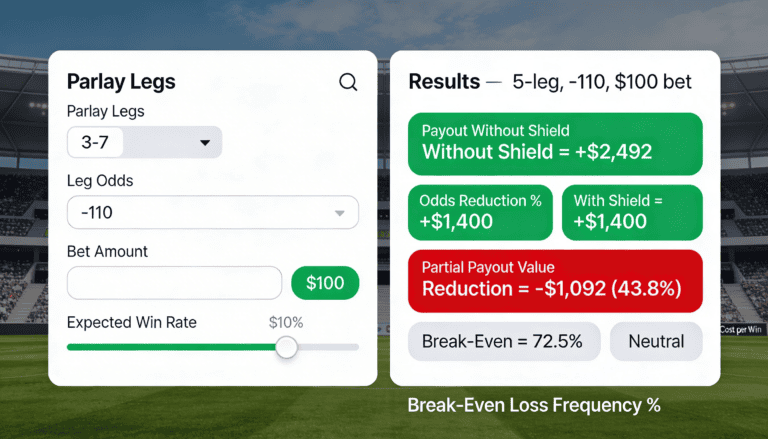
Plug in your leg odds, your bet amount, and your expected win rate. The calculator shows: potential payout without Shield, potential payout with Shield, and your break-even win rate. Here are 5 pre-built examples at standard -110 US parlay odds.
Without Shield: all 3 legs hit = +$364 payout | any leg loses = $0
With Shield: all 3 legs hit = +$240 payout | 2 legs hit = $85 partial payout
Cost of Shield on 3-leg: $124 in lost winnings. Gain if you lose 1 leg: $85. You need to lose 1 leg on more than 59% of your 3-leg parlays for Shield to break even.
Without Shield: all 4 legs hit = +$936 payout | any leg loses = $0
With Shield: all 4 legs hit = +$580 payout | 3 legs hit = $180 partial payout
Cost of Shield on 4-leg: $356 in lost winnings. Gain if you lose 1 leg: $180. You need to lose 1 leg on more than 66% of your 4-leg parlays for Shield to break even.
Without Shield: all 5 legs hit = +$2,492 payout | any leg loses = $0
With Shield: all 5 legs hit = +$1,400 payout | 4 legs hit = $420 partial payout
Cost of Shield on 5-leg: $1,092 in lost winnings. Gain if you lose 1 leg: $420. Break-even: you need to lose 1 leg on more than 72% of your 5-leg parlays. If your actual loss rate is higher, Shield is a net win.
Without Shield: all 6 legs hit = +$6,848 payout | any leg loses = $0
With Shield: all 6 legs hit = +$3,600 payout | 5 legs hit = $900 partial payout
Cost of Shield on 6-leg: $3,248 in lost winnings. Gain if you lose 1 leg: $900. Less attractive than 5-leg unless you’re a frequent 1-leg loser on 6-leg parlays.
Without Shield: all 7 legs hit = +$18,014 payout | any leg loses = $0
With Shield: all 7 legs hit = +$8,200 payout | 6 legs hit = $1,800 partial payout
Cost of Shield on 7-leg: $9,814 in lost winnings. Gain if you lose 1 leg: $1,800. Shield is less valuable on mega-parlays because the odds reduction is so steep. Reserve Shield for your 4-5 leg bets where the cost is lower relative to the partial payout value.
To calculate your own break-even point: Odds reduction cost equals the drop in payout when all legs hit (no Shield vs with Shield). Partial payout is what you get if 1 leg loses. Divide the cost by the partial payout. That’s your break-even loss frequency. Example: 4-leg parlay. Cost = $356. Partial payout = $180. Break-even = 356 divided by 180 = 1.98. You need to lose 1 leg on nearly 2 out of 3 of your 4-leg bets for Shield to pay for itself. Do the math for your situation.
Stake Shield is available in most regions (US, UK, Australia, Canada) but blocked in some jurisdictions (Netherlands, some US states). Minimum account level is typically Level 1. Regional licensing restrictions apply.
| Region | Shield Available | Account Level Required | Notes |
|---|---|---|---|
| United States | Yes (with exceptions) | Level 1 | Not available in NY, IL, or states where Stake doesn’t operate. Check your state on the Stake app. |
| United Kingdom | Yes | Level 2 (verification recommended) | Works on accumulators. Acca terminology applies. UKGC licensed. |
| Australia | Yes | Level 1 | Works on multi-bets with 3+ legs. Subject to AU gambling regulations. |
| Canada | Yes | Level 1 | Available on all major sports. Provincial restrictions may apply. |
| Netherlands | No | N/A | Blocked due to local gambling regulations. Not available to NL players. |
| Germany | No | N/A | Restricted by local law. Contact support for details. |
Stake Shield is available to most US players. Exception: some states where Stake doesn’t operate (like New York, Illinois) won’t see Shield. Account level required is typically Level 1 (basic verification). Tip: if you’re US-based and Shield doesn’t show, check if Stake is even available in your state via the Stake app or website geolocation tool.
Stake Shield is available to UK players. The feature applies to accumulators. Requires account verification (Level 2 recommended for safety). UK accumulators with 3 or more legs qualify. No special restrictions. Acca terminology applies here (accumulators instead of parlays).
Stake Shield works for Australian multi-bets with 3 or more legs. Subject to Australian gambling regulations. Account verification is required. Available on all major sports.
Netherlands, Germany, and some other European Union countries restrict Shield due to local gambling regulations. If you’re in a blocked region, you won’t see the toggle. Contact Stake support to confirm your location’s status.
Gambling involves risk. Never bet more than you can afford to lose. If you need support, visit BeGambleAware.org or contact a local helpline.
No. Shield only works on accumulators (multi-leg bets with 3 or more selections combined). Single bets and system bets are ineligible. You must activate Shield before confirming your bet. You can’t apply it retroactively to a live bet.
You get $0. Shield protects you only if at least some legs hit. If all legs lose, you lose your entire stake just like without Shield. This is why Shield is not traditional “insurance” in the sense of a stake refund. It’s partial-win protection.
No. Shield is set when you confirm your bet. Once live, you can’t toggle it off. You can only use cashout to exit early. Plan your Shield decision before you hit Confirm.
Most live bets aren’t eligible for Shield. Shield works best on pre-game parlays where odds are locked. If your betslip includes live bets, the Shield toggle may not appear or may be grayed out. Stick to pre-game selections for Shield eligibility.
No official minimum stated by Stake. Shield makes more sense on bets of $50 or more where the partial payout has real impact. On $5 bets, the math matters less. No hard limit enforced. It’s your decision.
Track your parlay results over 30 days. Count how many times you lost exactly 1 leg on 3-5 leg parlays. Divide that number by your total parlay bets. Compare the percentage to the break-even number in our Scenario 3 table above. If your loss rate is higher than break-even, Shield is a win for you. If it’s lower, skip it.
Stake can adjust Shield payout structures and odds reduction rates. Once you confirm a bet with Shield, your payouts are locked. But future bets may have different Shield terms. Check the odds and partial payout before every bet.
Yes. Activate Shield when placing the bet. If the bet goes live and you want to exit early, use Cashout during the event. They don’t conflict. Shield provides the baseline payouts. Cashout gives you a live exit option.
Shield is a payout structure, not a bonus. Bonus bets and free bets are promotional credits from Stake. Shield applies to your own money. You can activate Shield on a bonus bet, but Shield doesn’t change the bonus mechanics. Shield just changes your payout structure on that parlay.
Depends on your parlay size. Losing 2 legs on a 3-leg parlay = no payout. Losing 2 legs on a 5-leg parlay = partial payout (for hitting 3 legs). Check the Shield payout table in your betslip to see which partial-win scenarios get paid.

Secod has streamed and tested games on Stake extensively, giving him direct insight into the platform’s bonuses, features and gameplay conditions. His experience ensures every Stake review reflects real usage rather than surface level analysis.

© 2018-2026 bonustiime.com






Casiibro is currently offline.
Learn more about them on their channel!
▶ Visit Casiibro's channelOr head to the Stream Hub.