
Stake.com, a Curacao-licensed crypto casino founded in 2017, launched SlotGPT in 2025 as the first player-facing AI slot generator embedded directly inside a live wagering platform. Any registered player can type a text prompt and receive a fully playable, real-money slot game, no coding required, no studio contract, no six-figure development budget. That shift matters because it moves game authorship from a closed industry of a few hundred studios to a community of millions of players worldwide.
What Is SlotGPT? The AI Slot Creator on Stake.com Explained
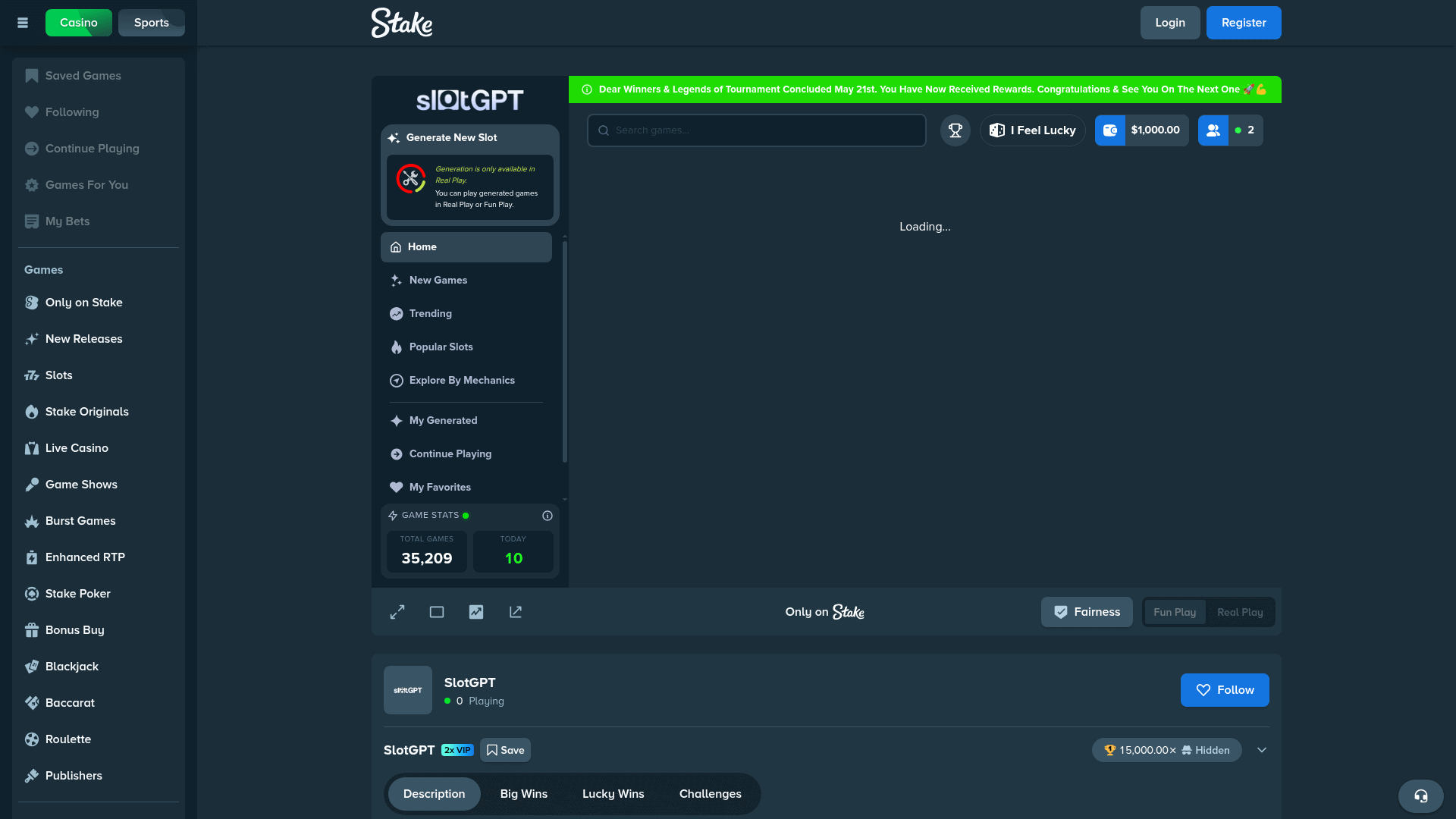
SlotGPT is Stake.com’s AI-powered tool that lets any registered player generate a fully playable slot game using a text prompt, with no coding, no design skills, and no development budget required. Launched in 2025 as Stake’s flagship differentiator, the feature sits inside the casino’s game library at stake.com/casino/games/slotgpt-slotgpt and is accessible directly from a player’s account dashboard. The player types a concept, the AI builds the symbols, background art, and base mechanics, and the result enters a moderation queue before publishing as a live, wagerable title on the platform.
The significance here is structural, not cosmetic. Before SlotGPT, every slot on a casino platform was produced by a licensed game studio, a process that typically costs hundreds of thousands of dollars and takes six to eighteen months per title. SlotGPT collapses that pipeline to a few minutes at effectively zero marginal cost per game. The community library grows with every approved creation, giving Stake a content volume advantage no traditional studio partnership can match at the same speed.
The Prompt-to-Playable-Slot Pipeline: How a Text Input Becomes a Real Game
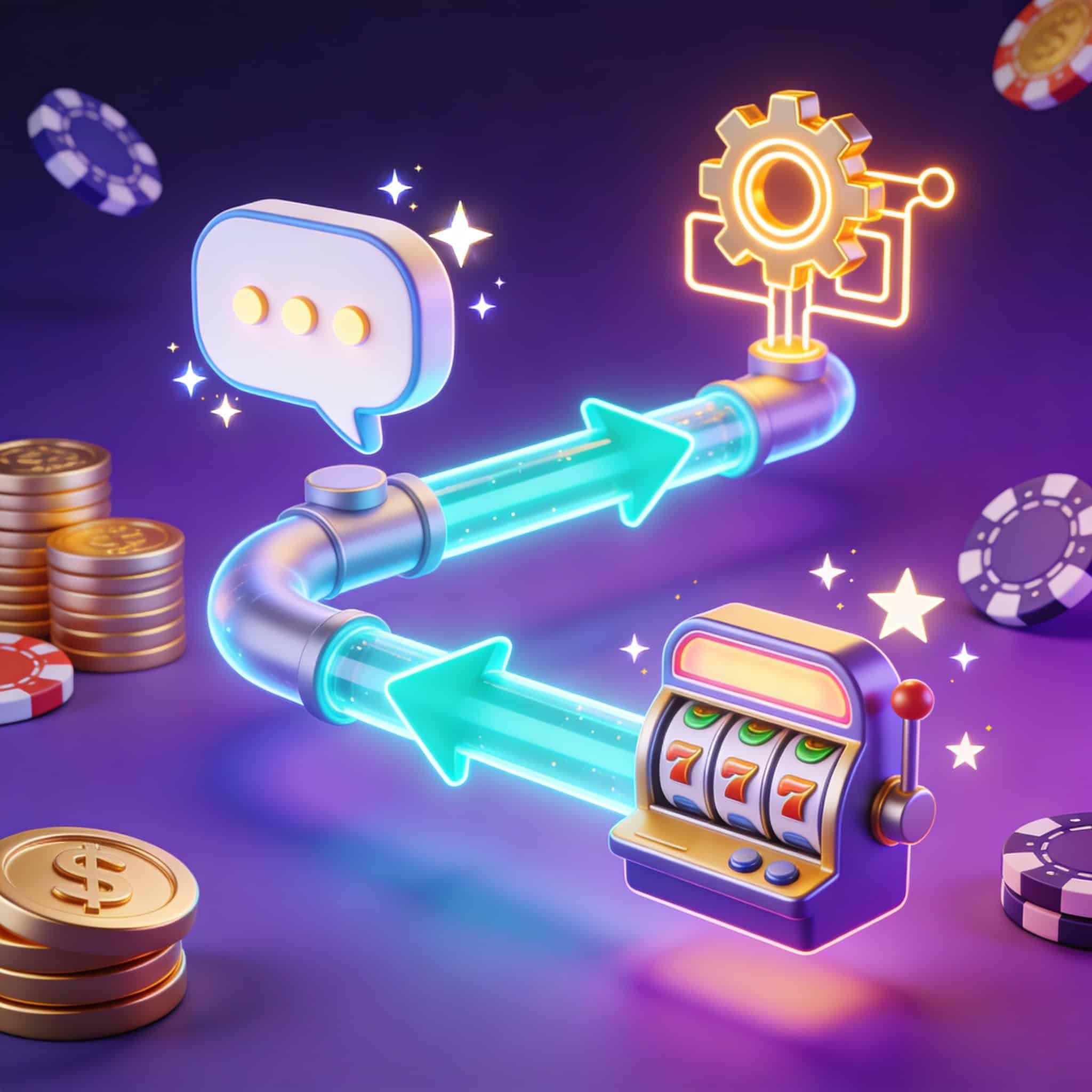
The pipeline has three distinct stages, each with a different actor doing the work. Understanding which stage controls what outcome is the key to using SlotGPT effectively.
Step 1: Writing Your Prompt and Selecting a Theme
The player writes a natural-language description of the slot concept. Theme, color palette, symbol set, and any specific mechanic preferences all belong here. A prompt like “deep-sea treasure hunt, bioluminescent jellyfish symbols, dark teal background, free spins triggered by an anglerfish scatter” gives the AI far more signal than “underwater slot.” Specificity is the single biggest quality lever available to the creator at this stage.
Step 2: AI Generation — What Happens Behind the Scenes
Once submitted, Stake’s AI engine interprets the prompt and generates the visual assets, symbol set, reel layout, and base mechanic structure. The process takes roughly three to five minutes per generation. The AI determines symbol weighting and payout distribution internally; the creator does not see or control those parameters. What the creator gets back is a visual preview of the game before it enters moderation.
Step 3: Moderation Review Before the Game Goes Live
Every generated slot passes through a human moderation review before it becomes playable. Moderators check for copyrighted characters, real-world brand names, offensive imagery, and any content that violates Stake’s platform guidelines. Games that clear review are published to the community library and become wagerable with real funds. Games that fail are rejected, and the generation attempt is consumed from the daily allowance.
What Makes SlotGPT Different from Standard Casino Game Releases
Standard casino game releases arrive via B2B licensing agreements between Stake and studios such as Pragmatic Play, Hacksaw Gaming, or Nolimit City. Those games are fully certified, carry published RTP figures, and have been tested by independent labs before going live. SlotGPT games are different in origin but not in house-edge governance: Stake applies its own RTP framework to every community-created title, so the math is controlled even when the creative direction is not. The distinction that matters to a player is authorship, not fairness architecture.
Who Can Use SlotGPT? Eligibility and Access Requirements
SlotGPT is available to registered Stake.com players who have completed the platform’s standard account verification process. Eligibility follows Stake’s jurisdictional restrictions, meaning players in blocked territories cannot access the feature regardless of account status. There is no VIP tier requirement or minimum wagering threshold to create slots. The daily generation cap of 55 attempts applies equally to all eligible accounts.
How SlotGPT Works: The Full Creation Process Step by Step
Players enter a text prompt describing their slot concept, the AI generates symbols, backgrounds, and mechanics, then Stake’s moderation team reviews the output before it becomes a live, wagerable game on the platform. The sequence from prompt submission to published game runs as follows:
- Log into your verified Stake.com account and navigate to the SlotGPT section of the casino library.
- Write a detailed text prompt covering theme, visual style, symbol ideas, and any mechanic preferences such as free spins or multiplier triggers.
- Submit the prompt. The AI engine processes the input and returns a generated game preview within approximately three to five minutes.
- Review the preview. If the output matches your intent, submit it for moderation. If not, refine the prompt and use another generation from your daily allowance.
- Wait for moderation review. Approved games are published to the community library and become playable for real money by any Stake player.
- Rejected games return a notification; the generation attempt is still counted against the daily cap.
Daily Creation Limits: Understanding Your 55 Generations
Each eligible player account receives 55 generation attempts per calendar day. The counter resets daily. Rejected generations count against the cap the same as approved ones, which makes prompt quality a resource management question, not just a creative one.
How to Prioritize Your Daily Generations for Best Results
Treat the first two or three attempts as drafts. Use them to test whether the AI interprets your core theme correctly, then refine the prompt based on the preview output before committing the remaining attempts to polished variations. Creators who front-load specificity in the initial prompt, naming exact colors, symbol counts, and mechanic triggers, consistently report fewer wasted generations than those who iterate from vague starting points.
What Happens When You Hit the Daily Cap
Once all 55 attempts are consumed, the creation interface locks until the daily reset. There is no paid bypass or premium tier that extends the cap, based on current platform documentation. Players who hit the cap mid-session should save their best prompt drafts externally so they can resume efficiently the following day without rebuilding the concept from scratch.
Prompt Strategy: What Inputs Produce the Most Distinctive Slots
Early community feedback, documented across Stake forums and player reports compiled by WorldPokerDeals at launch, confirms that vague prompts yield generic, visually repetitive outputs. The AI defaults to familiar slot tropes when given insufficient direction. Prompts that specify an unusual setting (a 1920s speakeasy, a Martian archaeological dig), a non-standard color palette, and at least one named mechanic trigger produce measurably more distinctive results. Avoid generic terms like “fantasy slot” or “lucky theme” without additional qualifiers. The more specific constraints you give the AI, the more it avoids falling back on defaults.
Early Community Creator Lessons: What Works and What Fails
Analysis of early player-created slots published on Stake reveals a clear pattern: the most-played community titles share three traits. They have a specific, non-generic theme that players have not seen in standard studio releases. They include at least one mechanic hook, typically a free spins trigger with a visual payoff. And they avoid the copyright traps that cause moderation rejection. The failure pattern is equally consistent: generic themes, stock-feeling symbol sets, and any prompt that references a real brand or character. Those rejections waste daily generations and produce nothing playable.
Stake’s Moderation Process: What Gets Approved and What Gets Rejected
Stake’s moderation team reviews every AI-generated slot before publication, rejecting content that includes real-world brand names, copyrighted characters, offensive imagery, or themes that violate platform guidelines. The review is human-led, not automated, which means turnaround time varies. Creators should treat moderation as a quality gate, not a rubber stamp. The practical implication is that a generation attempt is a two-part investment: the AI’s output quality and the moderation outcome are both uncertain until the review completes.
Themes and Elements That Trigger Automatic Rejection
Based on Stake’s published platform guidelines and early adopter reports, the following categories reliably trigger rejection:
- Real-world brand names, logos, or product references in any symbol or background element.
- Recognizable copyrighted characters from film, television, gaming, or sports franchises.
- Offensive imagery including hate symbols, graphic violence, or sexually explicit content.
- Themes that reference real individuals, living or deceased, without clear fictional framing.
- Content that mimics or parodies regulated financial products or government institutions.
Copyright and IP Risks: Why Using Real Brands in Prompts Is Dangerous
The risk is not just rejection. A prompt that generates an asset resembling a trademarked character, even unintentionally, creates a content liability for the platform. Stake’s moderation layer exists partly to catch these cases before they reach the live library. For creators, the practical rule is simple: if the theme requires a named brand or franchise to make sense, it will not pass moderation. Build original concepts. A “space pirate treasure hunt” is approvable. A “Star Wars cantina slot” is not.
How Long Moderation Takes and What Creators Can Expect
Moderation timelines are not published as a fixed SLA by Stake. Early community reports suggest review periods range from a few hours to over 24 hours depending on submission volume. Creators should not assume same-day publication. The practical workflow is to submit in the morning and check for approval status the following day. If a game is rejected, the notification typically includes a category reason, which helps creators adjust the prompt for a subsequent attempt.
RTP, Volatility, and Fairness: Who Controls the Math in SlotGPT Games
Stake controls the RTP (return-to-player percentage) and volatility parameters in all SlotGPT games; individual creators cannot set these values, meaning players wagering on community slots face the same house-edge framework as standard Stake originals. This is the most important fairness fact about SlotGPT. The creative layer, what the game looks like and how its bonus triggers are structured visually, is player-controlled. The mathematical layer, how much the game pays back over time and how frequently wins cluster, is Stake-controlled. Those two layers do not overlap.
For players deciding whether to wager on a community-created slot, this means the house edge is not an unknown variable. Stake applies its standard RTP framework, and the game’s math is governed by the same infrastructure as any other title in the library. The creator’s prompt influences aesthetics and surface mechanics, not payout probability. Players who understand how RTP works in online slots can apply that knowledge directly to SlotGPT games without adjustment.
What Bonus Mechanics Creators Can Configure vs. What the AI Decides
The creator-versus-AI split in mechanic control is more nuanced than a simple yes/no list. Here is the practical breakdown:
Configurable: Free Spins, Wilds, and Multiplier Triggers
Creators can specify in their prompt whether they want a free spins bonus round, wild symbol behavior (expanding, sticky, or standard), and multiplier triggers tied to specific scatter combinations. The AI attempts to implement these requests within the constraints of its generation model. Specifying these mechanics in the prompt increases the probability they appear in the output, but the AI does not guarantee exact implementation of every requested feature.
AI-Determined: Symbol Weighting and Payout Distribution
Symbol frequency on the reels, the probability weighting of each symbol, and the distribution of payout values across the paytable are all determined by the AI within Stake’s RTP framework. Creators have no input into these parameters. This is structurally identical to how a licensed studio game works: the studio designs the visual and mechanic layer, the math model is certified separately. SlotGPT replicates that separation, with the AI standing in for the studio’s math team.
Are SlotGPT Games Provably Fair? Verification and Transparency
Provably fair verification, a cryptographic method that lets players independently verify each spin outcome using a server seed, client seed, and nonce, is a feature Stake applies to its original in-house games. Whether every SlotGPT community game carries the same provably fair verification infrastructure is not explicitly confirmed in current platform documentation. Players who require provably fair verification for every wager should confirm the status of a specific community slot before wagering, rather than assuming it applies universally.
Real Money vs. Free Play: How Wagering Works on Community Slots
SlotGPT games published to the community library are wagerable with real funds, the same as any other game in Stake’s casino. There is no mandatory free-play mode before real-money wagering. Players can wager cryptocurrency or supported fiat currencies depending on their account setup and jurisdiction. The creator of a slot does not receive a share of wagers placed on their game, based on current platform terms. Creation is a creative act on this platform, not a revenue-share arrangement.
SlotGPT vs. Traditional Slot Development: Speed, Cost, and Industry Impact
Traditional slot development takes 6 to 18 months and costs hundreds of thousands of dollars per title; SlotGPT compresses that to roughly 3 to 5 minutes at near-zero marginal cost, fundamentally changing who can produce casino content. The comparison is not just about speed. It is about who holds the keys to the content pipeline.
Development Timeline Comparison: AI Generation vs. Studio Production
| Factor | Traditional Studio Development | SlotGPT AI Generation |
|---|---|---|
| Time to playable game | 6 to 18 months | 3 to 5 minutes |
| Cost per title | Hundreds of thousands of dollars | Near-zero marginal cost |
| Who creates the game | Licensed game studio team | Any registered Stake player |
| RTP certification | Independent lab certification required | Stake-controlled framework applied internally |
| Content moderation | Regulatory certification process | Stake human moderation review |
| Daily output potential | A few titles per year per studio | Thousands of player submissions per day |

What This Means for the Broader Online Casino Industry
The studio model is not disappearing. Certified, independently tested games from established providers carry regulatory weight that SlotGPT community titles currently do not. But SlotGPT signals a credible alternative content pipeline for platforms operating under their own licensing framework. If the model proves commercially durable at Stake, expect other crypto-native casinos to build similar tools. The studios most at risk are mid-tier providers whose competitive advantage was speed and volume rather than brand recognition or proprietary math models.
Beddie and Beyond: Stake’s Broader AI Ambitions in Online Casino
Beddie is Stake’s AI betting assistant, announced via the platform’s official Instagram in 2025, that extends Stake’s AI strategy beyond slot creation into autonomous wagering support, representing a wider vision of AI-native casino infrastructure that goes well beyond SlotGPT alone. Where SlotGPT puts creative tools in the player’s hands, Beddie is positioned as an AI agent that assists with or automates betting decisions. The two products address different parts of the player experience: creation versus execution.
What Beddie Does and How It Differs from SlotGPT
SlotGPT is a content creation tool. The player is the author; the AI is the production engine. Beddie, by contrast, is described as an agentic AI that operates on the wagering side of the platform, potentially placing or recommending bets based on player-defined parameters. The distinction matters for regulatory and responsible gambling reasons: an AI that creates games raises content questions, while an AI that places bets raises conduct and consumer protection questions. Beddie was still in early announcement phase as of mid-2025, with limited public detail on its final feature set.
Stake’s AI Roadmap: Where SlotGPT Fits in the Long-Term Strategy
SlotGPT is the first publicly deployed layer of what appears to be a multi-product AI strategy at Stake. The pattern, content creation first, then wagering assistance, suggests Stake is building toward a platform where AI touches every stage of the player journey. For players interested in best crypto casino bonuses and the broader Stake ecosystem, the AI roadmap is worth tracking because it will likely influence how promotions, game recommendations, and account features are structured over the next two to three years.
Responsible Gambling and AI-Generated Content: Safeguards on Stake
Stake applies its standard responsible gambling tools, including deposit limits, session timers, and self-exclusion, to SlotGPT games, and the moderation layer adds a content-safety filter specific to AI-generated casino material. The ease of creating and playing new slots does not change the underlying risk profile of wagering. Players who set deposit limits before engaging with SlotGPT games are applying the same protection that applies to any other title in the library.
Platform-Level Responsible Gambling Tools Available to All Players
Stake’s responsible gambling tools include deposit limits (daily, weekly, monthly), loss limits, session time reminders, cooling-off periods, and full self-exclusion. These tools are accessible from the account settings panel and apply across the entire platform, including community-created SlotGPT titles. Players who want to engage with responsible gambling tools can find the full suite documented in Stake’s responsible gambling policy section.
Content Moderation as a Responsible Gambling Mechanism
The moderation review that every SlotGPT game undergoes before publication serves a dual function. It is a content quality gate and a responsible gambling filter. Games that incorporate themes designed to exploit psychological vulnerabilities, or that reference real-world events in ways that could encourage impulsive wagering, are subject to rejection on content grounds. This layer does not replace player-level tools, but it adds a platform-level check that standard studio games do not require because their content is pre-certified through a different process.

Stake Promo Code: BonusTiime Exclusive Offer
New players registering on Stake.com can activate an exclusive welcome bonus by entering the BonusTiime promo code at registration. The promo code unlocks a deposit bonus that gives new players additional funds to explore the full casino library, including SlotGPT community games, Stake Originals, and the thousands of titles from licensed studio partners. Responsible gambling tools and support resources are available to all players at any time.
Here is how to claim the offer in four steps:
- Visit stake.com and click the registration button to create a new account.
- Complete the account verification process, including identity confirmation where required by your jurisdiction.
- Navigate to the promotions or bonus section of your account settings.
- Enter the BonusTiime promo code and make your qualifying deposit to activate the bonus.
The bonus applies to your initial deposit and credits additional wagering funds to your account. Wagering requirements and minimum deposit thresholds apply; review the full terms on Stake’s promotions page before depositing. Bonus funds can be used across the casino library, which means you can test SlotGPT community creations, Stake Originals, and licensed studio titles all within the same bonus balance.
One practical note: if you plan to use SlotGPT as a creator rather than just a player, the promo code bonus gives you a funded account to test your own published games once they clear moderation. That is a genuinely useful way to evaluate whether your prompt strategy is producing games with engaging mechanics before inviting others to wager on them.
For a full breakdown of Stake’s current promotions, reload bonuses, and rakeback structure, see the full Stake.com review on BonusTiime. The review covers the complete bonus architecture, funding methods, and game library depth in one place.
Frequently Asked Questions
What is SlotGPT on Stake.com?
SlotGPT is Stake.com’s AI-powered slot creation tool, launched in 2025, that lets any registered and verified player generate a fully playable casino slot game by entering a text prompt. No technical skills are required. Created games enter a moderation queue before going live as real-money wagerable titles.
How does SlotGPT work to create a slot game?
A player submits a natural-language text prompt describing the slot’s theme, visual style, and mechanic preferences. The AI generates symbols, backgrounds, and base mechanics in roughly three to five minutes. The output then undergoes human moderation review before being published to Stake’s community game library.
Is SlotGPT available to all Stake.com players?
SlotGPT is available to registered players who have completed Stake’s account verification process and are located in jurisdictions where Stake operates legally. There is no VIP tier or minimum wagering requirement to access the creation tool. Players in restricted territories cannot access the feature regardless of account status.
Can players create their own slot games with AI on Stake?
Yes. SlotGPT is specifically designed for player-created slots. Any eligible registered player can submit prompts and, once their game clears moderation, see it published as a live, wagerable title in Stake’s community library. The creator does not receive revenue from wagers placed on their game under current platform terms.
Are SlotGPT games played for real money or free play?
SlotGPT games published to the community library are wagerable with real funds, the same as any other game on Stake. There is no mandatory free-play mode. Players can wager cryptocurrency or supported fiat currencies depending on their account configuration and jurisdiction.
How many SlotGPT games have been created so far?
Stake has not published a running total of approved SlotGPT games as of mid-2025. Given the 55-generation daily cap per player and the size of Stake’s registered player base, the community library is growing rapidly. The exact published count is best checked directly on the SlotGPT section of stake.com, where the live library is displayed.
Does SlotGPT require any coding or technical skills?
No. SlotGPT requires only a text prompt written in plain language. The AI handles all asset generation, reel layout, and mechanic construction. The only skill that meaningfully improves output quality is prompt specificity, which is a writing discipline, not a technical one.
Are SlotGPT games moderated before they go live?
Yes. Every AI-generated slot undergoes a human moderation review before publication. Moderators check for copyrighted content, brand references, offensive imagery, and guideline violations. Games that fail review are rejected, and the generation attempt counts against the creator’s daily cap. Approved games are published to the live community library.
Who controls the RTP and volatility in SlotGPT games?
Stake controls all RTP and volatility parameters in SlotGPT games. Individual creators cannot set or adjust these values. The house-edge math is applied by Stake’s platform infrastructure, meaning community-created slots carry the same mathematical governance framework as standard Stake Originals and licensed studio titles.
What is Beddie and how does it relate to Stake’s AI features?
Beddie is Stake’s AI betting assistant, announced in 2025, designed to assist players with wagering decisions rather than game creation. Where SlotGPT is a content creation tool, Beddie operates on the wagering side of the platform. Together they represent Stake’s broader strategy of embedding AI across the full player experience, from game authorship to bet execution.
Sources
- WorldPokerDeals, “Stake Launches SlotGPT: DIY Slots Feature Announcement” — worldpokerdeals.com (2025)
- Tribuna Casino News, “Stake Launches SlotGPT AI Tool Letting Players Create Their Own Slot Games” — tribuna.com (December 26, 2025)
- Stake.com, “SlotGPT — Official Feature Page” — stake.com (2025)