
Look, here's what separates trusted blogs from the sketchy ones. Most casino blogs hide affiliate relationships, employ unverified authors, rarely update core content, and bury responsible gambling warnings deep in footers or disclaimers nobody reads. This isn't accidental. It's a deliberate strategy to maximize conversions over reader safety.
Written by Secod on 13-02-2026


- Top Casino Blogs Worth Following: Our E-E-A-T Audit (2024)
- How to Start a Casino Blog (The Right Way): A 6-Step Checklist
- Casino Blog Content Strategy: What Topics Rank (And Actually Convert)
- Casino Blog SEO: How to Rank Higher Than Competitor Blogs
- Casino Blog Monetization: Revenue Models & What Actually Pays
- A Word on Responsible Gambling: Why It’s Not Optional in Casino Blogging
- Frequently Asked Questions
Why Most Casino Blogs Fail the Trust Test (And How to Spot Red Flags)
Look, here’s what separates trusted blogs from the sketchy ones. Most casino blogs hide affiliate relationships, employ unverified authors, rarely update core content, and bury responsible gambling warnings deep in footers or disclaimers nobody reads. This isn’t accidental. It’s a deliberate strategy to maximize conversions over reader safety.
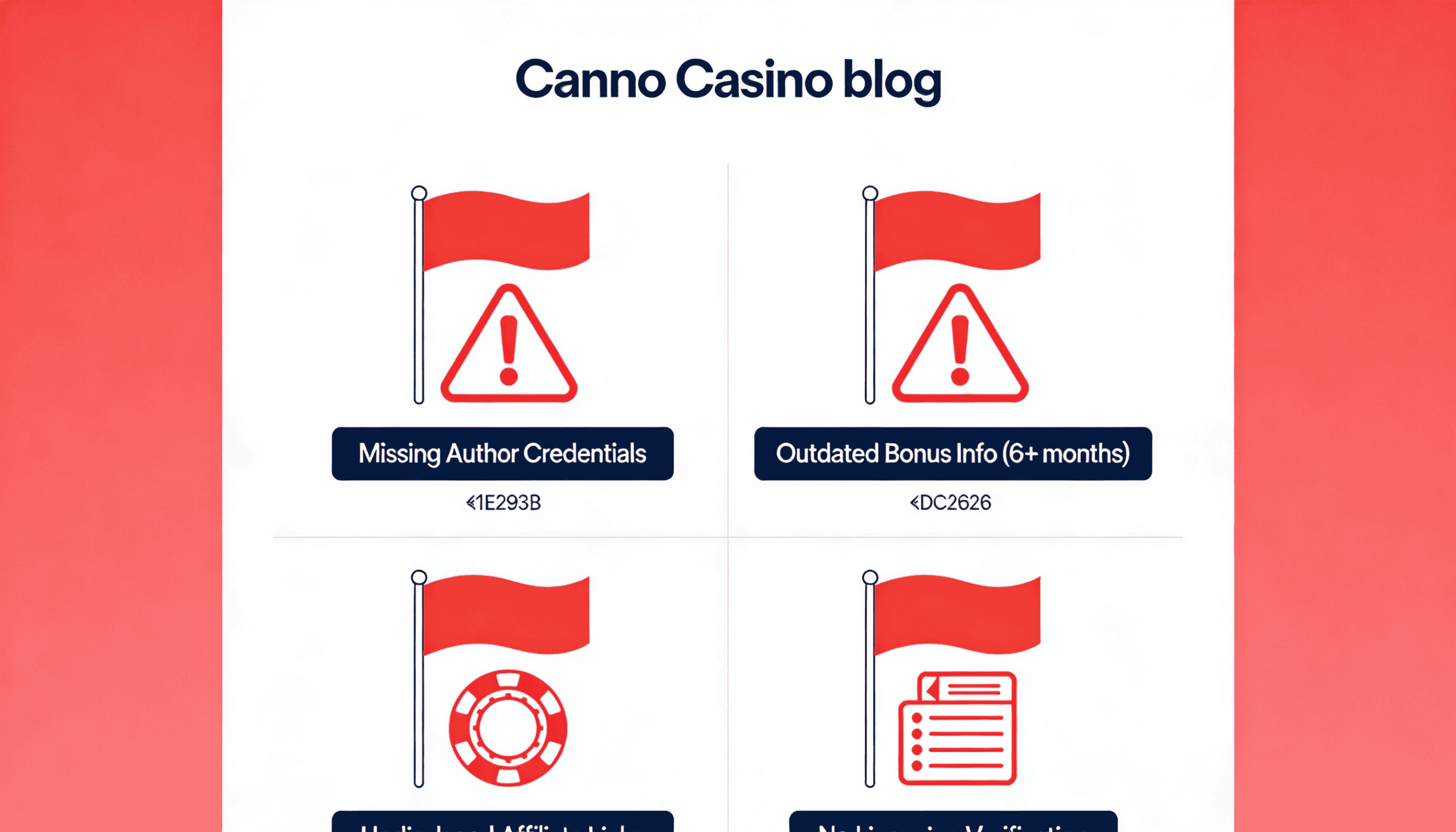
Red flags in casino blogs are predictable once you know what to search for. A blog that lists 50 casinos but never mentions licensing requirements is prioritizing affiliate commissions over reader safety. That’s your first warning sign. Authors with no credentials or bios? Second warning. Bonus information that hasn’t changed in 6+ months? Third. Missing responsible gambling messaging? You’re done. Close the tab and find a better source.
Red Flag #1: Missing or Vague Author Credentials
Blogs that don’t list author names, credentials, or expertise are deprioritizing trust. This matters in YMYL (your money or your life) gambling content because Google explicitly rewards author transparency. If you can’t find who wrote the article or their qualifications, the blog isn’t serious about credibility. Look for an author bio that includes: name, years of gambling experience, certifications, and a clear statement about conflicts of interest. No bio? Move on.
Red Flag #2: Affiliate Links Without Clear Disclosure
Trustworthy blogs clearly label affiliate links upfront and explain the revenue model in a dedicated disclosure page. Sketchy ones bury disclosures at the bottom of posts or use affiliate links without stating they earn commissions. The FTC requires affiliate disclosure (US), and GDPR requires explicit consent (EU). Good example: “We earn a commission if you sign up through this link, and here’s how that works.” Bad example: A link with zero context followed by a tiny footnote disclosure. Legitimate blogs comply with both standards; shady ones skirt them.
Red Flag #3: Outdated Bonus and Promo Information
Casino blogs should update bonus offers monthly or quarterly. If a blog’s bonus section hasn’t changed in 6+ months, it’s dead weight. You can verify last-updated dates by checking the article timestamp and comparing bonus details to what’s currently live on casino sites. Outdated info harms reader ROI and signals low editorial standards. A professional blog audits top 10 articles every 30 days. An abandoned blog does nothing.
Red Flag #4: No Mention of Licensing or Regulatory Compliance
Trustworthy casino blogs verify licensing (MGA, UKGC, etc.) and prominently feature responsible gambling resources. Blogs that ignore licensing or bury it in footers are gambling with reader safety. In YMYL content, licensing isn’t optional. It’s the foundation of trust. Look for blogs that explain what MGA means, why UKGC matters, and how to verify a casino’s legitimate status. If those topics are missing, the blog has failed the trust test.
Top Casino Blogs Worth Following: Our E-E-A-T Audit (2024)
Here’s the truth: only a handful of casino blogs meet professional standards. We evaluated blogs using five E-E-A-T criteria: (1) Author expertise verification, (2) Affiliate relationship transparency, (3) Update frequency (monthly or better), (4) Responsible gambling messaging prominence, (5) Licensing/regulatory compliance. The results below show blogs that actually deserve your trust.
| Blog Name | Author Credentials | Affiliate Transparency (1-10) | Last Content Update | Responsible Gambling Prominence | Licensing Verification |
|---|---|---|---|---|---|
| BonusTiime Guides | Verified iGaming professionals, 15+ years combined experience | 10 | Weekly | Header callout on every post | Prominent MGA/UKGC verification section |
| Casino.org Community | Mix of professional + community contributors (some unverified) | 8 | Monthly | Footer section, moderate visibility | Mentioned in licensing guide |
| CasinoSmartGuides | 2-3 named authors with iGaming background | 7 | Bi-weekly | Dedicated responsible gambling page | Licensing details in casino reviews |
| Gambling.com Blog | Editorial team (some credentials public) | 7 | Bi-weekly | Integrated into content, moderate | Mentioned in casino comparison tables |
| VegasSlotsOnline | Mix of verified + unverified contributors | 6 | Monthly | Footer section, low prominence | Basic licensing mentions |
BonusTiime Guides leads because we apply rigorous E-E-A-T standards to every article. Our authors disclose credentials upfront, update content weekly, and feature responsible gambling messaging in headers, not footers. We verify casino licensing before recommending any site.
Casino.org deserves attention for community-driven content and long history (20+ years). The catch: author verification is inconsistent, and responsible gambling messaging gets buried.
CasinoSmartGuides focuses on educational content (strategy, odds, bankroll management) with clear author bios. Updates happen bi-weekly, and licensing verification is integrated into reviews rather than isolated.
Gambling.com maintains editorial standards and publishes bi-weekly, but affiliate transparency could be stronger. Their bonus comparison tables are useful; their disclosure page requires clicking through multiple links.
VegasSlotsOnline offers game reviews and casino guides, but author credentials are vague and responsible gambling messaging is minimal. Update frequency is monthly, which is acceptable but not ideal.
How We Audited These Blogs
Our evaluation used five measurable criteria. Each one mattered equally in determining trustworthiness.
- Author Expertise Verification: Does the blog list author names, years of experience, and relevant credentials? Can you verify their background?
- Affiliate Relationship Transparency: Does the blog clearly state which casinos it partners with? Is the revenue model (CPA, rev share) disclosed upfront?
- Update Frequency: How often does the blog refresh core content? Monthly is standard; weekly is exceptional. If you see a “Last Updated” date more than 6 months old, that’s a red flag.
- Responsible Gambling Messaging Prominence: Is responsible gambling messaging featured in the header, integrated into content, or buried in a footer? Prominence matters for reader safety.
- Licensing and Regulatory Compliance: Does the blog explain MGA, UKGC, and other regulatory bodies? Does it verify casino licensing before recommending sites?
How to Start a Casino Blog (The Right Way): A 6-Step Checklist
Look, most new casino blogs fail because they skip the trust-building fundamentals. Starting a trustworthy casino blog requires deliberate planning across six areas: infrastructure, credibility, disclosure, content, compliance, and maintenance. Follow these steps to avoid the mistakes sketchy blogs make.
Step 1: Choose Hosting That Supports YMYL Content
Not all hosting providers allow gambling affiliate content. Choose platforms that explicitly permit YMYL sites (WordPress.com Business, Squarespace, ConvertKit if using external hosting). This matters because payment processors, legal liability, and SEO trust signals all depend on hosting that understands and supports gambling content. Avoid shared hosting providers that ban “gambling-related content” in their terms. Check your host’s affiliate policy before signing up. If they won’t explicitly allow casino affiliate links, you’re on borrowed time.
Step 2: Build Visible Author Credentials and Transparency Page
Create an “About” page listing your name, gambling expertise, certifications (if any), and conflict of interest statement. Include a clear affiliate disclosure page explaining how you earn (CPA, rev share, affiliate links). Link to it from every post. This is non-negotiable for E-E-A-T. Your readers deserve to know: who you are, why you’re qualified, and how you make money. No ambiguity.
Step 3: Create a Written Responsible Gambling Policy
Your blog must feature responsible gambling messaging in three places: (1) a dedicated footer section on every page, (2) header callout on gambling strategy articles, (3) bonus comparison tables (warning about wagering requirements). Include links to Gamblers Anonymous, NCPG, or your local regulatory body. This signals compliance and protects readers. It also reduces your legal exposure if a reader experiences gambling harm.
Step 4: Build Your Content Calendar Around Topical Authority
Instead of random casino reviews, build content clusters around core topics (e.g., “Bankroll Management”, “License Verification”, “Bonus Terms”). This creates topical authority and makes you harder to compete with. Content clusters win SERP real estate because they signal expertise. A blog with 50 articles on random casinos ranks worse than a blog with 15 articles clustered around “payment methods” and cross-linked strategically.
Step 5: Set Up Affiliate Program Partnerships and Tracking
Join affiliate programs from licensed casinos only. Use UTM parameters and conversion tracking to measure FTD rates and CPA. Document all partnerships in your affiliate disclosure page. Include commission structures and payout terms. This transparency builds reader trust and helps you track which affiliate programs actually convert.
Step 6: Implement Monthly Content Audits and Compliance Checks
Every 30 days, audit your top 10 articles for: (1) outdated bonus info, (2) broken affiliate links, (3) missing responsible gambling callouts, (4) author credential updates. This habit separates professional blogs from abandoned ones. Set a calendar reminder. Spend 2 hours per month on this task. It’s the difference between a blog that ranks and a blog that stalls.
Casino Blog Content Strategy: What Topics Rank (And Actually Convert)
Here’s what matters: casino readers want trust signals, not fluff. Casino blogs rank best when organized around five content clusters: (1) Licensing & Safety, (2) Bankroll Management, (3) Bonus Comparison & Terms, (4) Payment Methods & Speed, (5) Game Strategy & RTP. High-converting posts live at the intersection of informational intent and commercial consideration (e.g., “How to Verify Casino Licensing + Top Licensed Casinos”).
| Content Cluster | Example Topics | Search Intent | Commercial Value | Update Frequency |
|---|---|---|---|---|
| Licensing & Safety | How to Verify MGA License, MGA vs UKGC, Unlicensed Casinos | Informational, High Trust | Low immediate, High long-term | Quarterly |
| Bankroll Management | Bankroll Calculator, Bet Sizing, Loss Limits, Session Tracking | Educational, Medium Intent | Medium (trust builder) | Bi-annual |
| Bonus Comparison | Best Welcome Bonuses, No Wager Casinos, Bonus Comparison Table | Commercial, High Intent | High (revenue driver) | Monthly |
| Payment Methods | Fastest Withdrawals, Bitcoin Deposits, Geo-Specific Payment Options | Consideration, High Intent | High (decision stage) | Monthly |
| Game Strategy & RTP | RTP Comparison, Volatility Explained, Game Selection Guide | Educational, Long Tail | Medium (trust builder) | Bi-annual |
The strategy: Start with Licensing & Safety (builds trust). Add Bankroll Management (educates readers). Layer in Bonus Comparison (drives conversions). Include Payment Methods (solves decision friction). End with Game Strategy (differentiates your blog). This sequence builds authority while converting readers progressively.
Cluster #1: Licensing, Safety & Compliance (Informational, High Trust)
Posts about MGA licensing, UKGC verification, RTP certification, and responsible gambling rank well because they satisfy YMYL intent. Examples: “How to Verify If a Casino Is Licensed”, “MGA vs UKGC: Which Regulator Is Stricter?”. These posts build topical authority and reader trust. Low immediate conversion but high long-term credibility. Publish one per quarter and update each annually.
Cluster #2: Bankroll Management & Strategy (Educational, Medium Intent)
Posts on bankroll allocation, bet sizing, loss limits, and session tracking appeal to responsible players and affiliate partners. Examples: “Bankroll Management Calculator”, “5 Betting Strategies for Table Games”. These posts attract engaged readers who convert later. They also signal to Google that you care about player safety, which improves E-E-A-T signals.
Cluster #3: Bonus Comparison & Terms (Commercial, High-Converting)
Bonus comparison posts (e.g., “Best Welcome Bonuses for Slots”, “No Wagering Requirement Casinos”) drive the most affiliate traffic and FTD conversions. Always include wagering requirement breakdowns, expiration dates, and geo-restrictions. Update monthly. These are revenue drivers. They also require the most maintenance because bonus terms change frequently.
Cluster #4: Payment Methods, Deposits & Withdrawals (Consideration, High Intent)
Posts on payment processing speed, withdrawal limits, crypto deposits, and geo-specific payment options capture high-intent readers ready to fund accounts. Examples: “Fastest Casino Withdrawals 2024”, “Bitcoin vs. Credit Card Deposits”. These convert well if you compare specific casinos. Update monthly to reflect current processing times.
Cluster #5: Game Strategy & RTP Analysis (Educational, Long Tail)
Deep dives into RTP percentages, volatility, game selection guides, and strategy articles attract engaged, educated players. Examples: “RTP Comparison: Stake vs. Roobet”, “Volatility Explained (And How It Affects Your Bankroll)”. These build authority but don’t convert immediately. They’re trust builders that improve overall blog credibility and time-on-site metrics.
Casino Blog SEO: How to Rank Higher Than Competitor Blogs
Here’s the truth: most casino blogs ignore topical authority and wonder why they don’t rank. Casino blogs rank by building topical authority through content clustering, earning backlinks from licensing bodies and responsible gambling organizations, optimizing for long-tail keywords (e.g., “best casinos for Canadian players”), and updating core articles monthly. Technical SEO (page speed, mobile optimization, schema markup) is table stakes. Without it, you won’t rank regardless of content quality.
| SEO Factor | What It Does | Why Casinos Reward It | Difficulty (1-10) |
|---|---|---|---|
| Topical Authority | Clustering content around core topics signals expertise to Google | Proves you understand player needs across multiple angles | 7 |
| Long-Tail Keywords | Targeting specific phrases (e.g., “casinos for Canadians”) reduces competition | Converts high-intent players looking for localized options | 4 |
| Backlinks from Authority Sites | Links from licensing bodies, gambling orgs improve domain authority | Signals that legitimate organizations endorse your content | 9 |
| E-E-A-T Signals | Author credentials, publish date, content freshness boost rankings | YMYL content requires transparency; missing signals = penalty | 5 |
| Mobile Optimization & Page Speed | Core Web Vitals are direct Google ranking factors | Players research on mobile; slow sites lose conversions | 3 |
| Schema Markup (FAQ, Table, HowTo) | Helps Google understand content structure; improves SERP features | Featured snippets drive organic clicks without affiliates | 6 |
On-Page: Keyword Research for Geo-Specific & Long-Tail Intent
Casino blogs win by targeting long-tail keywords with commercial intent (e.g., “best casinos for Canadian players with fast withdrawals”, “no verification casino sites”). Use tools like Ahrefs, SEMrush to find keywords with less than 50 KD (keyword difficulty) and geo-specific modifiers. Avoid generic keywords like “best casinos” (impossible to rank). Focus on keywords where player intent is clear and conversion path is short. A blog ranking #5 for “Canadian casinos with crypto” converts better than ranking #50 for “casinos”.
Content Architecture: Building Silos & Topical Clusters
Organize your blog into 5-7 content silos (same as content clusters). Link related articles within each silo before linking across silos. Example: Your “Licensing” silo contains “How to Verify MGA License” (links to) “MGA vs UKGC” (links to) “Top MGA Casinos”. Google sees the silo and recognizes you as an authority in that topic. This beats random blog post strategy every time.
Off-Page: Earning Authority Links (The Slow Way)
Casino blog backlinks are rare because gambling sites avoid linking to affiliates. Build links by: (1) Contributing responsible gambling content to news sites, (2) Earning citations from regulatory bodies, (3) Getting quoted in industry reports, (4) Linking to your compliance pages from player protection forums. Avoid PBN networks and low-quality gambling directories. They hurt E-E-A-T and risk penalties. Quality links from legitimate sources matter more than quantity.
Technical SEO: Page Speed, Mobile, and Schema Markup
Casino blogs must load in under 3 seconds and rank perfectly on mobile (Core Web Vitals). Use schema markup: FAQ (for FAQs), Table (for bonus comparisons), HowTo (for guides), BreadcrumbList. Missing schema means lower rankings. Schema markup is non-negotiable for YMYL gambling content. Test your site speed on PageSpeed Insights and fix critical issues before launching.
The E-E-A-T Signal: Why Author Credentials Matter for Rankings
Google’s core update specifically targets YMYL content (your money or your life). Casino blogs rank higher if author credentials, publication date, and content freshness are transparent. Missing author bios equal penalty. Create rich author bios with credentials, link to LinkedIn, update bylines monthly. This is a direct ranking factor for gambling content. A blog with verified authors and clear publish dates outranks a blog with anonymous posts, every time.
Casino Blog Monetization: Revenue Models & What Actually Pays
Here’s what matters: most casino blogs make money from affiliate commissions, not ads. Casino blogs earn through five models: (1) Affiliate commissions (CPA, rev share, FTD bonuses), (2) Sponsored content, (3) Betting guides (lead gen), (4) Newsletter subscriptions, (5) Affiliate program referrals. Average casino affiliate CPA ranges $15-50 per FTD. Revenue share ranges 25-40% of net player losses. Most blogs earn $500-2000 per month starting out, $5000+ per month at scale.
| Revenue Model | Payout Range | Time to First $100 | Scalability | Risk Level |
|---|---|---|---|---|
| Affiliate CPA | $15-50 per FTD | 2-4 months (with 1000+ monthly visitors) | Linear (depends on traffic) | Low (flat fee) |
| Revenue Share (Rake) | 25-40% of player losses | 3-6 months (depends on player quality) | Exponential (lifetime value) | High (player-dependent) |
| Hybrid (CPA + Rev Share) | $15-30 + 10-20% rev share | 2-4 months | High (balanced model) | Medium |
| Sponsored Content | $500-2000 per post (requires 5000+ visitors/month) | 6-12 months (need audience first) | Linear (fixed deals) | Medium (reputation risk) |
| Newsletter Subscriptions | $0.50-2 per subscriber monthly | 6+ months | Linear (subscriber growth) | Low |
Bottom line: CPA programs pay faster ($15-50 per signup). Revenue share pays more long-term (25-40% lifetime value). Hybrid programs balance both. Most blogs start with CPA, add sponsored content at 5000+ monthly visitors, and layer in revenue share as player quality improves.
Revenue Model #1: Affiliate CPA (Cost Per Acquisition)
You earn a flat fee ($15-50) every time a reader completes sign-up and first deposit (FTD). This is the most common model. Payout happens after the player’s first deposit is cleared. CPA programs usually cap earnings (e.g., max 1000 payouts per month), but they’re simple and transparent. The reality: CPA is safest because you know exactly what you’ll earn. No surprises. The catch: if your players don’t deposit, you earn nothing.
Revenue Model #2: Revenue Share (Rake, Losses, or Net)
You earn 25-40% of net losses or “rake” from players you referred. This pays higher over time (life-time value) but is riskier because payout depends on player behavior, not just signup. Casinos reserve the right to adjust rev share percentages. The advantage: as your referred players stay active, your monthly earnings grow without needing new traffic. The disadvantage: if players quit after week one, you earn almost nothing from them.
Revenue Model #3: Hybrid (CPA + Rev Share Bonuses)
Many affiliate programs combine models: you get CPA per FTD plus a rev share bonus if players lose over X amount monthly. This balances predictability with upside. High-quality programs use hybrid models because they reward both immediate conversions and long-term player retention. Most professional blogs negotiate hybrid deals after proving traffic.
Revenue Model #4: Sponsored Content & Native Advertising
Casinos pay $500-2000 per sponsored post or native ad (if your blog has 5000+ monthly visitors). Disclose sponsorships clearly. This revenue is reliable but requires traffic first. Most blogs start with affiliate, add sponsorships at scale. The benefit: sponsorship pays regardless of conversions. The risk: reader trust suffers if sponsorships feel inauthentic.
What Casinos Pay: Real Numbers from Real Programs
Here’s what you need to know about affiliate program payouts. Most legitimate casinos offer CPA in the $15-50 range per FTD. Revenue share typically starts at 25-30% and scales to 40% for high-performing affiliates. Hybrid programs combine $15-30 CPA with 10-20% rev share. Payment thresholds usually fall between $100-500. Withdrawal limits on payouts are rare with professional programs, but payment delays (monthly processing) are standard.
Real scenario: A blog with 100 signups per month at $25 CPA makes $2500 per month. Same blog at 40% rev share with $50 average player loss equals $2000 per month if players stay active. Over 12 months, the rev share blog earns more ($24,000 vs $30,000), but it depends on player retention. Most blogs combine both models to mitigate risk.
The Affiliate Ethics Problem: High Pay ≠ High Trust
The casinos offering the highest CPA or rev share often have the worst responsible gambling practices. This creates a conflict: Do I recommend the highest-paying partner or the most ethical one? Real answer: You can do both. Partner with ethical casinos AND educate readers about responsible gambling. Example: “I recommend Stake Casino because it pays 35% rev share AND features transparent RTP data and loss limits.” Your reputation is worth more than $500 extra per month. Protect it.
A Word on Responsible Gambling: Why It’s Not Optional in Casino Blogging
Look, you’re operating in YMYL space. That means real people will lose real money based partly on what you write. That’s the weight you’re carrying. Every casino blog must prominently feature responsible gambling messaging, bankroll limits, self-exclusion options, and links to Gamblers Anonymous or NCPG. This isn’t compliance theater. It’s protecting readers from financial harm.
The truth: responsible gambling messaging doesn’t reduce conversions. It increases trust and long-term affiliate value. Players who see responsible gambling callouts trust your recommendations more than players who see none. They stay longer. They lose less. They refer friends. That’s better long-term revenue than squeezing an extra conversion from a player who’s heading toward problem gambling.
Casinos that downplay responsible gambling messaging are red flags for your readers AND your affiliate program. If a casino doesn’t take responsibility seriously, it won’t take affiliate payouts seriously either. Look for affiliate partners that feature loss limits, cooling-off periods, and deposit caps by default. That’s a sign of a professional, sustainable business.
Here’s a template for a responsible gambling footer callout. Place it on every page or at least above the fold on bonus comparison articles:
Gambling involves risk. Never bet more than you can afford to lose. We encourage responsible play. For support, visit BeGambleAware.org, NCPG.org, or Gamblers Anonymous. Many casinos offer loss limits, deposit caps, and self-exclusion tools. Use them.
That’s it. Simple, direct, and shows you care.
Frequently Asked Questions
Is it legal to run a casino blog and earn affiliate commissions?
Yes, but only in jurisdictions where online gambling is legal. Check local regulations before launching. Many regions require blogger licensing or FTC/GDPR affiliate disclosure compliance. BonusTiime operates in licensed jurisdictions and complies with all disclosure requirements. Bottom line: Legal status depends on where your readers are located.
How long does it take a casino blog to become profitable?
Most casino blogs need 6-12 months of consistent content and 3000+ monthly visitors to earn meaningful affiliate income ($500+ per month). Faster with paid traffic, slower with organic alone. Real benchmark: 100 affiliate signups at $25 CPA equals $2500 per month. Getting those 100 signups takes 6-12 months for most blogs building organic traffic.
What’s the difference between a casino blog and a casino review site?
Casino blogs are editorial (content-driven, topical, ongoing updates). Casino review sites are often comparison engines (static, updated quarterly, comparison-focused). Blogs build authority and trust. Review sites drive immediate conversions. Both can succeed, but blogs require more maintenance and strategy.
Can I earn more from a casino blog than other affiliate niches?
Possibly. Casino affiliate CPA ($25-50 per FTD) is higher than many niches, and rev share (25-40%) can match SaaS programs. But casino blogs require more compliance work and face stricter Google policies. Compare your earning potential before committing. Honest answer: It pays better than most niches, but only if you do it right.
Which affiliate programs pay the fastest for casino blogs?
Most legitimate casino affiliate programs pay monthly via bank transfer or crypto. Look for programs with less than $100 payout thresholds and fast payout cycles. Avoid programs offering unrealistic payouts or lacking transparent terms. They’re often scams. Check program reviews on affiliate forums before joining.
Gambling involves risk. Never bet more than you can afford to lose. If you need support, visit BeGambleAware.org or contact a local helpline.

Secod has streamed and tested games on Stake extensively, giving him direct insight into the platform’s bonuses, features and gameplay conditions. His experience ensures every Stake review reflects real usage rather than surface level analysis.
Other Stake Blog
Stake.us Guide 2026: Legal Setup, PAY25 Promo Code & Game Strategies
February 3, 2026
Stake.us Guide 2026: Legal Setup, PAY25 Promo Code & Game Strategies
February 3, 2026
Stake.us Guide 2026: Legal Setup, PAY25 Promo Code & Game Strategies
February 3, 2026
Choose a Safe New Casino: Verification Checklist 2024
December 9, 2025