
Stake Originals Strategy Guide: RTP, Provably Fair & Bankroll Math | BonusTiime
Here's the brutal truth: No strategy beats Stake Originals long-term. The math is stacked against you from the first spin. But that doesn't mean you should play blind. This guide breaks down the real numbers, shows you how to verify fairness yourself, and teaches you the only math that actually protects your money: bankroll discipline.
Written by Secod on 03-03-2026


- How to Verify Provably Fair Seeds (And Why This Matters for Your Edge)
- Bankroll Strategy: The Only Math That Actually Protects Your Money
- Plinko Strategy: Multiplier Chains vs. Standard Mode (Real Edge Analysis)
- Crash Strategy: Why Your Cashout Point Doesn’t Matter (Math Proof)
- Mines Strategy: No Patterns, No Edge, Only Variance Management
- Dice Strategy: Why Doubling Down Mathematically Guarantees Ruin
- Bonus Abuse + Stake Originals: How to Spot Untrue Claims
- Common Stake Originals Myths vs. Math Reality
- BonusTiime’s Protective Verdict: Should You Play Stake Originals?
- Frequently Asked Questions
What is RTP and Why It Kills Most Stake Originals Strategies
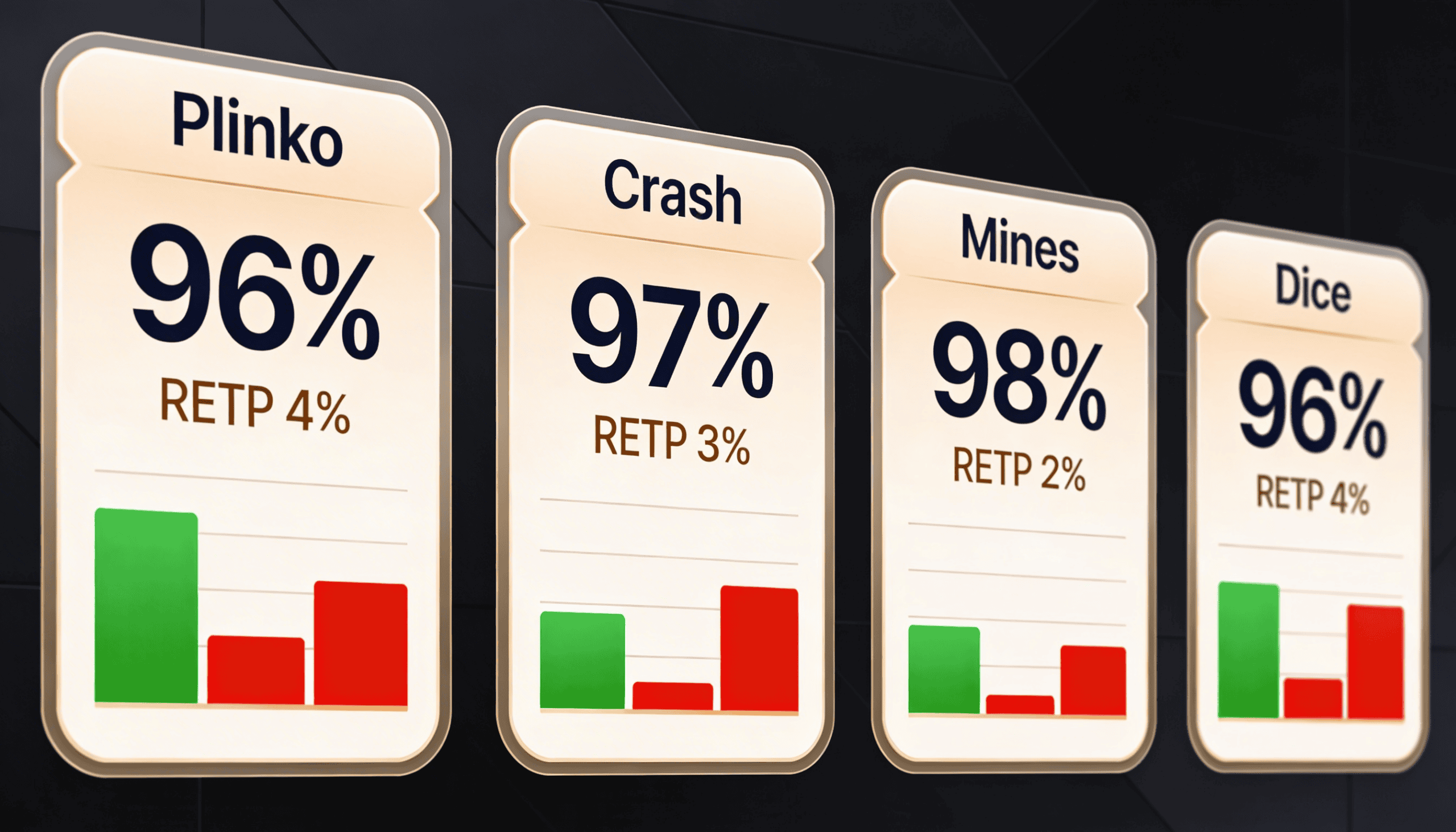
RTP (Return to Player) is the percentage of all bets a game returns to players over infinite spins. Stake Originals games show 95–98% RTP, meaning 2–5% house edge is baked in mathematically. No strategy beats this long-term. Here’s what that means in real money: At a $1,000 bet total on a 96% RTP game, you lose $40 on average over time. Variance can mask this for short sessions (short-term luck hides the truth). But the math always wins eventually.
Players still try to beat this because of what’s called the “illusion of control.” A Crash game feels like you can time your cashout. Plinko feels like there’s a pattern to the multiplier chains. Mines feels like you can predict where the mines are. None of this is true. Each round is independent. Each outcome is random. The house edge exists in every single game regardless of your strategy.
Plinko RTP Breakdown: 96% Standard, 99% Max Multiplier
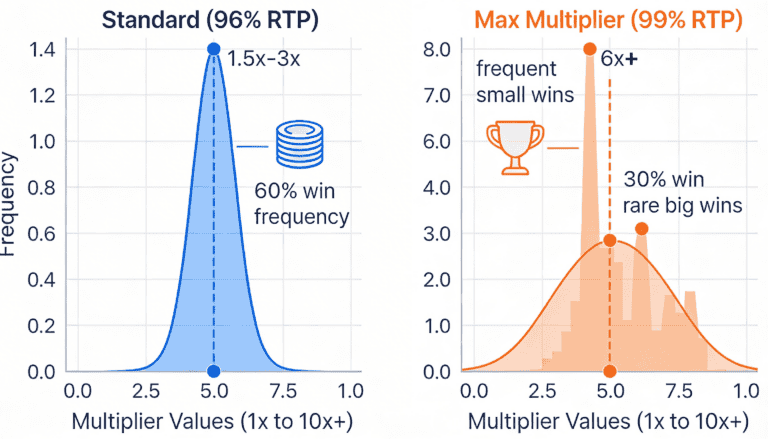
Stake offers two RTP tiers for Plinko. Standard mode sits at 96% RTP; Max Multiplier mode offers 99% RTP. Here’s the math: At 96% RTP, a $100 bet loses $4 on average. At 99% RTP, that same $100 bet loses $1 on average. The multiplier chain mechanics explain the difference. Max Multiplier mode allows rarer but larger payouts, which mathematically requires a lower house edge to balance.
The catch: Higher RTP often means lower hit frequency on big wins. You’ll experience longer dry spells between payouts. Standard mode clusters wins around 1.5x to 3x multipliers. Max Multiplier mode offers fewer wins overall but hits harder when they land.
| Mode | RTP | Hit Frequency | Trade-off |
|---|---|---|---|
| Standard | 96% | High (frequent small wins) | Feels rewarding but depletes bankroll steadily |
| Max Multiplier | 99% | Low (rare big wins) | Requires larger bankroll to survive dry streaks |
Crash Game Volatility: Why Your Cashout Timing Doesn’t Change the Math
Crash has fixed 97% RTP regardless of your cashout strategy. This is the biggest myth in the game. Players genuinely believe they can “time the crash” based on recent behavior. They can’t. Each round is provably fair and independently seeded.
The illusion exists because humans are pattern-matching machines. After three consecutive 2x cashouts, your brain screams “this is unsustainable—a crash is coming.” After three crashes at 1.1x, it whispers “a big hit is overdue.” Both feelings are cognitive bias, not math. Streak illusion is the technical term. Your brain invented the pattern; the game didn’t.
Here’s a real scenario to prove the point. Player A consistently cashes out at 1.5x over 20 rounds. Player B consistently cashes out at 5x over the same 20 rounds. The expected value for both is identical: a loss of roughly 3% of their total bets. Different paths to the same destination. Cashout timing affects variance (how bumpy the ride feels), not house edge (where you end up). This is the core misunderstanding that destroys bankrolls.
Mines and Dice: The Illusion of Pattern Recognition
Mines (98% RTP) and Dice (96% RTP) use provably fair randomization; no patterns exist. Every tile reveal in Mines is independent. Every roll in Dice is independent. Yet players hunt patterns constantly. Recency bias is the culprit. You hit three consecutive 15x multipliers in Mines, so you “know” the pattern and adjust your strategy on the next session. Then you bust in five reveals. That’s not bad luck; that’s confirmation bias destroying you.
Here’s how to verify randomness yourself using Stake’s seed verification (explained in detail in the next section). After playing, pull your client seed, Stake’s server seed, and compare them to the published result using a SHA-256 hash. If the seeds don’t match the outcome, Stake cheated you. On Stake, they always match because the games are fair. The randomness is real. The patterns are phantom.
Red flag: If someone claims a Mines winning strategy, they’re either lying or got lucky. Getting lucky once and convincing yourself you’ve cracked the code is how fortunes disappear.
How to Verify Provably Fair Seeds (And Why This Matters for Your Edge)
Provably fair means you can verify every game result using your client seed, Stake’s server seed, and a SHA-256 hash. This proves the game wasn’t rigged after you played. Stake publishes this data in-game for every single round. This is the trust anchor that separates transparent casinos from rigged ones. Here’s why it matters: You can mathematically prove Stake can’t cheat you retroactively without breaking the hash. The game was fair the moment you clicked spin. Period.
Step-by-Step: Finding Your Client Seed and Server Seed
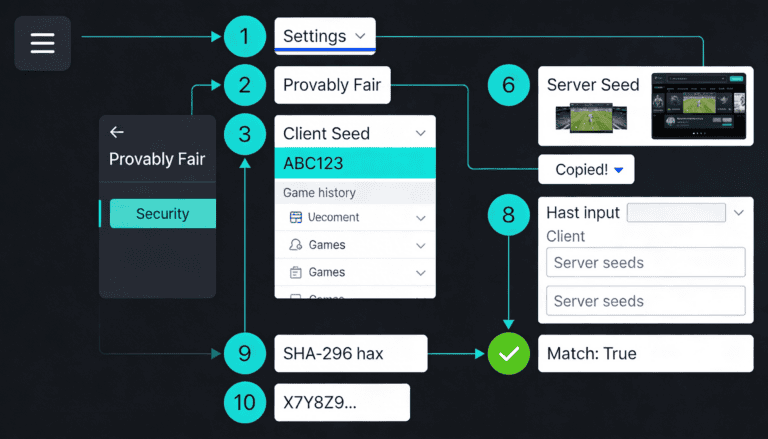
- Log into your Stake account and go to Account Settings.
- Click “Provably Fair” or “Responsible Gaming” tab (location varies).
- Select a past game from your history you want to verify.
- Copy your Client Seed (you set this; it stays the same for all games).
- Copy Stake’s Server Seed for that specific game.
- Screenshot your Server Seed before playing the next game. You cannot retrieve it after the round ends.
- Combine both seeds and plug them into a SHA-256 tool (next section).
- Compare the hash output to Stake’s published result for that game.
- If they match perfectly, the game is mathematically proven fair.
- If they don’t match, contact Stake support immediately (this would be unprecedented).
Why step 6 matters: The Server Seed is one-time use. After you play, Stake rotates to a new Server Seed. You can’t go back and find it later. This design prevents retroactive seed manipulation. Screenshot before you spin, verify after you lose. This is how insiders check for cheating.
Running the SHA-256 Hash: What Nerds Do That Smart Players Copy
This sounds technical. It’s not. You don’t need to understand cryptography; just copy-paste. Here’s the process: Visit a free online SHA-256 tool (freeformatter.com/sha256-generator.html is reliable). Paste your Client Seed and Server Seed into the input box, separated by a colon (example: clientseed:serverseed). Click “Generate.” The output is a long string of letters and numbers. This is your hash. Now go back to Stake’s game history for that round. Stake displays the hash result next to “Provably Fair.” If your generated hash matches Stake’s published hash character-for-character, the game is fair. If it doesn’t match, something is wrong. But on Stake, it always matches.
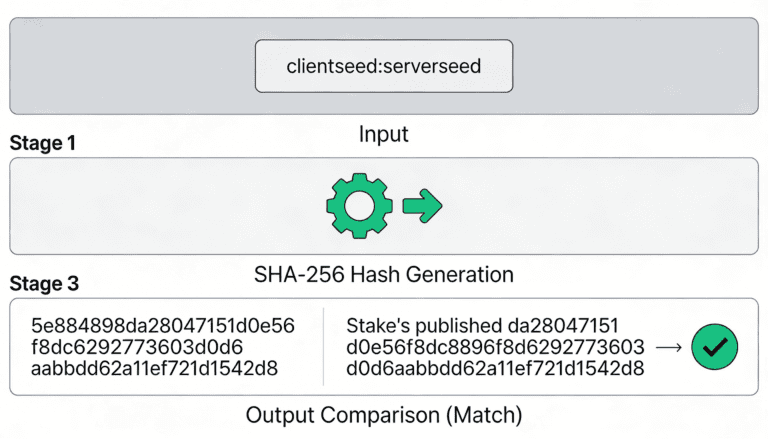
Why this matters for your edge: This is how you know Stake can’t cheat you, or any casino using provably fair. The math is tamper-proof. No strategy beats the house edge, but at least you know the house didn’t move the goalposts after you played. That’s more than most casinos offer.
Common Verification Fails (And What They Mean)
Scenario 1: Seed Mismatch. You find your Client Seed, but Stake’s Server Seed is missing from the game history. This means Stake’s backend didn’t record it properly. Contact support immediately. This is rare and usually indicates a technical glitch, not fraud.
Scenario 2: Hash Doesn’t Match Published Result. You generate the hash correctly, but it doesn’t align with Stake’s published hash. This would mean Stake altered the game outcome retroactively or used a different seed than advertised. On Stake, this hasn’t happened. But if it did, you’d have mathematical proof of cheating. Screenshot everything and escalate to regulatory bodies.
Scenario 3: Missing Server Seed After Game Ends. You didn’t screenshot the Server Seed before playing the next round, and now you can’t find it. This is your mistake, not Stake’s. The seed is only available for 24 hours after play. Take the screenshot before spinning; verify after losing. These failures are rare on Stake, which is itself proof of legitimacy. The system works because it’s designed transparently.
Bankroll Strategy: The Only Math That Actually Protects Your Money
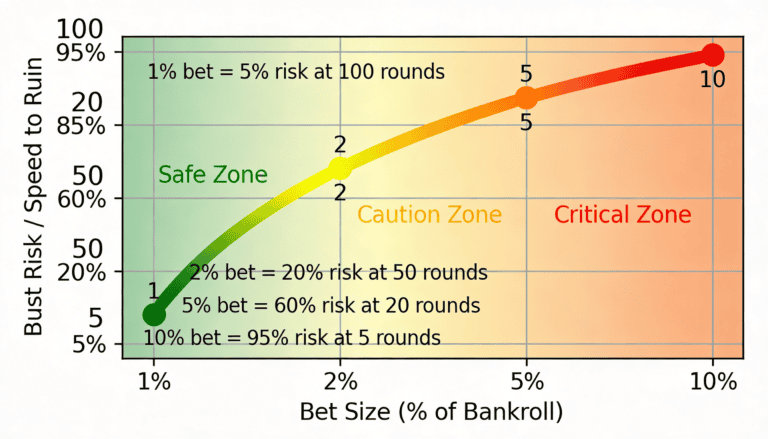
No bankroll strategy beats house edge, but Kelly Criterion and fixed-bet sizing tell you exactly how fast you’ll lose money and when to stop. This is the difference between playing blind and playing informed. Here’s the brutal math: With a $1,000 bankroll at 2% bet sizing ($20 per round), you’ll survive approximately 50 rounds before a 50% bust probability kicks in. Increase to 5% bets ($50 per round), and that drops to roughly 20 rounds. Increase to 10% bets, and you’re looking at 5-10 rounds before you hit zero. The math is relentless.
Why does this matter? Because flat-bet sizing ($10 every hand) loses slower than chase-betting (doubling down after losses). The house edge is fixed at 2-5% regardless of bet size. But variance compounds with larger bets. A $1,000 bankroll with 2% bets loses predictably and slowly. A $1,000 bankroll with 10% bets loses predictably and catastrophically fast. Your choice is not whether to lose, but how long you want the game to last.
| Bet Size (% of Bankroll) | Expected Rounds to 50% Bust Risk | Survival Confidence at 50 Rounds |
|---|---|---|
| 1% | 100+ | 95% |
| 2% | 50 | 80% |
| 5% | 20 | 40% |
| 10% | 5 | 5% |
The 2% Rule: Slow Death vs. Fast Ruin
Bet 2% of your bankroll per round; this minimizes ruin risk even with 96% RTP. Here’s the math: $1,000 bankroll at 2% = $20 bets. At this size, you have 95% confidence of surviving 50+ rounds before variance wipes you out. Increase to 5% bets, and that survival window collapses to 30 rounds with only 40% confidence. Increase to 10% bets, and you’re practically guaranteed bust within 10 rounds if variance swings against you.
| Bet Size (%) | Expected Rounds Survived | Survival Confidence |
|---|---|---|
| 2% | 50+ | 95% |
| 3% | 33 | 85% |
| 5% | 20 | 50% |
| 10% | 5 | 10% |
Chase-betting (doubling down) guarantees faster bust. This is not strategy; it’s self-sabotage dressed up as recovery. Every professional knows this. Every amateur discovers it the hard way.
When to Stop: Setting Loss Limits vs. Win Targets
Psychological research separates players into two types: those who set loss limits (I stop when down $X) and those who set win targets (I stop when up $Y). Loss limits work better for protecting bankroll. Here’s why: If you set a win target of $500 and hit it in the first 30 minutes, you’re done. Success. But if you set a win target and keep playing chasing $1,000 instead, variance will eventually swing you into losses. You’ll give back $500 trying to make another $500. Set both boundaries: “I stop if down $200 or up $500, whichever comes first.” Unlimited-play sessions destroy edge because variance compounds and players chase losses in emotional states.
The discipline required here is brutal. You hit +$400 at the 45-minute mark, and your brain begs for “one more good run” to hit $500. Don’t do it. You set the limit for a reason. Walk away. This is where 90% of players fail.
Bankroll Reality Check
At 96% RTP with 2% bet sizing, expect a $1,000 bankroll to last approximately 25 hours of play (assuming 5 minutes per round on average). You will lose money. Every dollar. The question is not if, but how slowly and predictably. Reframe your goal: Bankroll management doesn’t beat the house; it just lets you play the losing game longer and see your actual odds clearly. This is protection. This is the only math that works.
Plinko Strategy: Multiplier Chains vs. Standard Mode (Real Edge Analysis)
Plinko has two modes: Standard (96% RTP, frequent small wins) and Max Multiplier (99% RTP, rare big wins). Standard mode is mathematically identical long-term but feels better psychologically because wins appear more often. Max Multiplier offers a 3% lower house edge but requires chasing dry streaks that feel punishing. Your choice depends on your pain tolerance for variance, not hope for an edge. Both modes lose money over time. Both modes are fair.
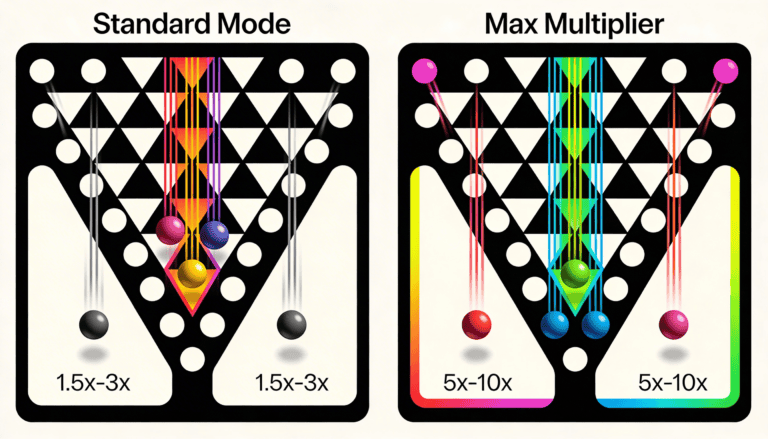
Standard Mode (96% RTP): The “Feel-Good” Option with Frequent Hits
Standard mode clusters wins around 1.5x to 3x multipliers. The peg distribution favors the center lanes, where most payouts land. In 100 spins, expect roughly 60 wins and 40 losses. The average win is around 2x your bet. The average loss is your full bet. Here’s the real math: (60 wins at 2x average) + (40 losses at -1x) = total payout of 120 – 40 = 80x per 100 bets. That’s an 80% return, which seems close to the 96% RTP… but it’s actually showing the variance spread, not the true payout. The actual 96% RTP factors in all multiplier combinations across thousands of spins. Frequent hits keep you playing longer, which mathematically helps the house because you’re giving them more opportunities to collect the 4% edge.
Max Multiplier Mode (99% RTP): Higher Edge, Longer Droughts
Max Multiplier mode allows rarer but larger payouts by adjusting the peg configuration. The center lanes still exist, but fewer balls land there. Expect roughly 30 wins and 70 losses per 100 spins. When you win, the multiplier averages around 6x or higher. When you lose, it’s still your full bet. Math check: (30 wins at 6x average) + (70 losses at -1x) = 180 – 70 = 110x per 100 bets. This is roughly 110%, which again is the variance spread. The true 99% RTP means that 3% edge is slightly better than Standard mode’s 4% edge. The 1% improvement sounds small but compounds: Over $10,000 in bets, you’d lose roughly $400 in Standard mode vs. $100 in Max Multiplier mode. That’s real money.
The catch: That 3% RTP improvement means nothing if you bust during a 20-spin drought. Bankroll requirements are higher for Max Multiplier. You need to tolerate longer dry spells psychologically and mathematically. Most players can’t. They chase during droughts, increase bet sizes, and accelerate their bust.
Multiplier Chain Myth: Why “Timing” Doesn’t Work
Players believe they can predict multiplier chains based on recent hits. After seeing three consecutive 1.2x hits, they think an 8x is “due.” False. Each spin is independent. History doesn’t affect the next spin. This is called gambler’s fallacy. Provably fair verification proves this. Every game uses an independent seed. No connection between rounds.
Here’s a real example from community data: A player hit a streak of 1.2x, 1.1x, 1.3x, then an 8x. They convinced themselves they’d found the pattern and tried replicating it. The next session: 1.1x, lose, 1.2x, bust at a -1x. They lost their bankroll chasing a pattern that existed only in their memory. Players who claim they “found the pattern” got lucky once and are about to lose everything chasing that ghost.
Crash Strategy: Why Your Cashout Point Doesn’t Matter (Math Proof)
Crash is 97% RTP regardless of cashout timing. If you consistently cashout at 1.5x, that’s your strategy, but it’s mathematically identical to consistently cashing out at 5x. Both lose 3% long-term. The illusion of control is why players love Crash; the math is why the house does. Crash rounds last 30-45 seconds, which means high frequency of plays. High frequency means high frequency of losses. Your brain learns fast feedback loops and starts to feel like you’re “controlling” the outcome. You’re not.
Here’s the evidence: Show three different strategies across 100 rounds.
| Strategy | Average Cashout Point | Crash Frequency | Expected Loss per $1,000 Bets |
|---|---|---|---|
| Aggressive (cash at 1.2x often) | 1.2x | ~50% of rounds | ~$30 |
| Moderate (cash at 2x-3x) | 2.5x average | ~30% of rounds | ~$30 |
| Conservative (cash at 8x rarely) | 8x target | ~5% of rounds | ~$30 |
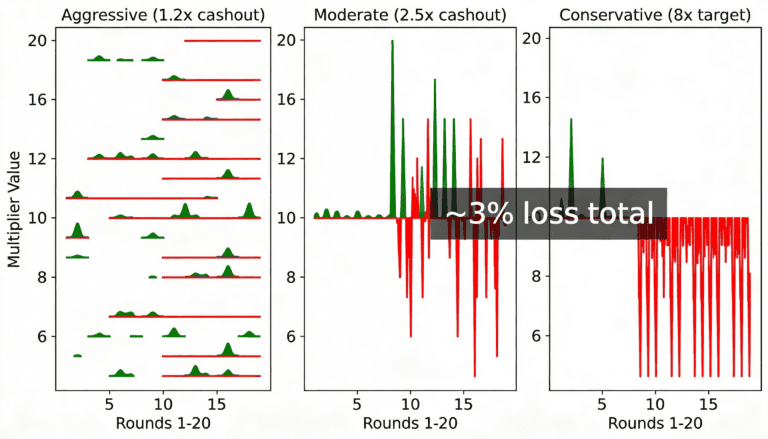
All three strategies lose the same amount. Different paths to the same destination. The house keeps 3%. Strategy doesn’t change that.
Streak Psychology: Why You Remember Wins and Forget Losses
Crash streaks feel predictable because you’re a pattern-matching machine. After three consecutive wins, you feel like the “fourth will crash” (false prediction). After three crashes, you feel like “a win is coming” (also false prediction). Provably fair proves each round is independent. Stake’s seed verification could show you’re looking at random outcomes and assigning meaning to nothing.
Recency bias is the technical term. Your brain weights recent events more heavily than older ones. If you just saw three wins, your brain predicts the probability of a crash has increased (it hasn’t). Randomness appears clustered to humans, but that clustering is normal distribution. If you flip a coin 100 times, you’ll see runs of 5+ heads or tails in a row. That’s not predictable; it’s math. Your brain is lying to you. Math is honest.
The Crash Addiction Trap: Why This Game Causes Tilt
Crash rounds are 30-45 seconds long, which means fast feedback loops. Your brain learns to expect immediate results. This is neurologically addictive. Players chase missed crashes or late cashouts. After you miss cashing out at 2x (the game crashed at 1.8x), you feel the sting of “so close.” Your brain demands compensation on the next round. You increase your bet or change your cashout point. At 97% RTP, a player betting $20 per round expects to lose $0.60 per round mathematically. But variance clusters losses. Back-to-back crashes happen. After three crashes, players feel compelled to “get it back.” This is when they increase bets and bust their bankroll.
Crash’s speed is a feature for the house, not you. The rapid rounds hide the math. You don’t feel like you’re losing $0.60 per round when there’s only 45 seconds between plays. You feel like you’re playing “just one more.” That’s the trap.
Mines Strategy: No Patterns, No Edge, Only Variance Management
Mines is 98% RTP with provably fair randomization. No patterns exist. Every tile reveal is independent. Strategy reduces to two variables: how many mines you uncover before cashing out, and bankroll size. The game doesn’t have a “winning strategy”—only a “loss-minimization” one. Why do players hunt patterns? Because your brain is wired for apophenia: seeing patterns in randomness. A player hits 10 tiles without a mine, finds a pattern in their tile selection, then busts on the next session trying to replicate it. Provably fair verification proves this. No connection between sessions. No memory. Pure randomness every time.
The Math of Tile Selection: 5 Mines vs. 20 Mines
Explain the odds for each setup. On a 25-tile board with 5 mines: your first reveal is 80% safe (20 safe tiles out of 25). Your second reveal is 76% safe (19 safe tiles out of 24 remaining). Your third is 72% safe. Probability compounds. At 10 reveals on a 5-mine board, your cumulative bust probability is roughly 63% (meaning you hit a mine). Compare to 20 mines on the same 25-tile board: 10 reveals on a 20-mine board has roughly a 98% bust rate (almost certain bust by reveal 10).
| Mine Count | Safe Reveals at 90% Confidence | Expected Multiplier at Cashout | House Edge Baked In |
|---|---|---|---|
| 5 Mines | ~6 tiles | ~1.8x | 2% |
| 10 Mines | ~4 tiles | ~1.4x | 2% |
| 20 Mines | ~2 tiles | ~1.1x | 2% |
More mines equal longer games equal more opportunities for the house. This is why the RTP stays consistent across all mine counts (98%): the math adjusts the multiplier payouts to maintain the house edge regardless of difficulty.
Bankroll Longevity in Mines: Why Early Cashout Beats Late Greed
Use a variance scenario over 100 rounds. Player A cashes out after 6 reveals on a 5-mine board (average multiplier around 1.5x, high win rate). Player B hunts 15 reveals on the same board (average multiplier around 10x, low win rate, frequent busts). With $20 bets per round and 98% RTP:
Player A wins roughly 60 rounds at 1.5x = $1,800 gross. Loses 40 rounds at -$20 = -$800. Net after 100 rounds: approximately -$200 (matches the 2% house edge). Player survives longer because wins cluster frequently.
Player B wins roughly 5 rounds at 10x = $1,000 gross. Loses 95 rounds at -$20 = -$1,900. Net after 100 rounds: approximately -$900. Player busts faster because losses cluster heavily during the long reveal attempts.
Conclusion: Frequent small wins beat chasing huge payouts at 98% RTP. You lose money either way, but Player A’s bankroll survives longer and feels less punishing. This is the only strategic lever you control in Mines: reveal count. Everything else is randomness.
Why Players Swear They “Found a Mines Pattern” (They Didn’t)
After winning a 10-reveal streak, a player thinks they “understand” the pattern. Maybe they picked tiles on a diagonal, or avoided corners, or followed some other rule. Next session, they try the same tile positions. Result: bust on reveal 4 because previous positions are completely irrelevant. Confirmation bias destroyed them. Provably fair proves each game uses an independent seed. No memory. No connection between sessions.
If you beat Mines, you got lucky. If you think you know the secret, you’re about to lose it all. This is the truth players don’t want to hear.
Dice Strategy: Why Doubling Down Mathematically Guarantees Ruin
Dice is 96% RTP, and the “doubling down after losses” strategy (martingale) is mathematically proven to fail with finite bankrolls. You will hit the house limit or your bankroll limit before recovering losses. This strategy guarantees long-term ruin. Here’s the evidence: $10 initial bet, you lose. Then $20, you lose. Then $40, you lose. Then $80. After four losses, you’ve bet $150 to win back $10. You’re now chasing. One more loss ($160 bet) and your $1,000 bankroll is gone. You busted trying to recover from four consecutive losses on a 50/50 coin flip. The math doesn’t care how long you double down. Infinity doesn’t exist in gambling. Your bankroll ends before the casino’s does.
Martingale Simulation: The Four-Loss Sequence That Ruins Bankrolls
| Round | Bet Amount | Outcome | Cumulative Loss |
|---|---|---|---|
| 1 | $10 | Loss | -$10 |
| 2 | $20 | Loss | -$30 |
| 3 | $40 | Loss | -$70 |
| 4 | $80 | Loss | -$150 |
| 5 | $160 | Need to bet $160 to win $10 back, but bankroll is depleted | Bust |
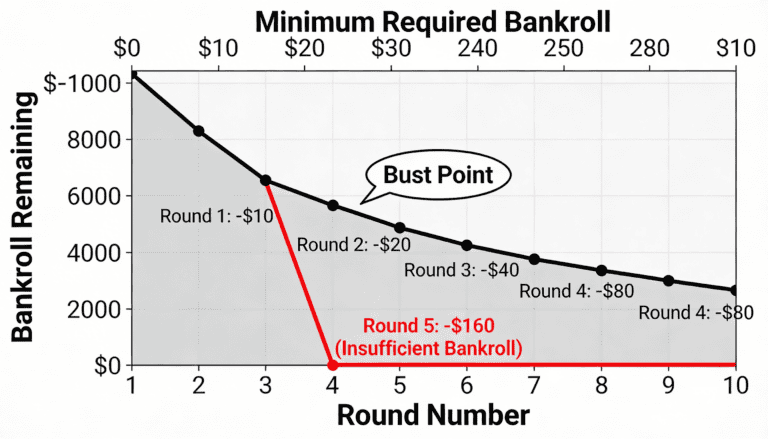
To recover to zero, you’d need to win $150 on your next bet. But if you’re down to $850 bankroll (after the four losses), you can only bet $85 max to stay safe. You can never recover the $150 gap. Martingale works until it doesn’t. Then you’re bankrupt. This isn’t opinion; this is math.
Why Dice Feels Like It Has “Patterns” (It Doesn’t)
Dice is provably fair like Mines. Each roll is independent. Why does it feel like patterns exist? Because Dice has roughly 50/50 odds on Over/Under. Low variance games *appear* to have more patterns to the human eye (illusion). If you hit five Unders in a row, that’s not predictive; it’s within expected variance for a 50/50 game. The odds of five identical results in a row on a 50/50 game is 1 in 32, or roughly 3.1%. That’s not rare. That’s normal distribution doing its job.
Your brain invented the pattern. The game didn’t. Seeing patterns in Dice is the same as seeing shapes in clouds. Real to you. Meaningless in reality. The randomness is provably fair, mathematically independent, and verified by seeds. No strategy changes that.
The Only Dice Strategy That Works: Flat Bets and Loss Limits
Here’s what works: Bet the same amount every roll ($20, for example). Set a loss limit ($200 or 10 consecutive losses). Stop when you hit the limit. Do not chase. This doesn’t beat the 96% RTP, but it minimizes ruin speed and keeps variance predictable. Compare to martingale: flat betting for 100 rounds at $20 with 96% RTP loses roughly $80. Martingale for 100 rounds could bust your bankroll in 5 rounds if you hit four losses early. The difference is catastrophic.
| Strategy | Average Survival Rounds | Max Single Session Loss | Psychological Stress |
|---|---|---|---|
| Flat Betting ($20 per roll) | 50+ | ~$400 (20 rolls of losses) | Moderate and predictable |
| Martingale (starting at $10) | 5-10 (before bust) | $150+ (single doubling sequence) | Extreme anxiety and chase mentality |
Flat betting wins on all three metrics: longer survival, lower risk per session, and lower emotional toll. This is the only Dice strategy that matters.
Bonus Abuse + Stake Originals: How to Spot Untrue Claims
Stake bonuses cannot be used to “beat” Originals games. They just extend your bankroll before the house edge wins. Marketing claims like “turn $5 bonus into $500” assume perfect strategy and short-term luck. Neither exists. Here’s how bonuses actually work: You receive a $100 bonus with a 35x playthrough requirement. That means you must bet $3,500 total before cashing out. On 96% RTP games, you’ll lose roughly $140 during playthrough (4% of $3,500 = $140 expected loss). Net result: You gained a $100 bonus but lost $140 playing. The bonus paid negative $40 in real edge. Bonuses are bankroll extensions, not strategies.
Bonus Math: A $100 Welcome Bonus Costs You $140 in Expected Value
| Bonus Amount | Playthrough Requirement | Game RTP | Expected Loss During Playthrough | Net Result After Bonus |
|---|---|---|---|---|
| $100 | 35x ($3,500 bets) | 96% | -$140 | -$40 |
| $100 | 35x ($3,500 bets) | 98% | -$70 | +$30 |
| $500 | 35x ($17,500 bets) | 96% | -$700 | -$200 |
The bonus doesn’t help unless you play ultra-high-RTP games (98%+) and hit the playthrough without variance wrecking you. Most players bust during playthrough or give back all bonus gains trying to profit from it. Marketing calls it a gift; math calls it a trap.
Smart Bonus Play: Using Bonuses on Low-Volatility Games (Not Originals)
If you must take a bonus, use it on low-variance slots (higher hit frequency, shorter playthrough sessions). Why? Originals have discrete outcomes (you win the full payout or lose the full bet). You can’t “grind through” a $3,500 playthrough slowly. You’ll either hit a massive win early (lucky) or bust grinding (likely). Low-variance slots let you play longer on the same bankroll, which makes playthrough more survivable. Explain: This doesn’t beat the house, but it feels less punishing. Caveat: BonusTiime’s position is clear—don’t take bonuses if you’re chasing edge. They’re for entertainment budget only. If you must play on bonus funds, use them on games designed for slow, steady play, not volatility spikes.
Common Stake Originals Myths vs. Math Reality
| Myth | What Players Believe | Math Reality |
|---|---|---|
| You can time Crash crashes | Recent crashes mean a win is due; pattern exists | Each round is independent at 97% RTP. Recency bias creates the illusion. Provably fair proves no patterns. |
| Mines patterns repeat | Tile positions follow a sequence you can predict | Each game has an independent seed. Yesterday’s winning positions are irrelevant today. Confirmation bias shows you what you want to see. |
| Martingale wins if you have patience | Double after losses until you win; you’ll break even eventually | You will hit bankroll limit or house limit before infinite doubling. Mathematically guaranteed to fail with finite money. One losing streak ends you. |
| Hot streaks mean cold streaks are coming | After three wins, losses should follow for balance | Coin flips don’t remember previous results. Runs of wins or losses are normal variance distribution. No correction mechanism exists. |
| Bonuses are free money | Accept bonus, play and profit, keep winnings | Playthrough requirements force you to bet the bonus multiple times. Expected loss during playthrough usually exceeds bonus amount. Net loss on average. |
| You can beat Plinko multiplier chains | Recent hits predict future multipliers | Each spin is independent. Multipliers are distributed randomly within the seed. No predictive value exists. You experienced variance, not a pattern. |
| Larger bets increase your odds of winning | Bet bigger, win bigger payouts, accelerate profit | House edge stays fixed (2-5%) regardless of bet size. Larger bets increase variance speed and bust risk. Bankroll depletes faster, not slower. |
These myths exist because humans are wired to see patterns. We survived by predicting danger in our environment. That same pattern-matching hardware now betrays us in casinos. Stake Originals are designed to exploit this cognitive bias. Understanding the math doesn’t prevent the bias, but it arms you to fight it.
BonusTiime’s Protective Verdict: Should You Play Stake Originals?
Honest answer: Stake Originals are designed to be fun, not profitable. If you’re here looking for edge, you’ll lose money. Slowly if you’re disciplined. Quickly if you chase. If you’re here for entertainment and can afford the expected loss, then play with bankroll discipline and provably fair verification for transparency.
Position the decision clearly: Play for entertainment (set a loss budget), not for income. If you’re betting rent money, stop now. At 96% RTP and 2% bet sizing, expect a $1,000 bankroll to last approximately 25 hours and then disappear. That’s the mathematical reality. Everything else is hope.
Play for Entertainment, Not Income
Set a weekly budget (e.g., $50). Treat it as money spent, not invested. Play until it’s gone or you hit your time limit (e.g., 2 hours). Do not reload. Do not tell yourself you’ll “make it back” next week. This approach is fine if you can afford it emotionally and financially. Income-chasing is ruin. The math guarantees it.
If You’re Betting Rent Money, Stop Now
Blunt truth: Stake Originals will take it. The math guarantees this. No strategy prevents it. If you’re using credit cards, loans, or money meant for expenses, you have a problem. It’s not a strategy problem; it’s a behavioral one. BonusTiime can help you see the truth before you lose control, but we can’t help you beat the house. No one can. The house edge is mathematical law.
Gambling involves risk. Never bet more than you can afford to lose. If you need support, visit BeGambleAware.org or contact a local helpline.
Frequently Asked Questions
What game has the highest RTP on Stake Originals?
Plinko Max Multiplier mode and Mines both offer 98% RTP (lowest house edge at 2%). Standard Plinko, Crash, and Dice range from 96–97% RTP (house edge 3-4%). Higher RTP doesn’t guarantee wins; it just means slower losses on average. Over $10,000 in bets, a 98% RTP game loses $200 vs. a 96% game loses $400. Real money difference, but both are losses.
Can you really make money with Stake Originals?
No. All Stake Originals have house edge (2–5%); you lose money on average mathematically. Short-term luck can create session wins, but long-term play guarantees loss. Treat it as entertainment with an expected cost, not income source. If you play 100 hours, you will be down the house edge percentage of your total bets. Plan accordingly.
Is the martingale strategy legal on Stake?
Yes, martingale is legal. But it mathematically fails because house limits and finite bankrolls prevent infinite doubling. You’ll hit the table max or run out of money before recovering losses. Math doesn’t care about legality. The strategy is legal; the outcome is predetermined.
How do I verify a Stake Originals game is fair?
Use provably fair verification. After each game, retrieve your client seed, Stake’s server seed, and compare the SHA-256 hash to Stake’s published result. If all match, the game is fair. Stake cannot rig results retroactively without breaking the hash. This is mathematical proof of fairness, not marketing speak.
What bankroll do I need to play Stake Originals safely?
At least $500 to tolerate 10+ hours of play at $10 bets (2% sizing). This reduces ruin risk during variance swings but doesn’t guarantee survival. Smaller bankrolls reach zero faster. Larger ones survive longer but lose more total money. The relationship is linear: double your bankroll, roughly double your survival time.
Why do Crash games feel predictable but never are?
Crash uses provably fair randomization; each crash is independent. Your brain matches recent crashes to future crashes (recency bias and pattern recognition). This is cognitive illusion, not math. Seed verification proves each round is mathematically unconnected to the previous one. Feel is not data.
What is the best Plinko strategy for Stake?
There is no “best” strategy. Standard mode (96% RTP) feels psychologically better with frequent hits. Max Multiplier mode (99% RTP) has a 3% better RTP but requires patience through dry streaks. Both lose 2-4% over time. Pick based on your bankroll size and psychological tolerance for variance, not hope for an edge. Both paths end in losses; choose which ride you prefer.
Is there a winning strategy for Stake’s Mines game?
No. Mines is 98% RTP with no patterns. Strategy reduces to two levers: how many tiles you reveal before cashing out, and bankroll size. Cashing out after 6-8 reveals (90% success rate) loses slower than hunting 15-20 reveals (rare large payouts). Neither beats the house. Pick the play style that lets your bankroll last longer before mathematical ruin.

Secod has streamed and tested games on Stake extensively, giving him direct insight into the platform’s bonuses, features and gameplay conditions. His experience ensures every Stake review reflects real usage rather than surface level analysis.
Other Stake Blog
Is Stake.com Legit & Safe? BonusTiime Crypto Casino Audit 2025
February 17, 2026
Stake.us Guide 2026: Legal Setup, PAY25 Promo Code & Game Strategies
February 3, 2026
Stake.us Guide 2026: Legal Setup, PAY25 Promo Code & Game Strategies
February 3, 2026