
Stake Plinko Strategy Guide: RTP, House Edge & Bankroll Math | BonusTiime
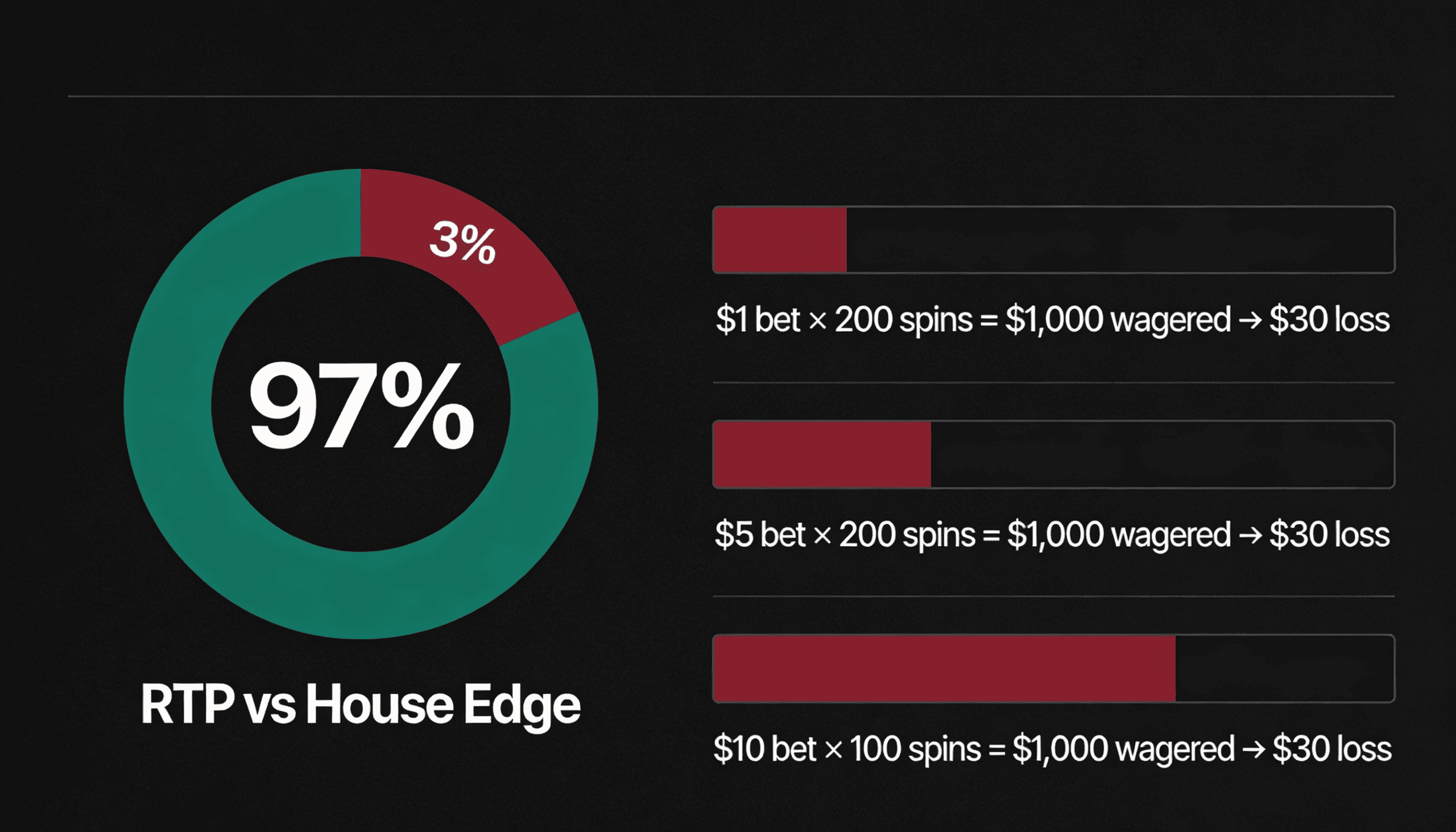
Plinko on Stake has a 97% RTP. That translates to a 3% house edge. Over time, this edge grinds down your bankroll automatically. Bet $100 across multiple spins? Expect to lose about $3 on average. Doesn't sound bad until you realize that edge compounds every single session.
Written by Secod on 03-03-2026


- Plinko Game Mechanics: Multipliers, Peg Count & Why Your ‘System’ Fails
- Bankroll Strategy: The Only ‘System’ That Actually Extends Your Play
- Plinko Volatility Tiers: Which Peg Count Is Right for Your Bankroll?
- RESPONSIBLE GAMBLING WARNING: Auto-Cashout Patterns That Triggered Loss Spirals
- Advanced: Plinko RTP Tracking & Real-Time Variance Detection
- VIP Rakeback Recovery Math: How to Offset Plinko Losses Faster
- Plinko vs Crash vs Mines: Which Game Fits Your Strategy?
- Common Plinko Mistakes That Drain Bankrolls (And How to Avoid Each)
- Frequently Asked Questions
Plinko’s 97% RTP Means a 3% House Edge. Here’s What That Actually Costs You.
Plinko on Stake has a 97% RTP. That translates to a 3% house edge. Over time, this edge grinds down your bankroll automatically. Bet $100 across multiple spins? Expect to lose about $3 on average. Doesn’t sound bad until you realize that edge compounds every single session.
Here’s the uncomfortable truth: No strategy beats math. Not Martingale. Not auto-cashout patterns. Not “waiting for the hot streak.” The 3% edge is baked into the game’s code, and Stake’s provably fair system confirms it. Your job isn’t to beat the game. It’s to manage your capital so the edge takes as long as possible to bankrupt you.
How to Calculate Your Expected Loss Per Session
The math is simple. Use this formula:
(Total Bets Placed × Bet Size) × 0.03 = Expected Loss
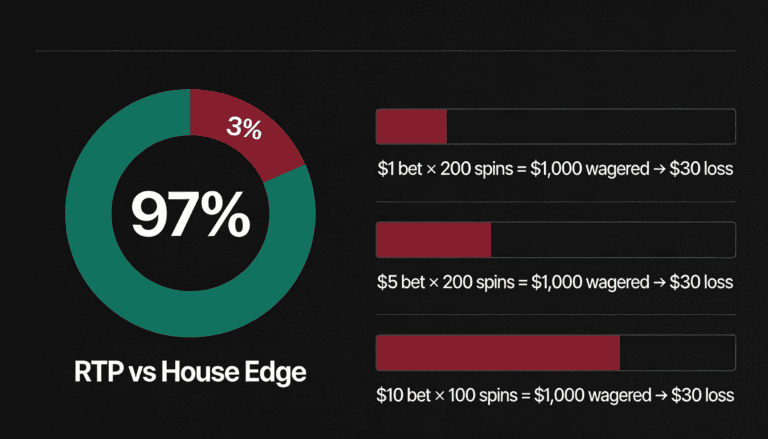
Let’s run real numbers. Say you play 200 spins at $5 per bet. That’s $1,000 wagered total. Multiply by 3%: $1,000 × 0.03 = $30 expected loss. You might win on individual spins. But across 200 spins, the math says you’ll lose around $30.
Now test it at the $1 level. 200 spins × $1 = $200 wagered. $200 × 0.03 = $6 expected loss. Same number of spins, smaller bet, smaller bleed. This is why bet sizing matters.
Here’s the catch: This is your expected loss, not a guarantee. Variance might give you a 10-spin hot streak or a 30-spin losing streak. But the longer you play, the closer your actual results creep toward that 97% RTP baseline. After 10,000 spins, you’re almost certainly in loss territory if you’re playing casually.
Why Plinko’s 97% RTP Is Actually Above Average (But Still Not Beatable)
Context matters. Stake’s slot games average 94–96% RTP. Plinko at 97% is genuinely solid. Crash, Stake’s other big Original, sits at 99% RTP, making it elite in the iGaming space. But here’s what players miss: A 99% RTP game isn’t “winnable.” It just loses slower.
The difference between 94% and 97% RTP is real money. On $1,000 wagered:
- 94% RTP = $60 expected loss
- 97% RTP = $30 expected loss
- 99% RTP = $10 expected loss
Plinko’s 97% puts it in the “good” tier for Stake Originals. But “good” doesn’t mean beatable. It means you’ll burn through your bankroll 2x slower than on typical slots. That’s the realistic takeaway.
Plinko Game Mechanics: Multipliers, Peg Count & Why Your ‘System’ Fails
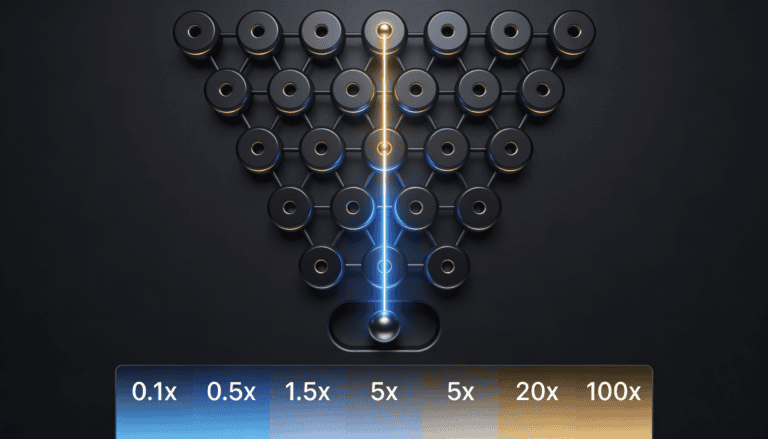
Plinko uses a fixed peg layout and a random ball drop. Your ball lands in one of the bottom slots, each mapped to a multiplier. These multipliers range from 0.1x to 1000x depending on which peg configuration you’ve chosen. Each spin is independent. Last spin hit a 100x? That has zero impact on spin number 51.
This independence is crucial. It kills every “system” based on pattern-chasing. The game uses a random seed (blockchain-verified), so results are deterministic for verification purposes. But deterministic doesn’t mean predictable to the player. It just means Stake can prove the game wasn’t rigged post-hoc.
The Multiplier Fallacy: Why ‘Catch a 100x Then Auto-Cashout’ Is Not a Strategy
Players love this idea: “I’ll set auto-cashout to 2x and let it ride until I hit a 100x, then cash out.” Sounds logical. It’s not. Multipliers are random and completely independent. A 1000x on spin 49 does not increase the odds of another 1000x on spin 50. Probability stays the same: extremely rare.
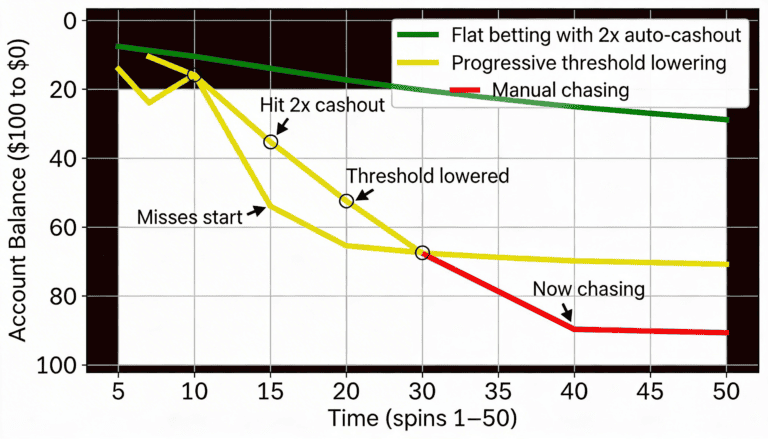
What actually happens? You hit your 2x auto-cashout on spins 1, 3, 5, 8, 12, 15. You’re winning. Then misses compound. Spin 20: nothing. Spin 25: nothing. By spin 35, you’re frustrated. The psychological pressure kicks in. You lower your auto-cashout threshold to 1.5x to “catch something.” Spin 40 still misses. Now you’re chasing. You place bigger manual bets to compensate. This is where $100 sessions become $500 losses.
The rule: Never change your bet size to compensate for losing streaks. Losing streaks are statistically normal with a 3% house edge. They don’t signal that a win is coming.
Risk Level: How Plinko Compares (Low Vol vs Crash, High Vol vs Mines)
Stake offers three main Originals, each with different volatility profiles:
Crash (Low Volatility): Payouts almost every spin, smaller multipliers. Smooth curve, low variance. Best for players who want steady action without huge swings.
Plinko (Medium Volatility): Payout every 4–8 spins on average. Multipliers range from 0.1x to 1000x. Balanced risk and reward. Most players gravitate here.
Mines (High Volatility): Long dry spells (30+ spins without payout), then huge 200x+ multipliers. Requires psychological tolerance for losing streaks and a much larger bankroll to survive them.
Volatility measures variance in payout frequency, not profitability. Higher volatility doesn’t make you more money. It just makes winning less frequent and losing streaks longer. Pick the volatility that matches your bankroll size and emotional capacity.
Bankroll Strategy: The Only ‘System’ That Actually Extends Your Play
Forget Martingale. Forget progressive betting. The only mathematically sound approach is proper bet sizing and stop-loss discipline. This doesn’t improve your odds against the 3% house edge. But it does prevent catastrophic bankroll collapse. Think of it as damage control, not profit generation.
Here’s the rule: Never bet more than 1–2% of your total bankroll per spin. If your bankroll is $500, your max bet is $5–10. If it’s $100, your max is $1–2. This isn’t arbitrary. It’s the threshold where variance stops destroying your ability to recover.
Flat Betting vs Progressive Betting: The Math Showdown
Let’s compare two players, each with a $500 bankroll.
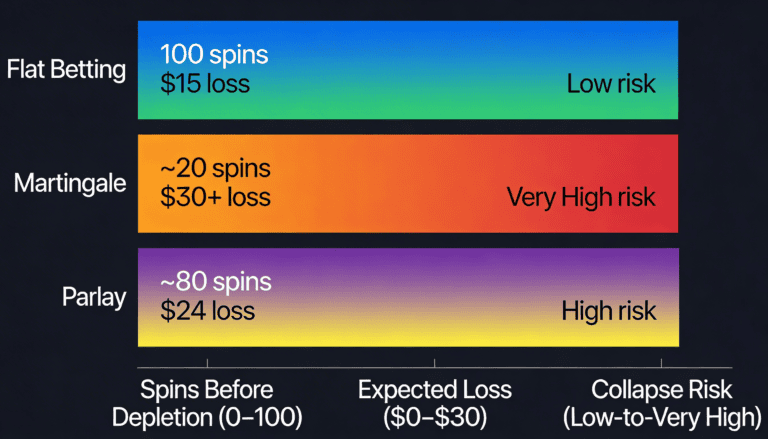
| Approach | Bet Amount | Spins Before Depletion | House Edge Cost | Collapse Risk |
|---|---|---|---|---|
| Flat Betting | $5 per spin | 100 spins (at 3% loss rate) | $15 expected loss | Low (predictable decline) |
| Martingale (1x, 2x, 4x, 8x…) | Start $1, double on loss | ~20 spins | $30+ loss (quick) | Very High (need $1,024 after 10 losses) |
| Parlay (1x, 2x, 4x…) | Start $1, double on win | ~80 spins | $24 loss | High (one loss resets everything) |
Flat betting wins every time. You play longer, you lose at a predictable rate, and you never face a sudden bankroll wipeout. Martingale looks attractive until you hit the inevitable losing streak. After 9 consecutive losses (statistically possible), you need $512 for the 10th bet just to break even on your $1 start. Most players only have $500. Game over.
Setting Your Stop-Loss: When to Walk Away Before Variance Wipes You Out
Here’s the hardest rule to follow: Stop playing after losing 50% of your session bankroll. If you bring $100 to a session and lose $50, quit. Done. Walk away.
Why? Variance creates losing streaks. With a 3% house edge, it’s statistically normal to hit 30 consecutive losing spins (depends on payout frequency and peg count). If you’re betting $5 per spin, that’s $150 lost in a row. If your stop-loss is 50%, you bail at $50 and live to play another day. If you don’t have a stop-loss, you keep betting, chasing the 3% back, and end up losing $150.
Stop-loss rules save bankrolls. They feel bad in the moment because you’re “leaving money on the table.” But you’re not. You’re preventing the cascade that turns a small loss into a session killer.
Beginner Bankroll Template: $100, $500, $1,000 Examples
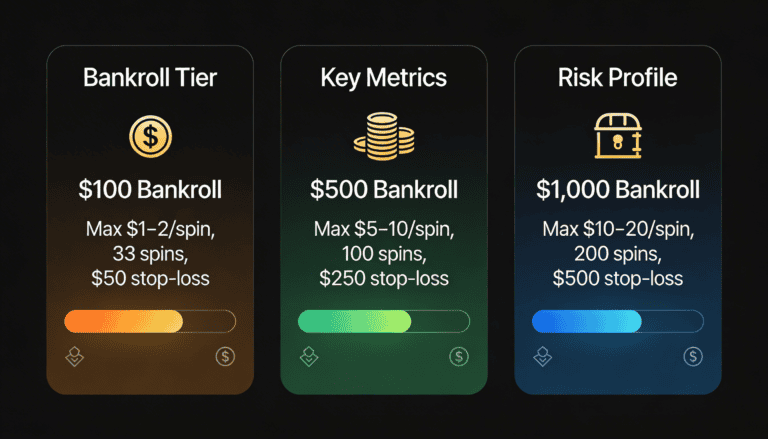
| Total Bankroll | Max Bet Per Spin | Recommended Sessions | Spins Until Depletion (flat 3% edge) | Stop-Loss Limit |
|---|---|---|---|---|
| $100 | $1–2 | $20–30 per session | ~33 spins at $3 avg | Stop at $50 loss |
| $500 | $5–10 | $50–100 per session | ~100 spins at $5 avg | Stop at $250 loss |
| $1,000 | $10–20 | $100–200 per session | ~200 spins at $10 avg | Stop at $500 loss |
These numbers assume flat betting at the middle of the range. If you’re spinning faster (more per minute), expect to burn through sessions quicker. The stop-loss amount is half your session buy-in, not half your total bankroll.
Plinko Volatility Tiers: Which Peg Count Is Right for Your Bankroll?
Stake’s Plinko offers four volatility modes: 8, 9, 12, and 16 pegs. Fewer pegs create lower volatility (frequent payouts, smaller swings). More pegs create higher volatility (rare payouts, bigger multipliers). Your bankroll size should determine which one you play.
The rule of thumb: Smaller bankroll = fewer pegs. Larger bankroll = more pegs. This prevents your money from getting shredded by variance you can’t survive.
8-Peg (Low Volatility): Steady Payouts, Smaller Multipliers
Frequency: You hit a payout roughly every 3–4 spins. Multipliers range from 0.5x to 50x. The low end means you might hit a 0.5x (losing half your bet), but you’re hitting something almost constantly.
Best for: Players with a $100–200 bankroll. Players who want to feel like they’re “in action” every few spins. Players new to Plinko who want to learn the game without massive dry spells. The downside: No mega wins. You’re unlikely to hit a 1000x on 8 pegs. But you’ll play longer for your money.
12-Peg (Medium Volatility): Balanced Risk-Reward
Frequency: Payouts every 8–10 spins on average. Multipliers from 0.1x to 200x. This is where most players camp out. It’s the goldilocks zone between frequent action and meaningful payouts.
Best for: Players with a $500+ bankroll. Players comfortable with 15–20 spin dry spells. This is the default Plinko experience. It’s medium volatility, so you’ll see losing streaks, but they’re survivable if you’ve got the bankroll and stop-loss discipline.
16-Peg (High Volatility): Chasing the 1000x
Frequency: Payouts every 30+ spins, sometimes longer. Multipliers from 0.05x to 1000x. This is where the mega wins hide. But this is also where bankrolls go to die.
Warning: 16-peg requires psychological tolerance for extreme losing streaks. A 50-spin dry spell is statistically normal. If you’re betting $10 per spin, that’s $500 lost before your next payout. You need at least a $1,000 bankroll to play this tier safely, and you need to be mentally prepared to watch that balance drop for 30+ spins without a single win. Most players can’t handle this. If you’re prone to chasing losses, stay on 12-peg or lower.
RESPONSIBLE GAMBLING WARNING: Auto-Cashout Patterns That Triggered Loss Spirals
Auto-cashout sounds like a protective tool. It’s not. It’s where emotion overtakes math.
Here’s the real scenario: You set auto-cashout to 2x. First 5 spins, you hit 2x four times. You’re up $40 (assuming $5 bet). Feels good. Spin 6: nothing. Spin 7: nothing. Spin 8: nothing. You’re down to +$20. Spin 9 misses. You’re back to breakeven. Spin 10 misses. You’re now down $5. The psychology flips. That 2x threshold that felt “conservative” 10 spins ago now feels impossible. You lower it to 1.5x. Spin 11: hits 1.5x. You’re up $7.50. But you’re frustrated. Spin 12–15: All misses. You’re down $20. Now you’re chasing. You turn off auto-cashout and manually bet $15 (3x your normal bet) to “recover faster.” Spin 16–20: All misses. You’ve now burned $75 trying to chase back the initial +$40.
This is the cascade. It’s not a flaw in your discipline. It’s a flaw in how human brains respond to near-wins and losing streaks. The 3% house edge depends on this cascade. It’s how the edge accelerates.
The ‘Lower Your Threshold’ Trap: How $100 Sessions Become $500 Losses
The threshold trap happens in stages. Stage 1: You hit your auto-cashout target a few times, you feel like you’ve “figured it out.” Stage 2: Misses start stacking. You lower the target because you think the game “owes you” a win. Stage 3: Even lower targets start missing. Now you’re betting bigger to hit smaller multipliers. Stage 4: You abandon auto-cashout entirely and play manual, hunting for the big hit to cover losses. Stage 5: You lose the session bankroll.
The trap exists because every player experiences variance. Losing streaks feel personal. They feel like the game is rigged or you’re doing something wrong. You’re not. You’re experiencing the statistical reality of a 3% house edge. But your brain interprets losing streaks as a problem to solve right now. So you solve it by betting bigger. The house edge grinds away.
Real talk: If you catch yourself lowering thresholds or increasing bet sizes during a session, stop immediately. Step away. The session is already compromised. Walk away.
Advanced: Plinko RTP Tracking & Real-Time Variance Detection
You can track your actual RTP to detect if something’s off. Create a simple spreadsheet. Record: Total Spins, Total Wagered, Total Won. Then calculate: Actual RTP = (Total Won / Total Wagered) × 100.
After 100 spins, expect your actual RTP to be between 92–102% (normal variance). After 500 spins, expect 94–100%. After 1,000 spins, expect 96–98%. The range tightens as your sample size grows. This is how variance works: small sample sizes swing wildly, but the law of large numbers pulls you toward the 97% baseline.
If your actual RTP after 1,000 spins is below 90%, something is wrong (either very bad luck or a potential game issue). If it’s below 85% after 2,000 spins, contact Stake support and request an RTP audit. Stake uses provably fair (blockchain seed verification), so they can prove whether the results match the expected RTP.
When 100 Spins Isn’t Enough: Variance Windows & Statistical Significance
Small sample sizes lie. After 100 spins, you might have 82% RTP (brutal losing streak). After 200 spins, it might jump to 95%. After 1,000 spins, it settles around 97%. This is normal. The law of large numbers ensures that longer sequences approximate the true RTP.
| Sample Size | Expected RTP Range | Volatility Window | Confidence Level |
|---|---|---|---|
| 100 spins | 85–109% | ±12% variance | Low (very noisy) |
| 500 spins | 92–102% | ±5% variance | Medium (trending toward true RTP) |
| 1,000 spins | 94–100% | ±3% variance | High (approaching true RTP) |
| 5,000 spins | 96–98% | ±1% variance | Very High (statistically significant) |
Don’t panic after 100 spins. You’re in the noise. Track 500+ spins before drawing conclusions about whether your account is fair or you’re just unlucky.
Red Flag: When Your Actual RTP Falls Below 90% (Sample Size Matters)
If after 1,000+ spins your actual RTP is below 90%, investigate. This is statistically abnormal (outside the expected variance window). It could mean:
- You’ve hit an unlucky streak (possible but rare after 1,000 spins).
- There’s a bug in the game (Stake should fix it).
- Your account has a restriction you don’t know about (verify your KYC status).
Contact Stake’s live chat, provide your seed verification hashes, and request an RTP audit. Stake’s provably fair system lets them prove whether the spins matched the expected 97% RTP. If they didn’t, there’s either a technical issue or an error on Stake’s side.
VIP Rakeback Recovery Math: How to Offset Plinko Losses Faster
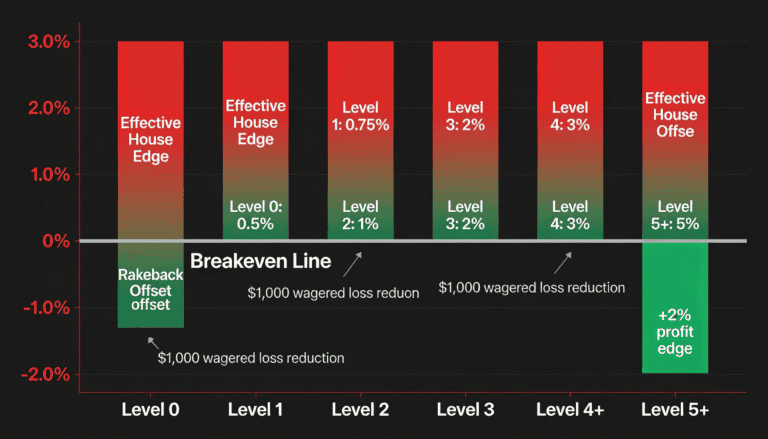
Stake’s VIP system offers rakeback on losses. This is the only mathematical way to reduce the house edge. Rakeback ranges from 0.5% (Level 0) to 5% (Level 5+).
Here’s what this means: At VIP Level 3 with 2% rakeback, your effective house edge drops from 3% to 1%. Over $1,000 wagered, you expect to lose $30 (3% house edge). But if you receive 2% rakeback on losses, you get $20 back. Your net loss: $10 instead of $30. That’s a 67% reduction in the house edge.
Rakeback is the only “edge” you get. It doesn’t improve your odds on individual spins. But it shrinks the long-term bleed. If you’re going to play Plinko regularly, climbing the VIP tiers is mathematically essential.
Rakeback Tiers: How Fast Can You Climb From Level 0 to Level 5?
| VIP Level | Rakeback % | Wagering Req. to Next Level | Approx. Time (at $100/session) | Effective House Edge |
|---|---|---|---|---|
| Level 0 | 0.5% | $5,000 | ~1 week | 2.5% |
| Level 1 | 0.75% | $25,000 | ~3 weeks | 2.25% |
| Level 2 | 1% | $100,000 | ~2 months | 2% |
| Level 3 | 2% | $250,000 | ~5 months | 1% |
| Level 4 | 3% | $500,000 | ~10 months | 0% |
| Level 5+ | 5% | $1,000,000+ | Long-term players | +2% (profit edge) |
Most casual players max out at Level 2–3. At Level 3 with 2% rakeback, the effective house edge is 1%. This is when Plinko becomes a reasonable long-term play. You’re still losing money, but you’re losing it 2x slower than without rakeback.
Plinko vs Crash vs Mines: Which Game Fits Your Strategy?
Stake has three main Originals. Each has different RTP, volatility, and strategic appeal. Here’s how they stack up:
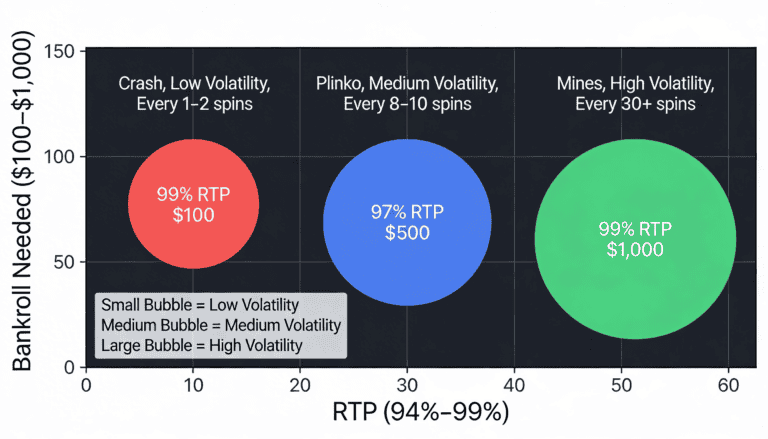
| Game | RTP | House Edge | Volatility | Payout Frequency | Bankroll Needed | Best For |
|---|---|---|---|---|---|---|
| Plinko | 97% | 3% | Medium | Every 4–8 spins | $500+ | Balanced players, medium strategy |
| Crash | 99% | 1% | Low | Every 1–2 spins | $100+ | Conservative players, frequent payouts |
| Mines | 96% | 4% | High | Every 20–30 spins | $1,000+ | Risk-tolerant players, big multiplier chasers |
The decision is simple: Crash gives you the best RTP and lowest house edge. Play that if you want the mathematically optimal game. Plinko is the middle ground (good RTP, medium volatility). Mines is for players chasing 500x+ multipliers and can afford 50-spin dry spells.
Common Plinko Mistakes That Drain Bankrolls (And How to Avoid Each)
Players lose money on Plinko not because the game is rigged, but because they repeat the same behavioral mistakes. Here are the top four, with how to avoid them.
Mistake #1: Starting With Max Bet on Your First Spin
You deposit $500. The max bet is $50. You want to feel the action immediately. So you bet $50 on spin 1. You lose. Now you have $450, you’re down 10%, and you feel the pressure to recover. You’re already in chasing mode.
Better approach: Start with 1% of your bankroll on the first 10 spins. $500 bankroll = $5 per spin for your first session. Feel the game. Learn the variance. Only increase your bet size after you’ve normalized the experience. Most players who jump to max bet immediately blow through their bankroll in 10–15 spins.
Mistake #2: Treating ‘I’ll Recover Losses With One Big Win’ as Strategy
You’re down $100. You think a single 1000x multiplier will fix it. Mathematically, you need a 1000x to win back your $100 (roughly). But hitting a 1000x multiplier on Plinko is extremely rare, depending on peg count. On 16 pegs, it’s approximately 1 in 5,000 spins. You’re statistically more likely to lose another $100 before you hit it.
This is chasing. And chasing is how $100 losses become $500 losses. The only cure: Stop playing when you hit your stop-loss limit. No exceptions.
Mistake #3: Playing While Stressed or Emotional
Bad days create bad bets. If you’re playing Plinko to escape a rough day, you’re already compromised. Emotional players abandon bet sizing, ignore stop-loss rules, and make larger bets to “feel better.” None of this improves your odds. It just accelerates the house edge’s work.
Real talk: If you’re stressed, angry, or using Plinko as emotional medicine, don’t play. Wait until you’re in a neutral mental state. The game will be there tomorrow. Your bankroll won’t be if you play emotional today.
Frequently Asked Questions
Can you actually win at Plinko on Stake?
Yes. Individual spins can win, and some players hit big multipliers (100x, 500x, even 1000x). But over time, the 97% RTP means you’ll lose money. Think of Plinko as entertainment with possible short-term gains, not as an income source. The house edge grinds every session. Winning requires luck plus discipline (bet sizing, stop-loss). Most players have neither.
What’s the best Plinko strategy for consistent wins?
No strategy beats a 3% house edge. Consistency comes from bankroll management and discipline, not from game mechanics. Flat betting, proper bet sizing, and stop-loss rules extend your playtime. This creates the illusion of “consistency,” but it’s really just slower losses. There is no “winning strategy” for a negative-expectation game.
Is the 1000x multiplier rigged or just rare?
It’s rare, not rigged. On 16-peg Plinko, hitting a 1000x is approximately 1 in 5,000 spins. Rare, but possible. Stake uses provably fair (blockchain seed), so results are verifiable. You can check your seeds post-hoc to confirm the multiplier was generated fairly. Rigging would be detected immediately.
What’s the maximum bet I should use on Plinko?
Never bet more than 2–5% of your total bankroll per spin. $500 bankroll = max $10–25 per spin. Higher bets accelerate losses during variance downswings and deplete your bankroll before recovery is possible. Most professionals stick to 1–2%.
How do I know if my Plinko account is fair or rigged?
Track 500+ spins and compare your actual RTP to the expected 97%. Variance will create swings (92–102% is normal), but larger samples normalize. Use Stake’s provably fair verification (click the seed icon after each spin) to confirm results match the blockchain hash. If actual RTP falls below 85% after 2,000 spins, contact Stake support and request an RTP audit.
Gambling involves risk. Never bet more than you can afford to lose. If you need support, visit BeGambleAware.org or contact a local helpline.

Secod has streamed and tested games on Stake extensively, giving him direct insight into the platform’s bonuses, features and gameplay conditions. His experience ensures every Stake review reflects real usage rather than surface level analysis.
Other Stake Blog
Is Stake.com Legit & Safe? BonusTiime Crypto Casino Audit 2025
February 17, 2026