How to Deposit Crypto: Complete Guide to Methods, Troubleshooting & Payment Speed
Welcome: Why Deposit Guides Matter
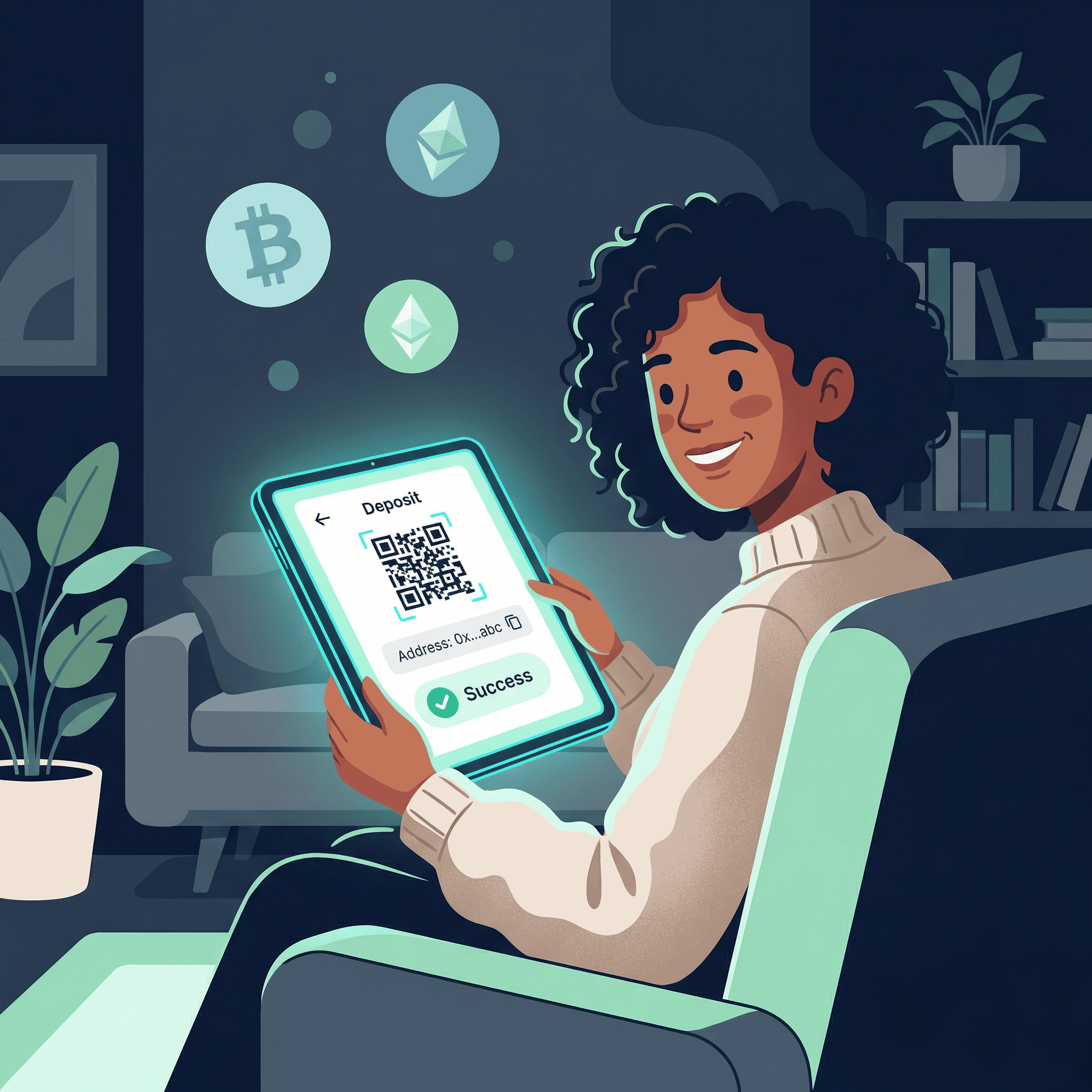
If you are reading this, you might be new to crypto deposits, recovering from a failed deposit, or simply curious about how crypto payments work. We understand deposits can feel confusing, especially if it is your first time. This guide covers everything you need to know: how to deposit safely, what to do if something goes wrong, and how to track your funds every step of the way.
The good news? Depositing crypto is not complicated once you know the basics. And if something does go wrong, most issues are fixable with the right steps.
Written by Secod on 29-01-2026


- Choosing the Right Network: ERC20, TRC20, BEP20 & More
- Deposit Not Showing Up? Troubleshooting Guide
- I Sent Crypto to the Wrong Address (or Wrong Network): What Now?
- Deposit Status: How to Track & What “Pending” Means
- Deposit Bonuses: Understanding Terms, Wagering & Promotions
- Deposit Limits: Minimums, Maximums & Account Tiers
- Deposit Security & Verification: Keeping Your Account Safe
- How Long Does Deposit Take? Timing by Crypto & Network
- Deposit Fees & Costs: What You’ll Pay & How to Minimize Them
- Still Having Issues? How to Contact Support
- Key Takeaways & Prevention Checklist
- Frequently Asked Questions
How to Deposit Crypto: Step-by-Step for All Methods
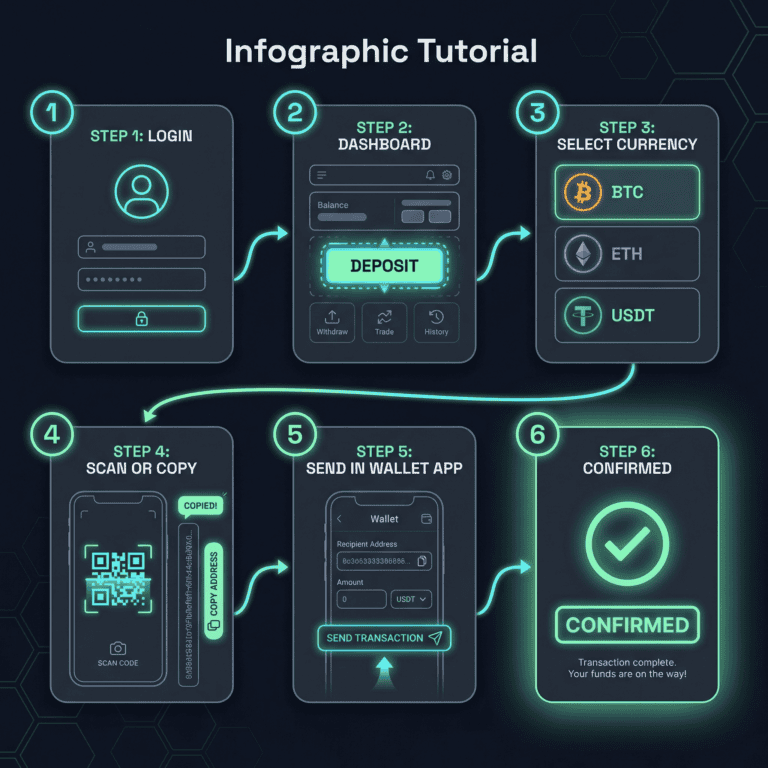
Every crypto deposit follows the same basic process, regardless of which cryptocurrency you are sending or which wallet you are using. Let us walk you through it.
The Basic Deposit Process (5 Steps)
Here are the universal steps that apply to all cryptocurrencies:
- Log into your account on our website or app
- Navigate to the Deposit section from your account dashboard
- Select your cryptocurrency type (Bitcoin, Ethereum, USDT, etc.)
- Copy your deposit address or scan the QR code we provide
- Send funds from your wallet or exchange to the address we gave you
- Confirm and wait for blockchain confirmation (typically 1–30 minutes)
We will explain each step in detail below, but this is the backbone of every deposit. Once you understand this flow, you can deposit any supported cryptocurrency.
Step 1: Log Into Your Account
Start by logging into your account on our website or mobile app. Use your email and password (or biometric login if enabled). Once logged in, you will see your account dashboard.
Step 2: Navigate to the Deposit Section
Look for the Deposit button or link in your account menu. This is usually on the main dashboard or under an Account or Wallet section. Click it.
Step 3: Select Your Cryptocurrency
You will see a list of supported cryptocurrencies. Select the one you want to deposit (Bitcoin, Ethereum, USDT, USDC, etc.). If you are unsure which to use, Bitcoin and Ethereum are the most common and widely supported.
Step 4: Copy Your Deposit Address or Scan QR Code
We will generate a unique deposit address for you. This address is like a mailbox: it is specific to your account, and only funds sent here will be automatically credited to you.
Important: Copy the address by clicking the copy button. Do not type it manually. Even one wrong character sends your funds to the wrong place.
Alternatively, if you are depositing from your phone, you can scan the QR code with your wallet app instead of copying the address.
Step 5: Send Funds From Your Wallet or Exchange
Open your cryptocurrency wallet (MetaMask, Trust Wallet, Ledger) or your exchange (Coinbase, Binance, Kraken). Look for the Send or Withdraw option. Paste the address you copied, enter the amount you want to deposit, and review the transaction details. Then send.
Your wallet or exchange may show a network fee (blockchain cost). This is normal and necessary. You will need to approve this fee to proceed.
Step 6: Confirm and Wait for Blockchain Confirmation
Your transaction is now on the blockchain. You will see it as Pending in your deposit history. The blockchain needs several confirmations (verifications) before we can credit your account. This typically takes 1–30 minutes, depending on which cryptocurrency and network you used.
Once confirmations are complete, your funds will appear in your account balance and are ready to use.
Depositing Bitcoin
Bitcoin is the most recognized cryptocurrency, but it is also one of the slowest to confirm. Here is what you need to know.
Bitcoin Mainnet vs. Lightning Network
Bitcoin has two main ways to deposit: the Bitcoin Mainnet (the standard blockchain) and the Lightning Network (a faster layer built on top).
Bitcoin Mainnet: This is the most common method. It is secure but slower. Typical time: 15–60 minutes. Fees are variable, usually $1–$5.
Lightning Network: This is much faster (seconds to minutes) and cheaper, but less commonly supported. If we offer it, choose it for speed and lower fees.
If you are unsure, use the Mainnet. It is the safest, most widely supported option.
Expected Timing & Fees
Bitcoin mainnet typically confirms in 15–60 minutes. During periods of high network activity (market volatility, major events), confirmation times can stretch to 1–2 hours. Network fees are not fixed; they depend on how busy the network is. You will see the estimated fee before you send.
Common Bitcoin Deposit Mistakes
The most common mistake is sending to the wrong address. Bitcoin addresses are long (26–35 characters) and look random. Always copy-paste the address; never type it. Another mistake is not waiting long enough before assuming the deposit is lost. Bitcoin can take an hour. Check the blockchain explorer (blockchain.com) to verify your transaction is progressing.
Depositing Ethereum (ETH)
Ethereum deposits are faster than Bitcoin and work well for larger amounts. Here is what you need to know.
Understanding Ethereum Mainnet
Ethereum mainnet is the primary Ethereum blockchain. When you deposit Ethereum (ETH) or ERC20 tokens (like USDT or USDC on Ethereum), they use the Ethereum mainnet by default. This is secure and widely supported.
ETH vs. ERC20 Tokens on Ethereum
ETH is the native Ethereum coin. ERC20 is a standard for tokens built on Ethereum. Popular ERC20 tokens include USDT, USDC, and DAI. The deposit process is identical for both; just select the token you want to send in Step 3.
Typical Timing & Gas Fees
Ethereum typically confirms in 5–15 minutes. Gas fees (network costs) are higher than newer networks but lower than Bitcoin. Expect $5–$30 depending on network congestion. If fees are very high, you can wait a few hours for congestion to decrease, or choose a different network (like Polygon) for the same token.
Depositing Stablecoins (USDT, USDC, BUSD)
Stablecoins are cryptocurrencies tied to the US dollar (or another fiat currency). They do not fluctuate in price, which makes them popular for deposits. USDT is the most common. Here is the critical thing to understand: stablecoins can exist on multiple networks.
USDT: Choosing the Right Network (TRC20, ERC20, Polygon)
USDT exists on Ethereum (ERC20), Tron (TRC20), Polygon, and other networks. Each network version is identical in value but uses different networks to move money.
ERC20 (Ethereum): Secure, widely recognized. Fees higher. Time: 5–15 minutes.
TRC20 (Tron): Very fast and very cheap. Fees often under $1. Time: instant to 60 seconds. Excellent for small to medium deposits.
Polygon: Fast, cheap, Ethereum-compatible. Fees under $1. Time: 1–5 minutes. Growing in popularity.
All three options are equally safe. The only difference is speed and cost. If we support multiple networks for USDT, choose based on your priority: speed (Tron), cost (Polygon or Tron), or security (Ethereum).
USDC and Other Stablecoins
USDC, BUSD, and other stablecoins work the same way. You will choose the network when depositing. Check which networks we support for each stablecoin.
Why Stablecoins Are Popular for Deposits
Stablecoins do not lose value while you wait for confirmation. If you deposited a volatile coin like Bitcoin and had to wait an hour, the price might drop. With a stablecoin, it stays at $1 (or whatever it is pegged to). This removes price risk during the deposit waiting period.
Other Cryptocurrencies (Litecoin, Dogecoin, etc.)
We support many cryptocurrencies beyond Bitcoin, Ethereum, and stablecoins. Litecoin, Dogecoin, Ripple (XRP), and others follow the same basic deposit process: select the crypto, copy the address, send from your wallet, and wait for confirmations.
Timing and fees vary by coin. If you are unsure about a specific coin, contact our support team or check the deposit page for timing estimates.
Depositing From Your Wallet vs. Exchange
You can deposit from two types of sources: a personal wallet or a cryptocurrency exchange. The process is identical from our end; the only difference is the sending platform.
Depositing From MetaMask or Trust Wallet
These are personal wallets you control. In MetaMask or Trust Wallet, go to Send or Withdraw, paste our deposit address, select the network, enter the amount, and confirm. The wallet will show a gas fee; approve it and the transaction will send.
Depositing From Coinbase or Binance
These are exchanges. Go to Withdraw, select the cryptocurrency, paste our deposit address, select the network if prompted, enter the amount, and confirm. Some exchanges may ask for a memo or destination tag (for certain coins like XRP). Do not skip this if asked; it is required. The process is otherwise identical to a personal wallet.
Depositing From a Hardware Wallet (Ledger, Trezor)
Hardware wallets are physical devices that store your crypto offline for security. Connect your hardware wallet to your computer or use the mobile app. Send from there the same way you would send from MetaMask or Trust Wallet. The extra security step (confirming on the device) is normal.
—
Choosing the Right Network: ERC20, TRC20, BEP20 & More
If you see terms like ERC20, TRC20, or BEP20 when depositing, you are choosing which network to use. This is one of the most common sources of confusion, so let us clarify it.
What Are Networks? (Simple Explanation)
Think of networks as shipping routes. Bitcoin uses the Bitcoin network. Ethereum uses the Ethereum network. But some cryptocurrencies (especially stablecoins like USDT) can travel on multiple networks. Choosing the right network ensures your crypto arrives quickly and cheaply.
If you pick the wrong network, your funds may not appear in your account (and recovery may be difficult). If you pick the right network but the wrong address, your funds are lost permanently. This section helps you pick the right network. The address section below covers sending to the wrong address.
ERC20 (Ethereum Network)
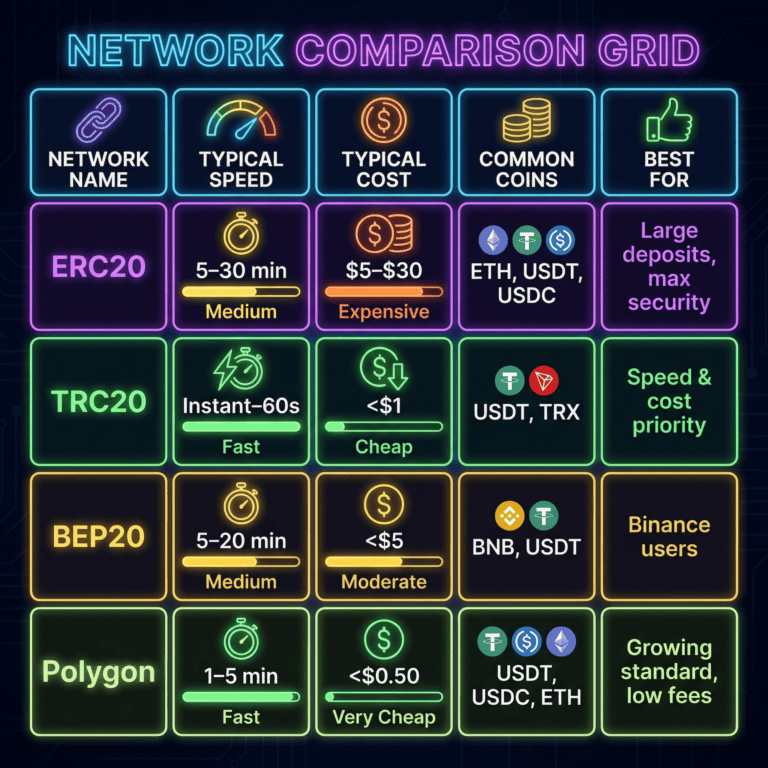
ERC20 is the standard Ethereum network. It is the most secure and widely recognized. Most large-cap cryptocurrencies and tokens are available on ERC20.
Speed: 5–30 minutes (depends on congestion).
Cost: $5–$50+ during peak times. Lower during off-peak.
Best for: Large deposits where security is the priority. Users who prefer Ethereum ecosystem tokens.
Common coins: Ethereum (ETH), USDT, USDC, DAI.
TRC20 (Tron Network)
TRC20 is the Tron network. It is newer and less well-known than Ethereum, but it is very fast and very cheap. It is especially popular in Asia.
Speed: Instant to 60 seconds.
Cost: Under $1 (often nearly free).
Best for: Cost-conscious users and frequent small deposits. Users who want instant or near-instant confirmation.
Common coins: USDT (very common on TRC20), TRX (Tron native token).
BEP20 (Binance Smart Chain)
BEP20 is the Binance Smart Chain network. It is fast, cheap, and compatible with Ethereum tools (like MetaMask). It is growing in popularity.
Speed: 5–20 minutes.
Cost: Under $1 to $5.
Best for: Balance of speed, cost, and security. Users familiar with Binance.
Common coins: Binance Coin (BNB), USDT, BUSD.
Polygon (MATIC)
Polygon is a layer-2 network built on top of Ethereum. It combines Ethereum’s security with very fast and cheap transactions.
Speed: 1–5 minutes.
Cost: Under $0.50 (usually pennies).
Best for: Users who want Ethereum security with faster speed and lower cost. Becoming the standard for low-fee deposits.
Common coins: USDT, USDC, Ethereum, Polygon (MATIC).
Other Networks (Ripple/XRP, Stellar/XLM, EOS, Cosmos, Solana)
We may support other networks depending on the cryptocurrency. Each has unique characteristics:
- Ripple (XRP): Fast (5–10 minutes), requires memo/tag. Popular for international transfers.
- Stellar (XLM): Very fast (few minutes), also requires memo/tag.
- Solana (SOL): Very fast (seconds to minutes), low cost.
- Cosmos (ATOM): Moderate speed (1–5 minutes).
For each supported cryptocurrency, we will show you which networks are available. Pick based on your priority.
How to Choose the Right Network
Here is the decision framework:
- Check which networks we support for your cryptocurrency. Our deposit page shows this clearly.
- Choose based on your priority:
- Fastest: Polygon, Tron, Solana.
- Cheapest: Polygon, Tron, Stellar (if supported).
- Most secure/recognized: Ethereum mainnet.
- When in doubt, use our recommended default. We will suggest the best network for each coin.
Most deposits confirm within 30 minutes regardless of network. Unless you need instant confirmation or have a specific preference, any supported network is fine.
Common Network Confusion: What Happens If You Choose Wrong?
If you select the wrong network, your deposit will not appear in your account. Here is the critical distinction:
- Sent to wrong address (not ours): Funds are lost permanently. The blockchain is immutable.
- Sent to our address but on the wrong network: Funds may be recoverable. We may be able to retrieve them from the network and credit your account manually.
We address the unrecoverable scenario in detail below. For now, the takeaway: choose the network carefully, but if you pick the wrong one, contact us immediately. There is a chance we can fix it.
—
Deposit Not Showing Up? Troubleshooting Guide
Your deposit should appear in your account within minutes to half an hour. If it has not, do not panic. Most delays are just the blockchain doing its job. Let us walk through the diagnostic steps.
Deposit Missing: First 5 Minutes After Sending
Deposits are not instant. When you send crypto, the transaction has to propagate to the blockchain network (30 seconds to 2 minutes), then get confirmed by miners or validators (seconds to minutes), then sync with our system. Total time: 1–5 minutes typically, longer if the network is busy.
If it has been less than 5 minutes, wait. Grab a coffee. Most deposits appear within this time frame. If you are still not seeing it after 10 minutes, proceed to the steps below.
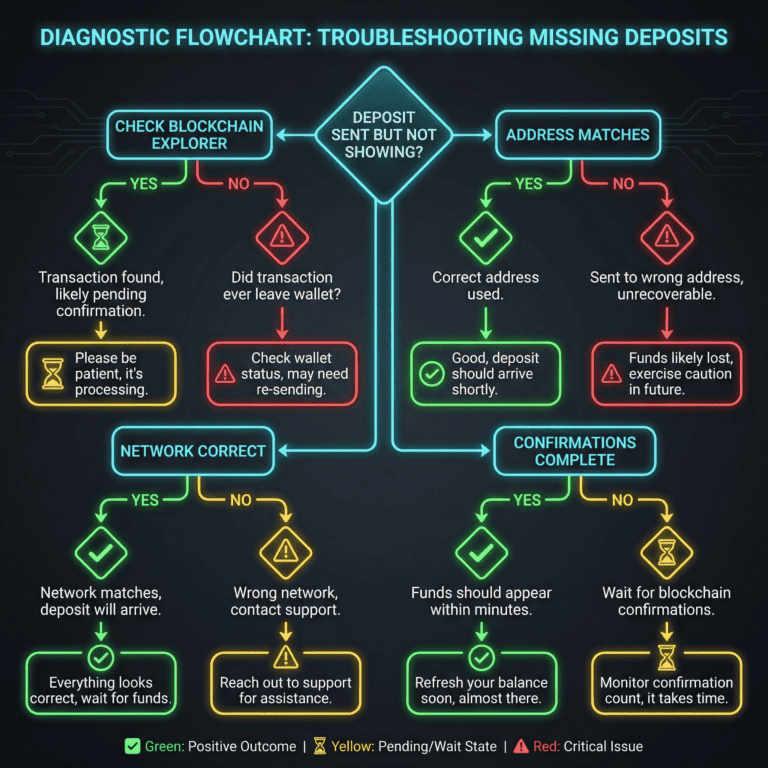
Step 1: Check the Blockchain (Verify Funds Sent)
The blockchain is like a public ledger. Every transaction is recorded. If your deposit is on the blockchain, it will arrive eventually.
To check the blockchain, use a blockchain explorer. These are free, public tools:
- Bitcoin: blockchain.com or blockchair.com
- Ethereum: etherscan.io
- Tron: tronscan.org
- Polygon: polygonscan.com
How to check: Go to the explorer, paste your deposit address in the search box, and hit Enter. You will see all transactions to that address. Look for your transaction. If you see it, the funds are definitely coming. If you do not see it, the transaction either failed or was never sent from your wallet.
If you see it: Move to Step 4 below (checking confirmations).
If you do not see it: Check your wallet or exchange. Did the withdrawal actually send, or did it fail? Look at your transaction history on the sending platform. If it shows failed, try again. If it shows pending, wait for it to go through before checking the blockchain again.
Step 2: Verify You Used the Correct Deposit Address
Blockchain addresses are exact. One wrong character sends funds to the wrong place.
How to verify: Go to your account deposit history. Find your recent deposit. Compare the receiving address to the one we gave you on the deposit page. They must match exactly, character for character.
Pro tip: You can use Ctrl+F (or Cmd+F on Mac) to search for a portion of the address in both places. If they do not match, the funds went to a different address.
If the address matches: Proceed to Step 3 (checking network).
If the address does not match: Unfortunately, if you sent to a different address, the funds are in someone else’s wallet. We will address this in detail in the “Wrong Address” section below. The short answer: wrong address deposits are not recoverable.
Step 3: Confirm You Selected the Correct Network
This is the most common error with stablecoins like USDT. You might have sent USDT on Ethereum, but we only accept USDT on Polygon. In that case, your deposit will not appear in your account, but it may be recoverable.
How to check: Go to the blockchain explorer, find your transaction, and look at which network it is on. Compare this to which networks we accept for that cryptocurrency.
If it is on a different network than we support, this is fixable. Contact support immediately with your transaction hash (a long string of letters and numbers identifying your transaction). We will assess whether we can recover the funds. Recovery is possible but not guaranteed; it depends on technical feasibility.
If the network matches: Proceed to Step 4 below.
Step 4: Check If Your Deposit Is Pending Confirmations
Blockchain confirmations are like verification steps. Each confirmation adds security. Once your transaction has enough confirmations, we credit your account.
Typical confirmation requirements:
- Bitcoin: 6 confirmations (~60 minutes)
- Ethereum: 12 confirmations (~3–5 minutes)
- Polygon: 35+ confirmations (~2–3 minutes)
- Tron: 19 confirmations (~30–60 seconds)
How to check: Look at your deposit history in your account. It should show something like “Pending: 3 of 12 confirmations.” This means the transaction is on the blockchain and progressing. No action needed; just wait.
You can also check the blockchain explorer. It will show the current confirmation count for your transaction.
If you see pending confirmations: Your deposit is on the way. Wait for all confirmations to complete. Once done, your balance will update instantly.
If confirmations show complete but your account still shows pending: Rare, but it happens. Refresh your page or wait 5 minutes. Our system sometimes takes a few extra minutes to sync. If it still shows pending after 10 minutes, contact support.
Step 5: Check Your Wallet or Exchange Transaction Status
Confirm the withdrawal was successful on the sending side.
In MetaMask, Trust Wallet, or Ledger: Look at your activity or transaction history. Find the outgoing transaction. What does it say? Confirmed? Pending? Failed? If it says failed, the deposit never left your wallet. Try again.
In Coinbase, Binance, or Kraken: Go to Withdraw history. Find your withdrawal. Does it show completed? If yes, the funds are in motion. If it shows pending, wait. If it shows failed, you can retry.
If the sending transaction is confirmed: Combine all the checks above. If blockchain explorer shows it, address matches, network is correct, and confirmations are progressing, your deposit is arriving. Just wait.
Still Not Showing? It Has Been Over 30 Minutes
At this point, we need your help to investigate. Gather the following information:
- Cryptocurrency type and amount (e.g., “0.5 BTC” or “100 USDT”)
- The deposit address we gave you (from your account history)
- Your blockchain transaction hash (from the explorer)
- The network you used (Bitcoin, Ethereum, Tron, Polygon, etc.)
- Your account ID (from your account settings)
Contact our support team with this information. We will investigate and get back to you. Most issues resolve within 24 hours.
—
I Sent Crypto to the Wrong Address (or Wrong Network): What Now?
This is a high-anxiety scenario, but let us be clear about what is recoverable and what is not.
Sent to Wrong Address (Outside Our Platform): Likely Unrecoverable
If you sent to an address that is not one of our deposit addresses, the funds are now in someone else’s wallet or a lost address. The blockchain is permanent and immutable. No one can reverse transactions. We cannot retrieve funds from another wallet.
This is true for all blockchains and all platforms. It is a security feature of cryptocurrency: only the person who holds the private key to that address can move the funds.
We are very sorry, but funds sent to the wrong address are not recoverable. This is why verification is so important.
What to do now: If this just happened, contact our support team immediately. In rare cases, the address might have been one we recently deactivated or one you misread. We will check. But if it is truly a different address, there is nothing we or anyone can do.
For the future: Always copy-paste addresses, never type them. For large amounts, send a small test amount first. Use a checksum verification tool if available.
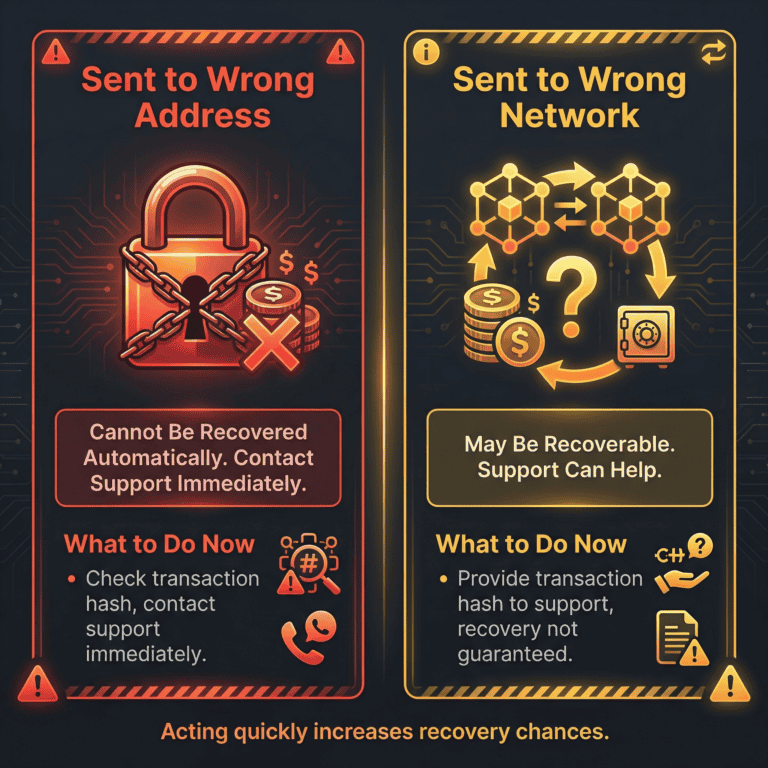
Sent to Wrong Network (But Right Address): Likely Recoverable
If you sent to our correct address but on the wrong network (for example, USDT on Ethereum instead of Polygon), there is hope. Here is why: the address exists on multiple blockchains, so the funds are technically in a wallet we control, just on the wrong chain. Recovery depends on technical feasibility, but it is possible.
What to do: Contact support immediately with:
- The exact transaction hash
- The network you used
- The amount and cryptocurrency type
Our team will assess recovery options. This may take 24–48 hours.
Manage expectations: Not all wrong-network deposits can be recovered. It depends on the network pairing and our technical capabilities. But if you act immediately, we have the best chance of helping.
Sent Without Memo or Tag (for Coins That Require Them)
Some cryptocurrencies, like Ripple (XRP) and Stellar (XLM), require a memo or tag in addition to the address. Think of it like an address and apartment number. If you send to the address without the memo, the funds land in a shared wallet, not your individual account.
If this happened: Contact support immediately with your transaction hash. We will manually credit your account once we verify the deposit. This usually takes 24 hours.
Our deposit page clearly indicates if a memo or tag is required. Always read the deposit instructions for each cryptocurrency.
My Funds Are Lost: What Are My Options?
If your deposit was sent to a truly different address (not ours) on the blockchain, it is permanent. Blockchains are designed to be irreversible; that is their core security feature.
We understand this is frustrating. But here is what you can do now:
- Contact our support team to confirm the address is not recoverable. Sometimes there is a small chance.
- Report it to your wallet provider or exchange, in case they have recovery options (unlikely, but worth asking).
- Document the transaction for your records and taxes (lost crypto is tax-deductible in some jurisdictions).
- Learn from it: next time, verify address in writing, send a small test amount first, or use address whitelisting in your wallet.
—
Deposit Status: How to Track & What “Pending” Means
You want to know where your deposit is at every moment. Here is how to track it and what each status means.
Where to Check Your Deposit Status in Your Account
Log in to your account and go to the Deposits section (usually under Account or Wallet). You will see a list of all your deposits with the following details:
- Cryptocurrency: What you sent (Bitcoin, Ethereum, etc.)
- Amount: How much
- Date sent: When you initiated the transaction
- Status: Pending or Confirmed
- Confirmations: Progress toward full confirmation (e.g., 3 of 12)
Pending means the transaction is on the blockchain but not yet fully confirmed. Confirmed means all confirmations are complete and you can use the funds.
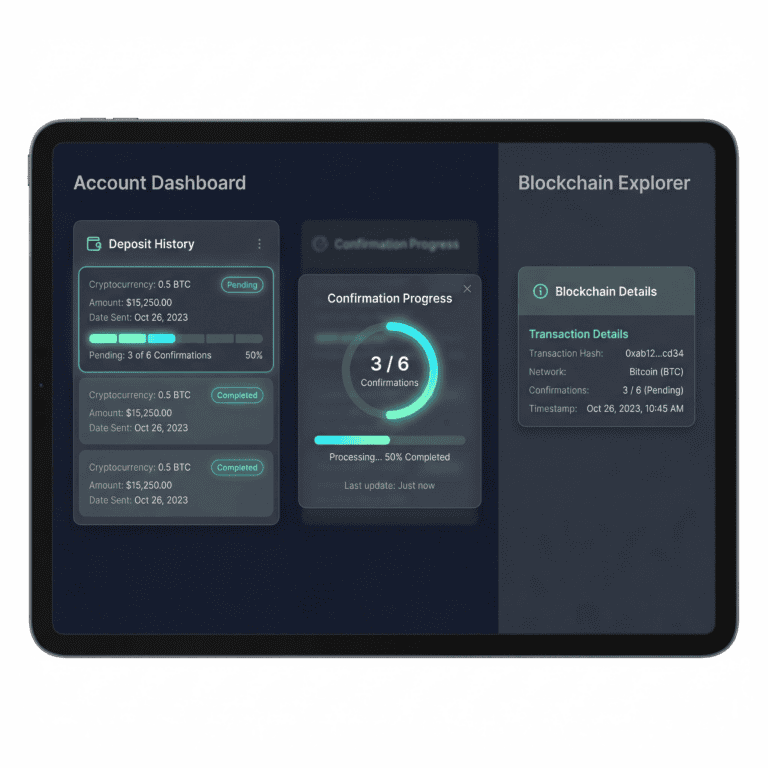
Understanding Blockchain Confirmations
Blockchain confirmation is like mail traveling through a postal system. Each confirmation is another sorting office handling your letter. Once it reaches enough sorting offices (usually 3–12, depending on the blockchain), it is considered fully delivered and secure.
Each blockchain has a different confirmation requirement:
- Bitcoin: 6 confirmations required (approximately 1 hour).
- Ethereum: 12 confirmations required (approximately 2–3 minutes).
- Polygon: 35+ confirmations required (approximately 2–3 minutes).
- Tron: 19 confirmations required (approximately 30–60 seconds).
This is automatic. You do not need to do anything. The network handles it. And you cannot speed it up; we all have to wait.
How Long Until My Deposit Is Confirmed?
Typical timing:
- Bitcoin: 10–60 minutes
- Ethereum: 2–15 minutes
- Polygon: 1–5 minutes
- Tron: 15–60 seconds
These times assume normal network conditions. During peak congestion (market crashes, major events), times can stretch significantly. Bitcoin might take 2 hours. Ethereum might take 30 minutes. But it always eventually confirms.
Once fully confirmed, your balance updates instantly and you can use the funds.
Checking the Blockchain Directly (Blockchain Explorer)
For the impatient: you can check your exact confirmation status on the blockchain before we credit your account.
Go to the relevant blockchain explorer (Etherscan for Ethereum, Tronscan for Tron, etc.), paste your deposit address, and search. You will see your transaction with the current confirmation count. This is the source of truth. If it shows confirmed, your funds are ours and will be credited. If it shows pending, your funds are on the way.
My Deposit Shows “Confirmed” But I Do Not See the Balance
Confirmed on the blockchain does not always mean confirmed in our system immediately. Sometimes our system takes a few extra minutes to sync. Refresh your page. If it still shows not credited after 5 minutes, refresh again. Our system usually catches up within 10 minutes.
If it has been over 30 minutes and the blockchain shows confirmed but your account does not, contact support. If the blockchain shows confirmed, your funds are definitively ours and will be credited. No funds are ever lost at this stage.
—
Deposit Bonuses: Understanding Terms, Wagering & Promotions
Deposit bonuses are free money we add to your account when you deposit. But they come with conditions. Let us explain how they work and what they actually mean for you.
What Is a Deposit Bonus?
A deposit bonus is free funds we credit to your account when you make a qualifying deposit.
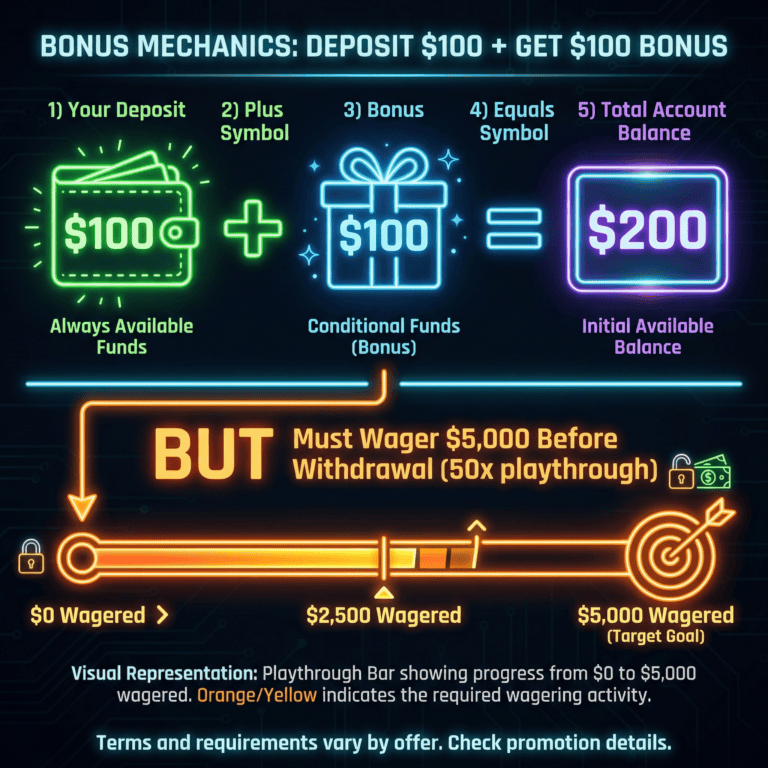
Example: You deposit $100. We add a $100 bonus. You now have $200 in your account.
The catch: Bonuses usually come with a wagering requirement. You have to bet the bonus (and sometimes your original deposit) a certain number of times before you can withdraw the bonus money. This is called playthrough.
Your original deposit is always yours. Only the bonus funds have wagering requirements.
First Deposit Bonus
Your first deposit often qualifies for our most generous bonus. A common offer is “100% match up to $500.” Here is what that means:
- You deposit: $500
- We add: $500 bonus (100% match)
- You have: $1000 total
- But you must wager: $1000 × 50x playthrough = $50,000 in total bets
Some bonuses require a promo code. Find the code on our promotions page, enter it at checkout, and the bonus credits automatically. If you forget the code, contact support; we can apply it retroactively in many cases.
Reload Bonuses & Ongoing Promotions
After your first deposit, we offer reload bonuses on subsequent deposits. These are smaller than the first deposit bonus but still worthwhile. A typical reload might be “50% match up to $250.”
Reload bonuses usually apply once per day or once per week, depending on our current promotion. Check the promotions page regularly for active offers.
Wagering Requirements & Playthrough (The Catch)
The wagering requirement (or playthrough) is how many times you must bet the bonus before you can withdraw it.
Example: $100 bonus, 50x wagering requirement. You must wager $5000 total (100 × 50) before the bonus becomes withdrawable. All your bets across all games count toward this total.
Important: This applies to the bonus only. Your original deposit is always available. The wagering requirement just means you cannot withdraw the bonus money until you have wagered it sufficiently.
Wagering requirements are standard across all online casinos. They protect against fraud. But they do mean bonuses come with a catch.
Bonus Terms & Conditions (What to Read)
Each bonus offer has specific terms. Before claiming a bonus, skim these key points:
- Minimum deposit: Some bonuses require a deposit of at least $50 or $100.
- Bonus amount or match %: How much free money will you get?
- Wagering requirement: How many times must you bet it?
- Expiration date: How long do you have to complete the wagering?
- Eligible games: Do all games count, or are some excluded? (Some bonuses exclude low-risk games like sports betting.)
Our terms are fair and transparent. If anything is unclear, contact support.
Bonus Not Credited or Not Working? Troubleshooting
If your bonus did not appear after your deposit, here are the most common causes:
- Did not enter bonus code: Some bonuses require a code at checkout. Check if one was needed and enter it now if possible.
- Bonus expired: Bonuses have expiration dates. Check the offer details.
- Deposit does not meet minimum: Some bonuses require a minimum deposit. You might have deposited below the threshold.
- Account not verified: We may require account verification before crediting bonuses.
- Bonus not available in your region: Some offers are region-specific. Check if it applies to you.
If none of these apply, contact support with your deposit details and the bonus offer name. We will investigate.
Using Crypto Deposits for Bonuses
Crypto deposits qualify for bonuses the same as other payment methods. There are no crypto exclusions (unless noted in a specific offer). Use your bonus code with your crypto deposit, and the bonus will credit just like with any other method.
—
Deposit Limits: Minimums, Maximums & Account Tiers
How much can you deposit? It depends on your account tier and our policies. Let us break this down.
Minimum Deposit Amount
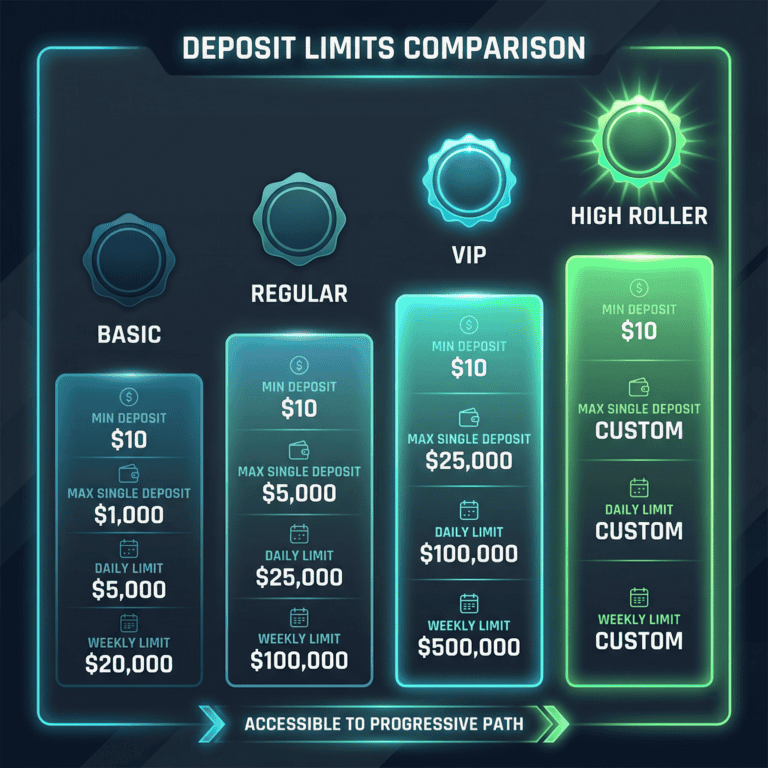
We require a minimum deposit to process transactions efficiently. The minimum is typically $10 or the equivalent in cryptocurrency. You can deposit any amount at or above this minimum.
For most users, this minimum is very accessible. If you have questions about whether a specific amount qualifies, contact support.
Maximum Single Deposit
There is a maximum per single deposit to manage platform liquidity and comply with regulations. This maximum varies by account tier and may be $1000, $5000, $50,000, or higher depending on your account status.
If you want to deposit more than the maximum, you can make multiple deposits. Each will be processed separately.
Daily, Weekly & Monthly Deposit Limits
In addition to per-deposit limits, we set cumulative limits on how much you can deposit within a day, week, or month. These reset automatically on the set schedule (e.g., daily limit resets at midnight).
These limits help us prevent fraud and protect users. But they are set generously for regular players. Most casual users will never hit them.
Account Tiers: Basic, Regular, VIP, High Roller
As you play and earn loyalty points or status, your account tier may increase. Higher tiers have higher deposit limits:
- Basic: Lower limits ($10–$1,000 per deposit, $5,000 daily)
- Regular: Standard limits ($10–$5,000 per deposit, $25,000 daily)
- VIP: Higher limits ($10–$50,000 per deposit, $100,000 daily)
- High Roller: Highest limits (custom; contact support)
Your tier is determined automatically based on your account activity. Tier perks are applied instantly; no action needed.
Requesting a Limit Increase
If you want to deposit above your current limit, contact support with your account ID and desired new limit. We may require account verification (to comply with regulations). Most reasonable requests are approved within 24 hours.
Increases are subject to our risk and compliance policies. We assess each request individually.
Deposit Limit Caps (Responsible Gaming)
You can also set your own limits to protect yourself. We offer tools to impose daily, weekly, or monthly deposit caps.
To set a limit, go to Account Settings > Responsible Gaming > Deposit Limits. You can adjust or remove these limits anytime. Setting deposit limits is a healthy practice and a sign of responsible gaming.
—
Deposit Security & Verification: Keeping Your Account Safe
We protect your account through verification and security measures. Here is how it works and why it matters.
Why We Verify Deposits (AML & KYC Compliance)
We verify deposits as required by law. AML stands for anti-money laundering. KYC stands for know-your-customer. These regulations exist to prevent fraud, money laundering, and illegal activity.
Verification protects both you and us. It ensures your account is legitimate and that deposits come from you, not a stolen card or hacked wallet.
Verification is normal, required, and confidential. Your information is encrypted and secure. We do not share it with third parties.
First deposits may be delayed 24–48 hours while we verify your account. Subsequent deposits are typically instant once you are verified.
Account Verification: ID, Address & Source of Funds
To verify your account, we may request:
- Valid ID: Passport, driver’s license, or national ID card
- Proof of address: Utility bill, bank statement, or government letter (must be recent, usually within 3 months)
- Source of funds: Where your deposit money comes from (employment, savings, sale of goods, etc.)
This is standard across all regulated online gambling platforms.
How to submit: Upload documents through your account dashboard. Our verification team reviews them and gets back to you within 24 hours, usually faster.
Privacy: We collect only the minimum information necessary. Your documents are encrypted and stored securely.
Deposit Address Verification: Why We Show Unique Addresses
We generate a unique deposit address for each of your deposits. This allows us to automatically know which deposit is yours and credit it instantly. It is like a personalized mailbox.
Keep your address confidential. Do not share it publicly. Treat it as you would a bank account number.
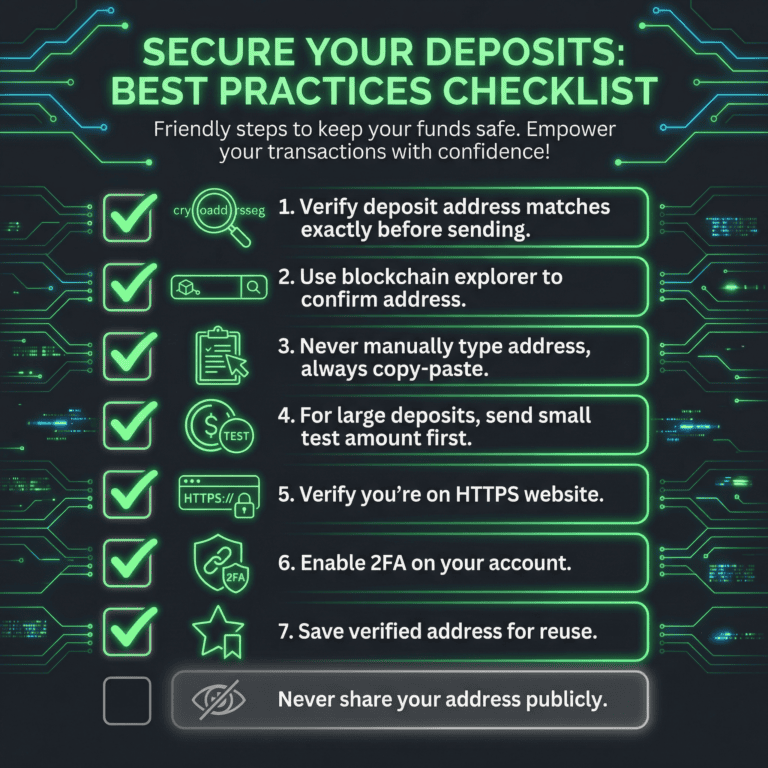
Best Practices: Safe Deposit Habits
Follow these simple habits to prevent security issues:
- ☐ Verify address before sending: Copy-paste the address; never type it manually. Even one wrong letter matters.
- ☐ Send a small test deposit first: For new addresses or large amounts, test with $10 or $50 first. Once it arrives, send the full amount.
- ☐ Use HTTPS only: Our website uses HTTPS (secure). Check the URL bar. If it says HTTP (not HTTPS), do not proceed.
- ☐ Enable 2FA on your account: Two-factor authentication adds a second layer. Enable it in Account Settings.
- ☐ Do not share your address: Do not post it on social media or public forums. Bad actors can target you.
- ☐ Do not click deposit links in emails: If an email asks you to click a link to deposit, go directly to our website instead. Many scams impersonate casinos in email.
These simple habits prevent 99% of security issues.
Phishing & Scams: How to Avoid Them
Scammers sometimes impersonate online casinos in emails or fake websites. They might ask you to “confirm” your deposit address or click a link to “speed up” your deposit. Here is how to protect yourself:
- We never ask you to verify your address outside our official website. If an email asks you to, it is a scam.
- We never send links in emails to deposit. Always go directly to our website by typing the URL yourself (or using a bookmark). Do not click email links.
- Check the URL. Make sure it is our real website. Scammers create fake URLs that look similar but are slightly different.
- Never give anyone your private key, seed phrase, or 2FA code. We will never ask for these. If someone asks, it is a scam.
- If something feels off, contact support directly. Use the number or email from our website, not from an email. Verify it is us before proceeding.
No-KYC vs. Full-KYC Deposits
We require verified account information before crediting deposits. This is mandatory for security and regulatory compliance.
However, first small deposits may be processed while verification is in progress, pending final approval. But verification must be complete before you can withdraw funds or claim large bonuses.
Verification is non-negotiable but fast: most accounts are verified within 24 hours.
—
How Long Does Deposit Take? Timing by Crypto & Network
Your deposit is not lost if it does not arrive instantly. Blockchain confirmation takes time. Here is what to expect.
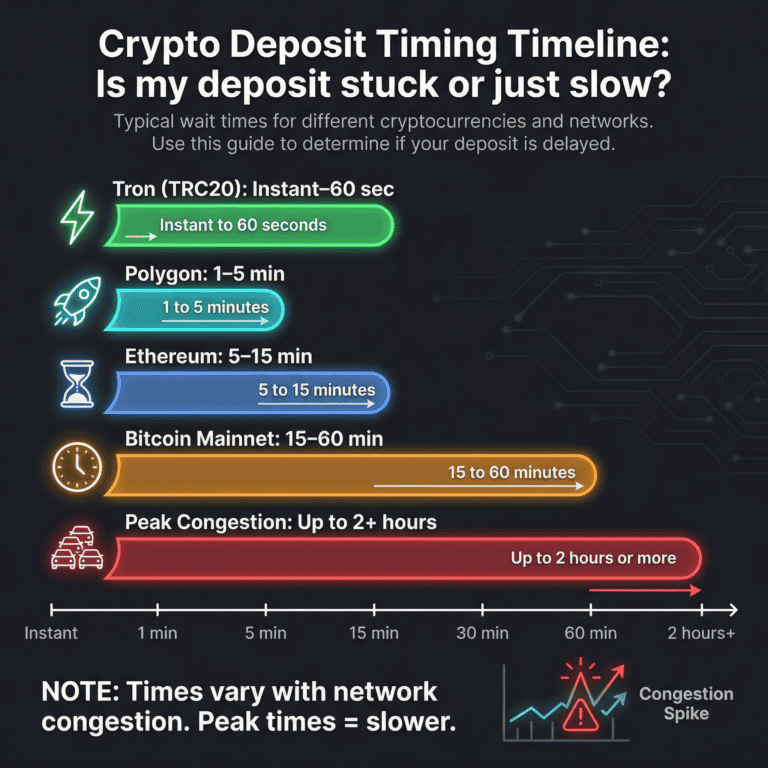
Typical Deposit Times by Cryptocurrency
- Bitcoin: 15–60 minutes
- Ethereum: 5–15 minutes
- Polygon: 1–5 minutes
- Tron: 15–60 seconds
- Ripple (XRP): 5–10 minutes
Note: These are typical times under normal network conditions. During peak congestion (market volatility, major events), times can increase significantly.
Fastest Deposit Methods (Polygon, Tron, Layer 2s)
If you want the fastest deposit, use Polygon or Tron. Both typically confirm in 1–60 seconds. The trade-off: they are less well-known than Bitcoin or Ethereum. But they are fully safe and increasingly popular.
Layer 2 networks like Polygon are built on top of Ethereum, so they inherit Ethereum’s security while being much faster and cheaper.
Why Do Deposits Take Time? (Blockchain Confirmation)
Blockchains need multiple confirmations (verifications) before they consider a transaction final. Bitcoin requires 6 confirmations. Ethereum requires 12. This is built into blockchain security. We cannot skip this; we must wait.
Think of it like a bank clearing a check. It does not instantly move to your account. It goes through clearing, verification, then settlement. Blockchains work the same way, except the process is public and transparent.
Once all confirmations are done, funds appear in your account instantly.
Network Congestion: Why Deposits Are Sometimes Slower
Blockchains get busy. During peak times (market crashes, major news events, holidays), more people are transacting. Confirmations take longer.
Bitcoin mainnet can take 1–2 hours during heavy congestion. Ethereum can take 30+ minutes. We cannot speed this up; it is blockchain-wide.
What you can do: During heavy congestion, use a faster network (Polygon or Tron). Or wait for congestion to ease (usually within a few hours).
Speeding Up a Slow Deposit
Once a transaction is on the blockchain, we cannot speed it up. But for your next deposit, you can:
- Use a faster network (Polygon instead of mainnet)
- Pay a higher gas fee for faster confirmation (option in your wallet/exchange)
- Avoid peak congestion times (e.g., do not deposit during major market moves)
Slow deposits always eventually complete. Patience is required.
When Your Deposit Is Taking Longer Than Expected
If timing exceeds our usual estimates:
- Check the blockchain explorer. Search your address. Most “stuck” deposits are just slow, not truly stuck.
- If blockchain shows pending, wait. Patience is required. It will confirm eventually.
- If blockchain shows confirmed but account shows pending, refresh your page or wait 5 minutes. Our system may be syncing.
- If no blockchain activity, contact support. This is rare, but it might indicate the transaction never left your wallet.
—
Deposit Fees & Costs: What You’ll Pay & How to Minimize Them
Deposits have costs, but they vary significantly by network and cryptocurrency. Here is how to understand and minimize them.
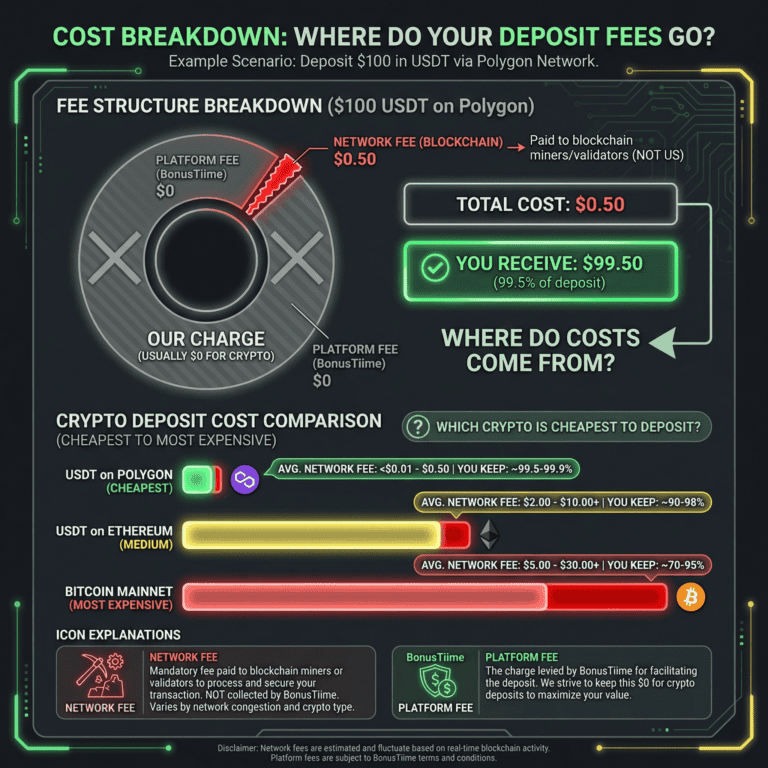
Types of Deposit Fees: Network vs. Platform
There are two types of fees:
- Network fee (gas): This is paid to the blockchain miners or validators, not to us. It is necessary for the blockchain to process your transaction. We do not receive this fee.
- Platform fee: This is what we charge you (if anything). For crypto deposits, we usually charge $0 platform fee.
Bottom line: You pay a network fee (mandatory, goes to the blockchain) and usually no platform fee (we absorb this cost).
Typical Fees by Network
- Bitcoin mainnet: $1–$20+ (variable, depends on network congestion)
- Ethereum mainnet: $5–$30+ (higher during peak times)
- Polygon: $0.01–$0.10 (very low)
- Tron: $0–$1 (often nearly free)
These are typical ranges. Fees fluctuate with network demand. During peak congestion, mainnet fees spike. During off-peak hours, they are lower.
Who Pays the Fee?
You do. The network fee is deducted from your deposit. If you deposit $100 and the network fee is $2, you receive $98 in your account.
We cannot waive network fees; they go to the blockchain itself. But we can occasionally reimburse platform fees for VIP members or run promotions that cover fees.
No-Fee Deposits (BonusTiime Fee-Free Promotions)
We periodically offer promotions where we reimburse network fees or waive platform fees. Check our promotions page for current offers.
Even when we waive platform fees, blockchain network fees still apply. But using cheap networks (Polygon, Tron) keeps those fees minimal anyway.
Choosing the Cheapest Deposit Method
To minimize fees, follow this logic:
- For deposits under $100: Use Polygon or Tron. Fees are pennies.
- For deposits $100–$1000: Polygon or Tron still best. Or use mainnet if you prefer those networks.
- For deposits over $1000: Network fee matters less. Choose based on speed or security preference.
- During peak congestion: Use Polygon or Tron. Mainnet fees spike; cheaper networks do not.
Estimating Your Deposit Cost
Before sending, check the expected network fee. Most wallets show this. You can also check a blockchain fee estimator (e.g., Etherscan’s gas tracker for Ethereum).
Example: “Ethereum current gas is 50 gwei, average fee $15.” Or: “Tron current fee is $0.50.”
This helps you decide if the network is worth it for your deposit size.
—
Still Having Issues? How to Contact Support
We are here to help. If you cannot resolve your deposit issue using the steps above, contact us.
When to Contact Support
Reach out if:
- Your deposit has not appeared after 30+ minutes and you have completed all checks above
- You sent to the wrong network or wrong address and need recovery help
- Your bonus did not credit
- Your account verification is pending and taking longer than expected
- You see an error message you do not understand
- Any other deposit issue
No question is too small. We are here.
Support Contact Methods
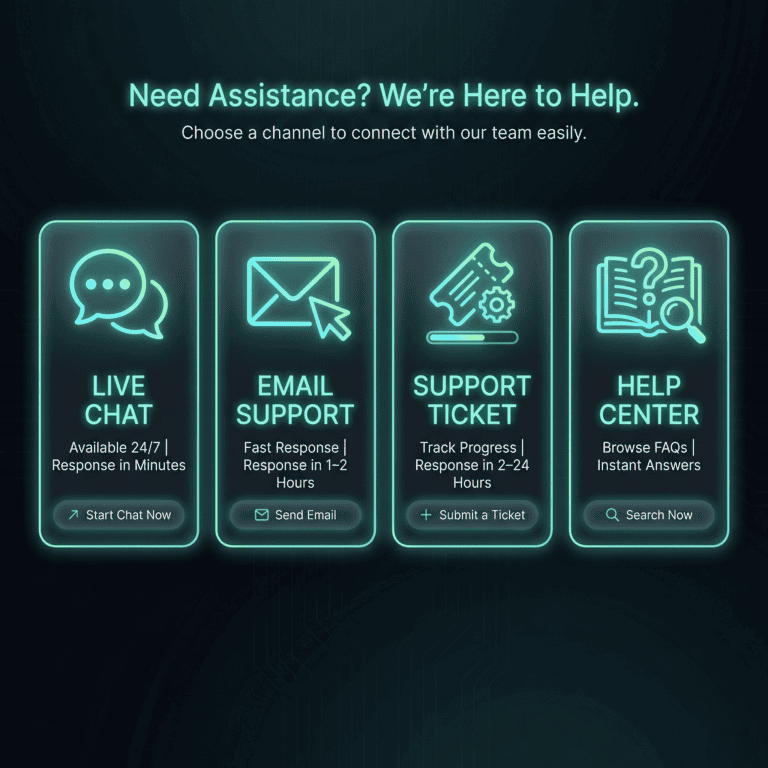
We offer multiple ways to reach us:
- Live Chat: Available 24/7. Response within minutes. Best for urgent issues.
- Email Support: Response within 1–2 hours. Good for detailed issues.
- Support Ticket: Submit a ticket and track its progress. Response within 2–24 hours.
- Help Center: Browse FAQs for instant answers to common questions.
For urgent deposit issues, use live chat. For less urgent matters, email is fine.
Information to Have Ready When Contacting Support
To help us help you faster, have this ready:
- Your account ID (from your account settings)
- Cryptocurrency type and amount (e.g., “0.5 BTC” or “100 USDT”)
- The deposit address we gave you (from your account history)
- Your sending address (from your wallet or exchange)
- The network you used (Bitcoin, Ethereum, Polygon, etc.)
- Your blockchain transaction hash (from the blockchain explorer)
- Screenshot of any error message (if applicable)
- Date and time of your deposit attempt
This information lets us investigate quickly and accurately.
What to Expect from Support Response
Here are typical response times:
- Live chat: Response within minutes
- Email/ticket: Response within 24 hours
- Deposit investigations: Resolution within 24–48 hours for most issues
- Fund recovery: 2–5 business days (if applicable)
We prioritize deposit issues. You will hear from us.
Escalation: When Issues Require Deeper Help
Some issues (wrong address recovery attempts, compliance holds, complex disputes) require our operations or finance team. These take longer: 2–5 business days.
We will keep you updated. You will hear from us regularly if your issue is complex.
—
Key Takeaways & Prevention Checklist
You now understand crypto deposits inside and out. Here are the critical points to remember.
5 Things to Remember About Crypto Deposits
- Choose the right network. Polygon and Tron are fast and cheap. Mainnet is secure but slower. Select based on your priority.
- Always verify address before sending. Copy-paste the address. One wrong character sends funds to the wrong place permanently.
- Blockchain confirmations take time. Bitcoin: 15–60 min. Ethereum: 5–15 min. Polygon: 1–5 min. This is normal.
- Wrong network = contact support immediately. May be recoverable. Wrong address = unrecoverable.
- Confirmations are automatic. You cannot speed them up. Just wait. Once done, funds appear instantly.
These 5 rules prevent 95% of deposit issues.
Pre-Deposit Checklist (Your Safeguard)
Before every deposit, use this checklist:
- ☐ I have selected the correct network for my cryptocurrency
- ☐ The deposit address on our website matches the address I am sending to (I verified it)
- ☐ Our website URL is HTTPS (secure)
- ☐ I am copying the address (not typing it manually)
- ☐ For my first time or large deposits, I sent a small test amount first
- ☐ I have noted the network and crypto type for my records
- ☐ My account is verified (if required)
- ☐ I have entered any bonus codes (if applicable)
Follow this checklist. You will not have problems.
You Are Ready to Deposit Confidently
You now understand deposits, networks, fees, timing, and troubleshooting. Whether it is your first deposit or your hundredth, you have the knowledge to do it safely and efficiently. If anything remains unclear, our support team is here. Welcome to BonusTiime, and we are glad you are here.
—
Frequently Asked Questions
How long does a crypto deposit take?
Typical times depend on the cryptocurrency and network:
- Bitcoin: 15–60 minutes
- Ethereum: 5–15 minutes
- Polygon: 1–5 minutes
- Tron: 15–60 seconds
These times are typical under normal network conditions. During peak congestion, times increase. See the “Deposit Speed & Timing” section for more detail and a full comparison table.
My deposit is not showing up. What do I do?
Do not panic. Most delays are just the blockchain processing. Follow these steps:
- Check the blockchain explorer to confirm your transaction was sent
- Verify you used the correct deposit address
- Confirm you selected the correct network
- Check how many confirmations your deposit has (it may still be pending)
- If still not showing after 30 minutes, gather your transaction hash and contact support
See the “Deposit Not Showing Up?” section for detailed steps.
What networks do you support? (ERC20, TRC20, BEP20, etc.)
We support multiple networks including:
- ERC20 (Ethereum): Secure, widely recognized, 5–30 min, higher fees
- TRC20 (Tron): Fast and cheap, instant–60 sec, under $1 fees
- BEP20 (Binance Smart Chain): Fast and cheap, 5–20 min, $1–$5 fees
- Polygon: Very fast and cheap, 1–5 min, pennies in fees
- Other networks depending on the cryptocurrency
The deposit page shows which networks we accept for each cryptocurrency. See the “Choosing the Right Network” section for a full comparison and decision framework.
I sent crypto to the wrong address. Can you recover it?
It depends:
- Wrong address (not ours): Unfortunately, no. The blockchain is permanent. Funds sent to the wrong address are lost.
- Wrong network (but our address): Maybe. We may be able to recover it. Contact support immediately with your transaction hash. Recovery is not guaranteed but is possible.
See the “I Sent Crypto to the Wrong Address or Wrong Network” section for more detail.
What are deposit fees? Do I have to pay them?
Deposit fees come in two forms:
- Network fees: Mandatory. Paid to the blockchain, not us. Deducted from your deposit.
- Platform fees: Usually $0 for crypto deposits. We waive these.
Network fees are unavoidable but vary by network. Typical costs: Bitcoin $1–$20+, Ethereum $5–$30+, Polygon $0.01–$0.10, Tron $0–$1.
To minimize fees, use cheap networks like Polygon or Tron for small deposits. See the “Deposit Fees & Costs” section for more detail.
How do I get my deposit bonus?
Deposit bonuses are automatic:
-
- Make a qualifying deposit (amount meets minimum)
- Enter bonus code if required (shown on our promotions page)
- Bonus credits automatically
- Wager the bonus + original deposit per the requirement before withdrawing
Example: Deposit $100, get $100 bonus (100% match). You have $200 total. You must wager $5000 (50x playthrough) before you can withdraw the bonus.
See the “Deposit Bonuses & Promotions” section for detailed explanation and wagering requirements.
What is the minimum/maximum deposit amount?
Limits vary by account tier:
-
-
- Basic: Min $10, Max $1,000 per deposit, $5,000 daily
- Regular: Min $10, Max $5,000 per deposit, $25,000 daily
- VIP: Min $10, Max $50,000 per deposit, $100,000 daily
- High Roller: Custom limits (contact support)
-
You can request a limit increase by contacting support. See the “Deposit Limits” section for more detail.
Do I need to verify my account before depositing?
Verification is required to comply with regulations (anti-money laundering and know-your-customer laws). You may need to provide ID, proof of address, and source of funds information.
First deposits may be processed while verification is pending (within 24–48 hours). But verification must be complete before withdrawal.
See the “Deposit Security & Verification” section for what is required.
Is it safe to deposit crypto here?
Yes. We use:
-
-
- Unique deposit addresses (prevents accidental misdirection)
- Account verification (KYC/AML compliance)
- HTTPS encryption
- Optional 2FA (two-factor authentication)
-
Following best practices (verify address, use HTTPS, enable 2FA) prevents 99% of security issues. See the “Deposit Security & Best Practices” section for safe habits.
My deposit shows “pending” in my account. When will it be credited?
“Pending” means your blockchain transaction is still being confirmed. Once enough confirmations are complete (typically 3–12, depending on the blockchain), your deposit is credited.
Typical timing: Bitcoin (1 hour), Ethereum (2–5 min), Polygon (2–3 min), Tron (1 min).
Refresh your page after full confirmation. If it still shows pending after 30 minutes, contact support.
I see my transaction on the blockchain, but it’s not in my account yet.
The blockchain and our account system are separate. Just because your transaction is on the blockchain does not mean our system has processed it yet.
If the blockchain shows confirmed, your deposit will appear in your account within minutes. Refresh your page. If still not showing after 10 minutes, wait a bit longer. Our system sometimes takes a few extra minutes to sync.
If it is still not showing after 30 minutes and the blockchain shows confirmed, contact support.
Can I deposit with [specific cryptocurrency]?
We support most major cryptocurrencies including Bitcoin, Ethereum, USDT, USDC, and many others. For less common cryptos, check the deposit page or contact support for availability.
If we support it, the deposit process is identical: select the crypto, copy the address, send from your wallet, and wait for confirmation.
What is a deposit bonus code and how do I use it?
A deposit bonus code is a promotional code that unlocks a specific bonus offer.
To use it: Find the code on our promotions page, enter it during deposit checkout, and the bonus credits automatically if you meet the requirements.
If you forgot to enter the code, contact support. We can often apply it retroactively.
Why was my deposit declined or rejected?
Common causes:
-
-
- Insufficient funds in your wallet
- Wrong address or network
- Account not verified
- Region restriction (some deposits unavailable in certain countries)
-
Check your wallet balance, verify your account, confirm the address is correct, and check if your region has any restrictions. If still unclear, contact support with the error message.
Can I cancel a pending deposit?
Once a transaction is on the blockchain, it cannot be cancelled. The blockchain is permanent.
If the transaction is still pending in your wallet/exchange (not yet sent to the blockchain), you can cancel it there before broadcast.
If already on the blockchain, it will eventually arrive. If you no longer want the funds, you can request a refund to your original wallet after it is credited.
How do I check my deposit history?
Log in to your account and go to Deposits (usually under Account or Wallet). You will see all your past and pending deposits with amounts, dates, and status.
All deposits are tracked and transparent. You can download a statement for records.
What happens if I send money to the wrong network?
Funds arrive in a wallet on that network. If we support that network for that cryptocurrency, we may be able to recover them. Contact support immediately with your transaction hash.
Recovery is not guaranteed. It depends on the network pairing and our technical capabilities. But there is a chance if you act quickly.
Do I need a memo or tag for my deposit?
Some cryptocurrencies (Ripple/XRP, Stellar/XLM) require a memo or tag. Our deposit page clearly indicates if one is required.
If you forgot to include it, the funds go to a shared wallet. Contact support with your transaction hash. We will manually credit your account within 24 hours.
I need help with my deposit. How do I contact support?
We offer multiple support channels:
-
-
- Live Chat: 24/7, response in minutes
- Email Support: Response in 1–2 hours
- Support Ticket: Response in 2–24 hours
- Help Center: Browse FAQs for instant answers
-
For urgent issues, use live chat. Have your account ID, transaction hash, and deposit details ready. We will help you quickly.

Secod has streamed and tested games on Stake extensively, giving him direct insight into the platform’s bonuses, features and gameplay conditions. His experience ensures every Stake review reflects real usage rather than surface level analysis.
Other Stake Deposit
Stake Deposit Methods & Payment Issues: Complete Guide
December 11, 2025
How to Deposit on Stake with Crypto (Step-by-Step 2025)
November 3, 2025
How to Deposit with Credit Card on Stake (2025 Guide)
September 15, 2025
Binance to Stake Casino Safe and Easy Deposit Guide
August 12, 2025
Coinbase to Stake Casino: Secure Deposit Guide
August 12, 2025
How to Withdraw on Stake: Complete Guide 2025
July 30, 2025