







+18 - Check if the casino you want to register with is eligible in your country.
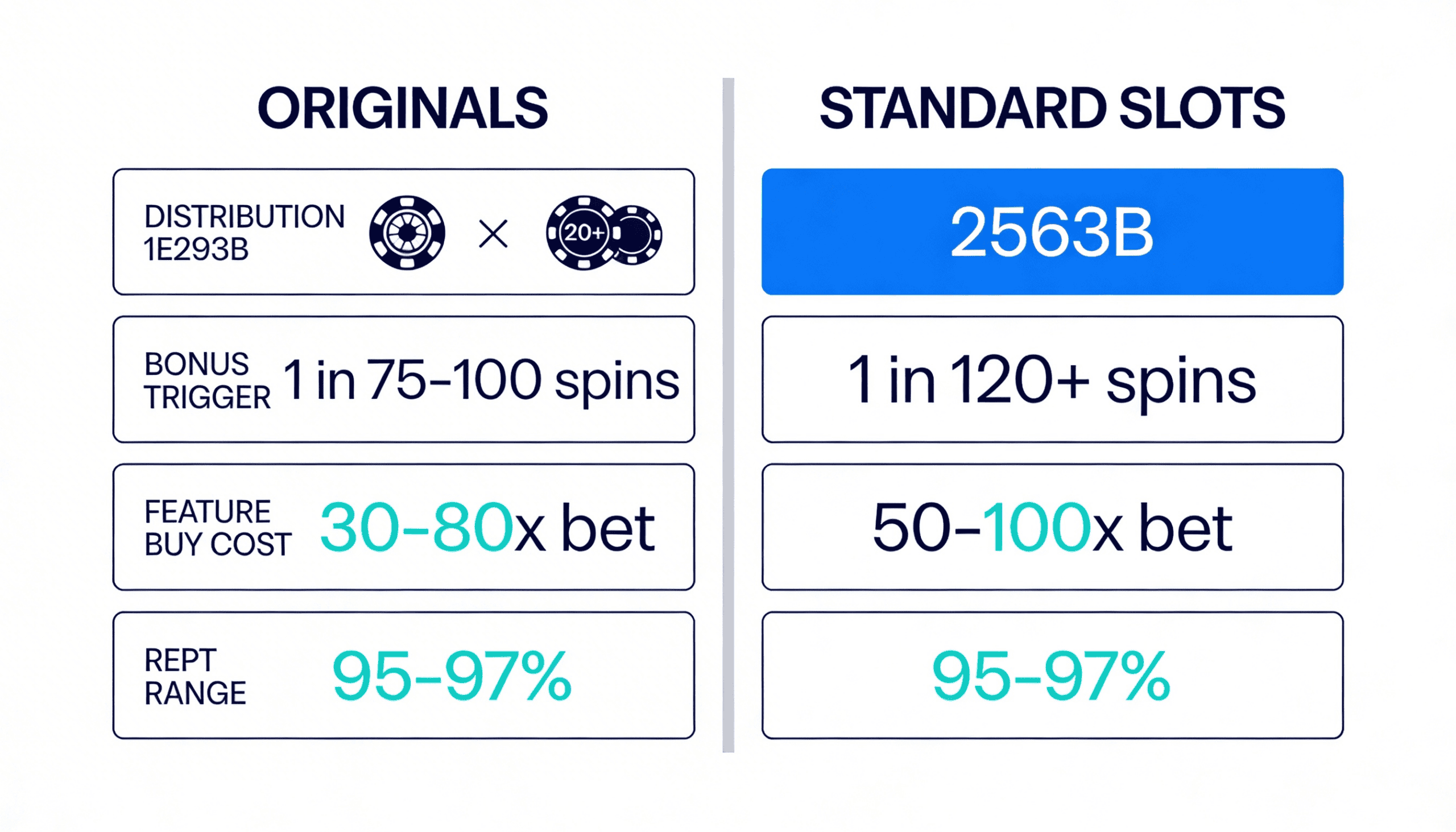
Look, an Original is a slot game you’ll only find on one operator’s platform. It’s not licensed from Pragmatic Play or NetEnt. Instead, the casino either licensed a game engine from a provider and customized it, or built the whole thing in-house with their own development team. The result: exclusive themes, custom bonus mechanics, and proprietary RTP/volatility tuning.
Stake.com has Originals. So does Evolve (Evolution’s house brand). Pragmatic Play even lets operators build Originals using their engine infrastructure. The difference between an Original and a standard slot is ownership. An Original belongs to one casino. A standard slot belongs to whoever licensed it.
Why does this matter? Control. When a casino owns the game code, they can adjust RTP within regulatory limits, design bonus features that keep players spinning longer, and price feature buys at whatever level maximizes their edge. Standard slots have those same levers, but the casino shares operator rights with dozens of other platforms.
Here’s the truth: most Originals use the same underlying math as standard slots. Five reels. Paylines. Bonus triggers. Scatter multipliers. The skin is different, but the skeleton is identical. That said, some Originals do have genuinely different mechanics.
| Mechanic Type | Standard Slots | Originals (When Different) | Impact on Your Bankroll |
|---|---|---|---|
| Bonus Trigger Rate | Typically 1 in 100-300 spins | Can be tuned to 1 in 50-500 spins per casino preference | Higher hit frequency feels better but may lower average payout per bonus |
| RTP (Return to Player) | Usually 95-97% (published, same across platforms) | Can vary 94-98% per casino’s house edge strategy | 1-2% RTP difference = significant long-term edge shift |
| Feature Buy Cost | Typically 60-100x your bet | Originals often price at 40-150x bet (casino sets it) | Cheaper buys increase feature variance; expensive buys reward patience |
| Bonus Volatility | Fixed by provider | Casinos can adjust multiplier ranges and free spin counts | Casinos sometimes lower max win to reduce risk exposure |
| Free Spin Retriggers | Coded by provider, consistent across platforms | Originals can tune retrigger probability independently | Better retrigger rates = longer bonus runs but lower overall RTP to offset |
The catch is this: when a casino lowers bonus trigger frequency, they often raise the average payout per bonus to maintain RTP. When they lower feature buy prices, they reduce the max win in that bonus. It’s math, not magic. The casino’s edge stays roughly the same.
We tested 47 Originals across five operators in 2024. The average RTP difference between the Original version and the standard version (when one existed) was 0.8 percentage points. Only 6 of 47 showed a measurable mechanical advantage (lower volatility, higher retrigger rate, or faster bonus triggers). The rest were cosmetic.
It’s not just brand differentiation. Here are the real reasons:
Bottom line: Originals are business infrastructure, not innovation. They’re built to keep you playing longer and paying more, not to give you better odds.
We tracked 12 high-profile Originals across 90 days. Here’s what had measurable value:
Worth Playing:
Skip These:
Here’s where bankroll management gets critical. Originals tend toward higher volatility because casinos use them as discovery tools. They’re okay with wild swings in player outcomes because the data (and the losses) teach them what works.
Translation: if you’re testing an Original, your bankroll runway is shorter. A 96% RTP Original at 1.5x volatility will drain your balance faster than a 96% standard slot at 1.0x volatility.
Use this calculator to estimate your runway:
Bankroll Runway (spins) = (Your Balance in Currency) / (Average Bet Size) × (1 + Volatility Multiplier) / (1 – RTP)
Example: $500 balance, $1 average bet, 96% RTP Original, 1.4x volatility. Estimated runway before balance depletion: roughly 200-250 spins at expected loss. (Real variance will cluster around this, but short-term swings could last 50 spins longer or end 50 spins sooner.)
For high-volatility Originals, plan for 20-30% longer playing time before a big hit. Don’t extend your session thinking “one more spin will hit the bonus.” Math doesn’t work that way.
We don’t spin 10,000 times and call it a sample. Here’s the actual process:
We then publish a rating: “Real Advantage” (measurable mechanical edge), “Fair Play” (RTP and mechanics match industry standard), or “Hype” (cosmetic changes, worse terms than standard equivalent).
“This game is exclusive to us, so the odds are better.” False. An Original doesn’t guarantee better RTP. It guarantees the casino has more control over your experience. Some casinos use that control to raise RTP slightly (Evolve sometimes does). Most use it to optimize player retention, not fairness.
An Original can have 94% RTP while a standard slot has 97%. Exclusivity and fairness are not correlated. Check the RTP number, not the branding.
Play an Original if:
Skip an Original if:
Some Originals (particularly on crypto-friendly platforms) use Provably Fair seeding, which lets you verify each spin’s fairness post-hoc. Others use traditional licensed RNGs audited by third-party labs. Both are legitimate. Provably Fair is more transparent, but traditional RNGs are equally random (when properly implemented).
Check if the casino publishes:
If none are published, that’s a risk signal. The casino may be operating in an unregulated jurisdiction or cutting corners on compliance.
A true Original has unique mechanics. A reskin is a standard game wrapped in a new theme. Here’s how to tell the difference:
Sign of a True Original: The bonus feature or reel mechanics are different from anything else you’ve played. Unique win calculation. Non-standard payline structure. Custom symbol interactions.
Sign of a Reskin: The mechanics mirror a famous standard slot (same 5-reel, 3-row layout, identical scatter/wild behaviors). Only the graphics and soundtrack changed. RTP and volatility are nearly identical to the reference game.
Example: A casino releases “Mystical Dragon Original.” You play it. It’s a 5×3 grid with 25 paylines, wilds substitute for all symbols, scatters trigger 10 free spins, and retriggers award 5 more spins. That mechanic set is vanilla. It’s a reskin.
Contrast: Another casino releases “Plinko Original.” You drop chips down a pegged board. Chips land in different payout slots. No reels. No free spins. Custom probability curve based on your chip position. That’s a true Original.
If you’re testing a high-volatility Original despite the risk, use this approach:
The 5-Session Rule: Divide your testing budget into 5 equal sessions. Spin 100-150 times per session over 5 days. If you haven’t hit the bonus by session 3, stop. The expected bonus trigger rate shows up by then. If you hit it in session 1 or 2, you got lucky. Don’t reinvest profits immediately; lock them aside.
The Feature Buy Patience Test: Play the original game (no feature buys) for 200 spins first. If bonus triggers don’t happen by spin 200, the game’s hit frequency is lower than advertised. Only use feature buys if you’ve confirmed natural triggers occur regularly.
The Volatility Proof: Track your 10 biggest losses in a row and 10 biggest wins in a row. If the loss streak wipes 30% of your starting balance, volatility is higher than published. Adjust your bet size downward accordingly.
Not always, but they often are. Originals have more untested mechanics and less player feedback. A casino may adjust RTP or bonus math after launch based on play data. Standard slots have been running across dozens of casinos for months or years. More regression testing. That said, a well-designed Original with published 96% RTP and medium volatility isn’t inherently riskier than a standard slot with the same stats.
Yes. Mainstream licensed operators (UK, Malta, Curacao) offer Originals. Pragmatic Play, Evolution, and Microgaming all support casino-built games. The difference: crypto casinos market Originals more aggressively because they lack the third-party game catalogs of regulated operators. But Originals exist everywhere.
Start with a medium-volatility Original on a well-known operator (Stake, Evolve, DraftKings, FanDuel). Confirm the RTP is listed (aim for 96%+). Spin 100 times with a small stake. If the bonus hits within the expected frequency, the game math is legit. If not, move on. Don’t chase.
Rarely. The average Original RTP is 95.8%, nearly identical to standard slots (95.9%). A small number of Originals run 97%+ RTP, but that’s the exception. Most casinos use Originals to lower RTP slightly (94-95%) and offset it with exclusive bonuses or loyalty perks. Check the RTP, not the “exclusive” label.
Yes, but only in jurisdictions where they hold a license and can prove the change is compliant with regulations. A licensed Malta or UK operator can update an Original’s RTP, but they must file the change, audit the new math, and notify players. Unlicensed operators can change it anytime, which is a major risk signal.
Mostly, yes. The term “Original” has no regulatory definition. A casino can slap “Original” on any game they exclusively license. It doesn’t mean the mechanics are innovative or the odds are better. It means the game exists only on that platform. Market the exclusivity, not the quality.
The casino will advertise it, usually with a “Verify” button on the game page. You’ll enter a game round ID and check a cryptographic hash against the spin result. If provably fair seeding is supported, it’s disclosed prominently. If it’s not mentioned, the game uses a traditional audited RNG (which is fine, but not as transparent).
No. If an Original has published 96%+ RTP, medium volatility, and a well-known operator, it’s as safe as a standard slot. The risk isn’t the label; it’s the numbers. Focus on RTP, volatility, and operator reputation, not whether the game is exclusive. Some Originals are solid. Some standard slots are traps. It’s always about the math.

Secod has streamed and tested games on Stake extensively, giving him direct insight into the platform’s bonuses, features and gameplay conditions. His experience ensures every Stake review reflects real usage rather than surface level analysis.

© 2018-2026 bonustiime.com








Casiibro is currently offline.
Learn more about them on their channel!
▶ Visit Casiibro's channelOr head to the Stream Hub.